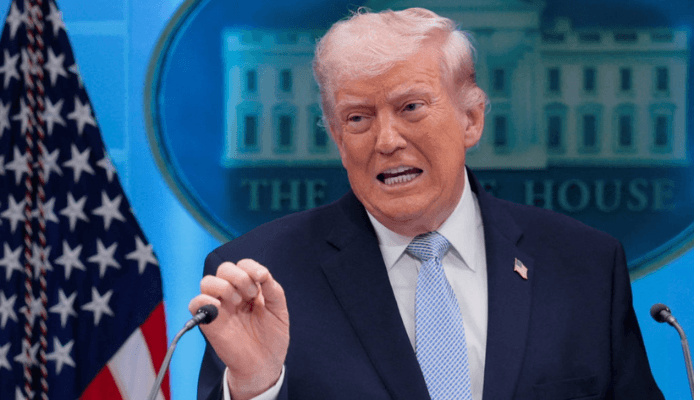
The United States military announced on Sunday that it would begin a blockade of all maritime traffic entering and leaving Iranian ports and coastal areas from Monday morning, after weekend negotiations in Islamabad failed to produce a deal to end six weeks of war, throwing a fragile ceasefire into serious doubt.
- +US announces blockade of Iranian ports after Islamabad talks collapse
The talks, which ran from Saturday into the early hours of Sunday, were the first direct US-Iranian meeting in more than a decade and the most senior diplomatic engagement between the two countries since Iran’s 1979 Islamic Revolution.
The talks, which ran from Saturday into the early hours of Sunday, were the first direct US-Iranian meeting in more than a decade and the most senior diplomatic engagement between the two countries since Iran’s 1979 Islamic Revolution. They collapsed over the same fault lines that have defined the conflict from the start: Iran’s nuclear programme and control of the Strait of Hormuz.
US Central Command said the blockade, effective from 10 am Eastern Time (3 pm WAT), would be “enforced impartially against vessels of all nations entering or departing Iranian ports and coastal areas.” Vessels transiting the strait to and from non-Iranian ports would not be impeded. Trump separately said US forces would intercept every vessel in international waters that had paid a toll to Iran. “No one who pays an illegal toll will have safe passage on the high seas,” he wrote on social media. “Any Iranian who fires at us, or at peaceful vessels, will be BLOWN TO HELL!”
He added that the US Navy would begin clearing mines Iran had dropped in the Strait of Hormuz, the choke point through which roughly 20 per cent of global energy supplies pass.
A US official said Iran rejected Washington’s demands to end all uranium enrichment, dismantle its major enrichment facilities, transfer its stockpile of highly enriched uranium, cease funding for Hamas, Hezbollah, and the Houthis, and fully reopen the strait. Iranian media reported that an agreement had been reached on several issues, but that the Strait and the nuclear programme proved insurmountable.
Iranian Foreign Minister Abbas Araqchi said his country had been “inches away” from an agreement when it encountered what he described as “maximalism, shifting goalposts, and blockade.” He added: “Zero lessons learned. Good will begets goodwill. Enmity begets enmity.”
Iran’s Revolutionary Guards warned that any military vessels approaching the strait would be considered a ceasefire breach and dealt with “harshly and decisively.”
The dollar and oil prices rose in early Asian trading on Monday following the collapse of the talks, while stock markets eased. Tankers that had briefly resumed transiting the strait over the weekend were steering clear of the waterway ahead of the blockade’s start.
Trump acknowledged on Fox News that fuel prices may remain elevated through November’s midterm elections — a rare admission of the war’s domestic political cost. Iran’s parliamentary speaker, Mohammad Qalibaf, posted a map of Washington-area petrol prices on social media with a pointed message: “Enjoy the current pump figures. Soon you’ll be nostalgic for $4–$5 gas.”
Trump’s own messaging remained characteristically contradictory. He told Fox News on Sunday morning that he believed Iran would return to the negotiating table, calling the Islamabad discussions “very friendly.” By Sunday night, he said he did not care whether Tehran came back at all. “If they don’t come back, I’m fine,” he told journalists.
Iran’s president, Masoud Pezeshkian, discussed the talks in a call with Russian President Vladimir Putin, saying Tehran wanted “a balanced and fair agreement” and that a deal was not out of reach if Washington returned to the framework of international law.