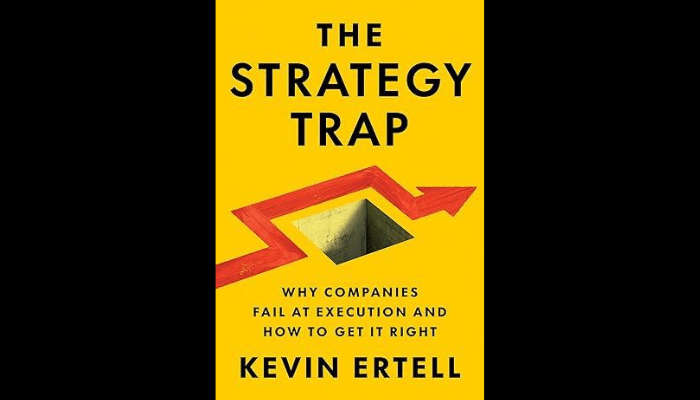
In ‘The Strategy Trap’, Kevin Ertell delivers a compelling examination of one of the most persistent problems in modern business: the failure of organisations to execute strategy effectively.
- +The Strategy Trap – A practical blueprint for turning vision into results
- +Date published: Ebook version Feb. 3, 2026
While many companies invest enormous resources in designing ambitious strategic plans, only a small percentage successfully translate those ideas into measurable outcomes.
Date published: Ebook version Feb. 3, 2026
While many companies invest enormous resources in designing ambitious strategic plans, only a small percentage successfully translate those ideas into measurable outcomes. Ertell’s book argues that the gap between strategy and execution is not caused by a lack of intelligence, innovation, or ambition, but by a misunderstanding of what execution truly requires.
Drawing from his leadership experience at companies such as Nike, Borders, and Sur La Table, the author presents execution not as a final phase of strategy, but as a disciplined process that begins the moment a strategic idea is conceived.
The book’s central message is clear: successful companies do not simply create better strategies; they build systems, cultures, and behaviours capable of sustaining execution over time.
Ertell begins with a sobering reality that immediately captures the reader’s attention. He notes that nearly 90 percent of organisations fail to execute their strategic priorities successfully.
These failures often occur despite significant investments in consultants, planning retreats, and leadership meetings. According to the author, executives frequently treat execution as a mechanical or administrative exercise rather than a human-centred process that requires alignment, communication, and accountability at every level of the organisation.
One of the most striking examples used in the book is the failed transformation of JCPenney under former CEO Ron Johnson. Johnson, who was widely praised for his success at Apple, attempted to reinvent the struggling retailer through bold strategic changes.
However, the turnaround collapsed because the organisation lacked the operational readiness, internal alignment, and cultural support necessary to implement such sweeping reforms.
For Ertell, the JCPenney story demonstrates that even brilliant strategic ideas can fail catastrophically when leaders underestimate the complexity of execution.
At the core of The Strategy Trap is Ertell’s “Six Cs” framework, which serves as the book’s guiding philosophy. The framework consists of co-creation, clarity, capacity, communication, coordination, and coaching. These six principles are presented as essential ingredients for transforming strategic plans into successful outcomes.
The first principle, co-creation, is particularly significant because it challenges the traditional top-down leadership model. Ertell argues that employees are far more likely to commit to a strategy when they participate in shaping it.
Rather than imposing decisions from the executive suite, successful leaders involve teams early in the process, creating shared ownership and reducing resistance to change. This emphasis on collaboration reflects the book’s broader argument that execution is fundamentally a people-driven activity.
Clarity is another crucial component of the framework. According to Ertell, many strategies fail because organisations communicate vague ambitions instead of defining concrete priorities.
Employees often leave strategic meetings inspired but uncertain about their actual responsibilities. The author insists that leaders must eliminate ambiguity by clearly defining goals, roles, timelines, and success metrics.
The remaining principles of capacity, communication, coordination, and coaching reinforce the need for continuous organisational support.
Capacity refers to ensuring that teams have the resources, skills, and time required to execute effectively. Communication involves maintaining consistent messaging across all levels of the organisation, while coordination focuses on aligning departments and functions that often operate in silos. Coaching, meanwhile, highlights the leader’s role in guiding teams through uncertainty and maintaining momentum during implementation.
One of the book’s strongest qualities is its practical approach. Unlike many business books that remain trapped in abstract theory, The Strategy Trap offers readers specific tools and methods that can be applied immediately within organisations.
Ertell introduces the concept of “premortems,” a process in which teams imagine a future failure scenario and work backwards to identify potential weaknesses before implementation begins. This proactive approach encourages organisations to confront risks early rather than reacting defensively after problems emerge.
Another practical tool discussed in the book is the use of Accountability Charts, which clarify ownership and eliminate confusion regarding decision-making responsibilities.
Ertell also introduces the concept of “Change Captains,” individuals within an organisation tasked with driving cultural adoption and maintaining enthusiasm during periods of transformation. These tools reinforce the book’s emphasis on execution as an ongoing discipline rather than a one-time event.
Ertell’s writing style is another factor that makes the book engaging. He combines business analysis with storytelling and cultural references that make complex ideas more relatable.
The author references Derek Sivers’ concept that “ideas are multipliers of execution” to illustrate that ideas alone have little value without disciplined implementation. He also draws inspiration from the development of Hamilton, showing how years of collaboration, experimentation, and refinement transformed a creative concept into a global success.
Perhaps the most memorable lesson from the book is the idea of “slowing down to speed up.” In many organisations, leaders rush strategic initiatives in an effort to demonstrate urgency and momentum.
However, Ertell argues that investing time in preparation, alignment, and co-creation often leads to faster and more sustainable execution later. Through examples such as the Monkey Cage Sessions, he demonstrates how deliberate collaboration can prevent costly mistakes and strengthen organisational commitment.
Ultimately, The Strategy Trap is more than a business management book; it is a warning against the culture of superficial strategic thinking that dominates many organisations today.
Ertell convincingly argues that execution cannot be separated from strategy because the two are inseparable components of organisational success. A brilliant strategy without disciplined execution is meaningless, while even an average strategy can produce extraordinary results when executed effectively.
For executives, entrepreneurs, managers, and business leaders navigating increasingly complex and competitive markets, The Strategy Trap provides a valuable roadmap for bridging the gap between ambition and achievement.