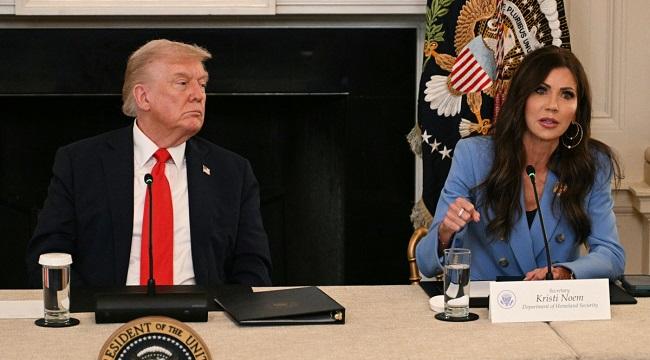
Trump Fires Homeland Security Chief Kristi Noem, Replaces Her with Oklahoma Senator Markwayne Mullin
In a dramatic shake-up of his administration, US President Donald Trump has fired Kristi Noem as head of the Department of Homeland Security (DHS), citing her handling of a recent immigration crackdown in Minnesota and her testimony at a Senate hearing this week.
In a dramatic shake-up of his administration, US President Donald Trump has fired Kristi Noem as head of the Department of Homeland Security (DHS), citing her handling of a recent immigration crackdown in Minnesota and her testimony at a Senate hearing this week. Noem, 54, will be replaced by Oklahoma Senator Markwayne Mullin, 48, a Republican who has been nominated by Trump to take over the powerful department on March 31.
According to multiple media reports, Trump was upset with Noem's handling of the large-scale operation against undocumented migrants in Minnesota, during which federal immigration agents shot dead two Americans. The incident sparked widespread criticism, with Democrats and some Republicans calling for Noem's resignation.
Noem's firing comes amid a partial shutdown at DHS, with Democrats opposing any new funding for the department until major changes are implemented to how the Immigration and Customs Enforcement (ICE) agency conducts its operations. The Democrats have demanded curtailed patrols, a ban on ICE agents wearing face masks, and a requirement that they obtain a judicial warrant before entering private property.
In a post on Truth Social, Trump announced Noem's departure and praised her for her service to the country. He described Mullin as a "MAGA Warrior" and said he will be a "spectacular Secretary of Homeland Security." Trump said Mullin will work tirelessly to keep the border secure, stop migrant crime, and end the scourge of illegal drugs.
Mullin's nomination will be subject to confirmation by the Senate, where Republicans hold a majority. Speaking to reporters, Mullin said his focus will be "to keep the homeland secure." He acknowledged that there are opportunities to build on successes and learn from mistakes.
Noem, in a post on X, thanked Trump for her new special envoy position and cited what she called "historic accomplishments" at DHS. She claimed that the department had delivered the most secure border in American history and that three million illegal aliens had left the US.
However, Democratic lawmakers welcomed Noem's departure, calling her the face of an unpopular and dangerous mass deportation campaign. Senator Dick Durbin said Noem was unfit for the job and that even Trump had conceded as much. Senator Adam Schiff of California said Noem should have been fired a long time ago.
Noem's leadership of DHS has been under bipartisan criticism, with Senator Thom Tillis calling for her resignation and saying her leadership has been a "disaster." Democrats repeatedly asked her to apologize for the deaths of the two Americans killed in Minnesota during protests against the immigration crackdown and for calling them "domestic terrorists."
The firing of Noem comes as Trump prepares to announce a new security initiative in the Western Hemisphere, dubbed "The Shield of the Americas." Noem will serve as Trump's special envoy for the initiative, which will be announced on Saturday.
The implications of Noem's firing and Mullin's nomination are significant for Nigeria, given the country's own immigration challenges and its efforts to strengthen its borders. As Trump's administration continues to crack down on immigration, Nigeria may face increased scrutiny over its own immigration policies and practices.
In the coming days, Nigerians can expect to see a more aggressive approach to immigration enforcement, with a focus on securing the border and stopping migrant crime. The implications for Nigeria's own immigration policies and practices will be closely watched, as the country continues to grapple with its own challenges in this area.
The Senate confirmation hearings for Mullin's nomination are expected to be contentious, with Democrats likely to push for changes to the way ICE conducts its operations. The outcome of these hearings will have significant implications for Nigeria, as the country continues to navigate its own complex immigration landscape.