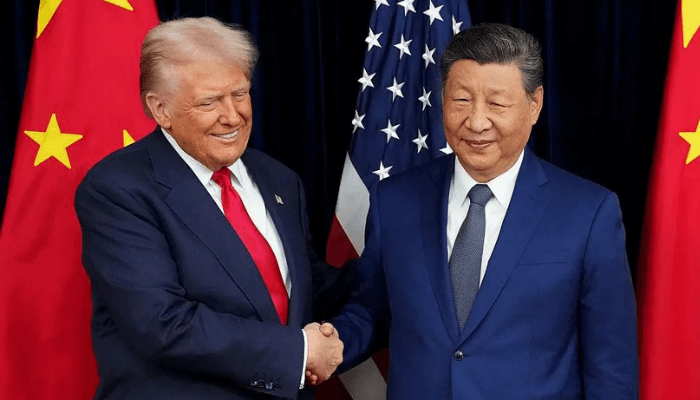
Donald Trump, United States president and Xi Jinping, the Chinese president wrapped up a closely watched summit in Beijing with warm words, symbolic gestures and promises of deeper cooperation, but without the major trade breakthroughs many businesses had hoped for.
- +Trump, Xi end Beijing talks without breakthrough trade deals
Trump arrived in China alongside some of America’s most powerful business leaders, including executives from the aviation, agriculture, electric vehicle and artificial intelligence sectors, as both countries sought to steady relations after months of tensions over tariffs, technology and the Iran war.
Trump arrived in China alongside some of America’s most powerful business leaders, including executives from the aviation, agriculture, electric vehicle and artificial intelligence sectors, as both countries sought to steady relations after months of tensions over tariffs, technology and the Iran war.
The visit carried the atmosphere of a diplomatic reset. Trump was greeted with a full state welcome that included an honour guard, a banquet and a rare invitation to Zhongnanhai, the highly restricted compound where China’s Communist Party leadership lives and works.
Speaking after the meetings, Trump described the talks as “very successful”, while Xi called the visit “historic and landmark”, according to BBC reports.
Yet behind the public warmth, concrete agreements remained limited.
Trump told reporters aboard Air Force One that China had agreed to buy 200 Boeing aircraft, with the possibility of an additional commitment for 750 more planes. Neither Beijing nor Boeing immediately confirmed the claim.
If finalised, the deal would mark Boeing’s first major breakthrough in China in almost a decade after years of trade disputes and political tensions shut the American aircraft maker out of one of the world’s largest aviation markets.
Trump also said China would purchase “billions of dollars” worth of American soybeans, a move aimed at reassuring United States farmers who were hit hard during the tariff battles between Washington and Beijing.
China, however, stopped short of confirming any specific purchases.
Guo Jiakun, Chinese foreign ministry spokesman said only that the “essence of China-US economic and trade relations is mutual benefit and win win cooperation”.
He added that both countries should work to implement the “important consensus” reached by the two leaders and bring greater stability to global trade and the wider economy.
Trade remained central to the summit, especially with a temporary tariff truce between both nations due to expire in November. The White House said the two leaders agreed to establish a “Board of Trade” to manage economic relations without reopening direct tariff negotiations. Surprisingly, Trump later revealed that tariffs were not discussed during his private talks with Xi.
According to the BBC, Scott Bessent, United States treasury secretary said Washington expected progress on a framework to support future investments, although American officials cautioned that substantial work remained before any agreements could take effect.
Technology also dominated discussions during the visit.
Elon Musk, Tesla chief executive and Nvidia chief executive Jensen Huang were among the business leaders who travelled with Trump and drew attention during the official welcome ceremony and state banquet.
Huang’s presence was particularly notable because Nvidia has been heavily affected by American export controls that restrict China’s access to advanced AI chips.
Tesla also remains deeply tied to the Chinese market through its Shanghai factory and growing consumer base.
Speaking to reporters, Trump said the two countries discussed possible “guardrails” around artificial intelligence cooperation. “We talked about possibly working together for guardrails,” Trump said.
When asked what that meant, he replied: “Standard guardrails that we talk about all the time.”
Despite the diplomatic optimism, long standing tensions remained unresolved. Taiwan emerged as one of the most sensitive issues during the summit. According to Chinese state media, Xi warned Trump that Taiwan remained “the most important issue in China US relations”.
“If mishandled, the two nations could collide or even come into conflict,” Xi reportedly said.
The Middle East conflict and disruptions in the Strait of Hormuz also featured prominently in discussions.
The BBC reported that Trump said Xi expressed willingness to help stabilise shipping flows through the vital oil route amid growing concerns over the impact of the Iran conflict on global energy markets. China later called for “a comprehensive and lasting ceasefire” and urged that shipping lanes be reopened quickly.
The summit ended with both sides agreeing to continue discussions ahead of a second meeting expected at the White House in September.
For now, the visit produced strong diplomatic theatre and signs of renewed engagement, but the deeper disputes over trade, technology and geopolitics remain unresolved.
According to BBC, officials on both sides hope continued talks between the world’s two largest economies could eventually lead to the major trade breakthrough that failed to materialise in Beijing.