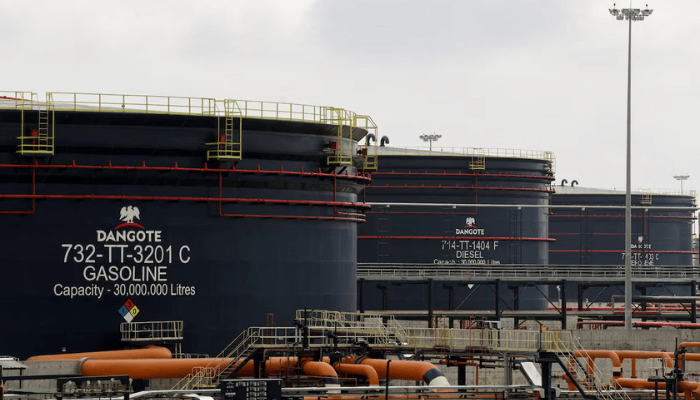
Nigeria’s Dangote Petroleum Refinery & Petrochemicals is reshaping the country’s economic standing on the global stage, earning explicit recognition from S&P Global Ratings, according to BusinessDay’s findings.
- +S&P sees Dangote Refinery as buffer against Middle East shocks for Nigeria
In an assessment released this week, S&P pointed directly to the operational ramp-up of the 650,000-barrel-per-day refinery complex in Lagos as a structural force multiplier behind Nigeria’s strengthening balance of payments, tightening foreign exchange position, and reduced exposure to supply disruptions emanating from the Middle East.
In an assessment released this week, S&P pointed directly to the operational ramp-up of the 650,000-barrel-per-day refinery complex in Lagos as a structural force multiplier behind Nigeria’s strengthening balance of payments, tightening foreign exchange position, and reduced exposure to supply disruptions emanating from the Middle East.
The upgrade marks a significant milestone for a country that spent much of the last decade haemorrhaging foreign reserves to import the very refined petroleum products it was sending abroad as crude.
“Significant refining capacity is now also online,” S&P stated in its report, noting that Dangote Industries Ltd.’s large-scale facility had ramped to near maximum throughput.
That shift, the agency said, is helping compress Nigeria’s refined product import bill, free up foreign exchange, and deliver greater predictability to domestic fuel, gas, and fertiliser supply chains.
With tensions across the Middle East continuing to introduce volatility into global crude and product markets, S&P flagged the Dangote complex as a domestic hedge, a physical buffer that insulates Nigerian consumers and businesses from the pricing shocks that have repeatedly convulsed import-dependent economies across sub-Saharan Africa.
S&P projected the country’s current account surplus would widen to 5.8 percent of gross domestic product in 2026, up from 4.8 percent in 2025, with domestic refining and hydrocarbon exports among the primary drivers.
Foreign exchange reserves, meanwhile, have climbed from roughly $33 billion in 2023 to nearly $50 billion by early 2026, a trajectory the agency tied partly to the sharp decline in refined fuel import demand since the Dangote facility came online.
The broader macro backdrop supporting the upgrade includes the removal of costly fuel subsidies, a liberalised exchange rate regime that has restored credibility to the naira market, and higher oil production linked to improved security conditions across the Niger Delta.
Together, these reforms have reoriented the Nigerian state’s relationship with petroleum revenue, from a subsidy-funded liability into an investable surplus.
Yet S&P’s most forward-looking signal concerned expansion. Dangote Industries has unveiled feasibility studies targeting a capacity doubling to approximately 1.4 million barrels per day, a threshold that would rank the complex among the largest refining installations anywhere on the continent and position Nigeria as a meaningful exporter of refined products to regional markets.
S&P indicated that this potential buildout, combined with the gradual rehabilitation of the country’s legacy state-owned refineries, could deliver additional balance-of-payments gains over the next several years.
The upgrade nonetheless came with candour about the road still ahead. S&P’s stable outlook reflects a careful accounting of Nigeria’s structural vulnerabilities, a narrow tax base, persistently elevated inflation, and low formal employment, which continue to cap the ceiling on any near-term further improvement. High global crude price sensitivity remains a residual risk, and market-driven domestic fuel pricing means that international commodity cycles still transmit directly into Nigerian household budgets.