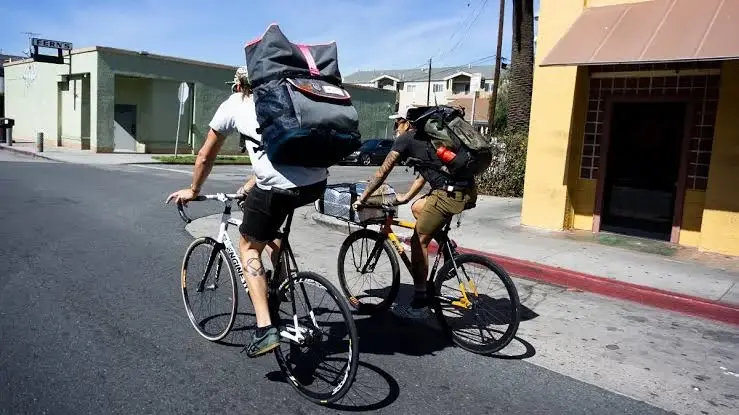
Rising fuel prices, worsening traffic congestion and the rapid expansion of e‑commerce are reshaping Nigeria’s urban logistics landscape, creating opportunities for an unlikely but increasingly important player in the delivery ecosystem, the bicycle courier, writes GODWIN AIKIGBE
- +Nigeria delivery ecosystem sees bicycle courier resurgence
Across major cities including Lagos, Abuja, Port Harcourt and Ibadan, young men on bicycles carrying brightly coloured delivery backpacks have become an increasingly familiar sight.
Across major cities including Lagos, Abuja, Port Harcourt and Ibadan, young men on bicycles carrying brightly coloured delivery backpacks have become an increasingly familiar sight. Whether weaving through traffic on busy highways, navigating narrow streets inaccessible to vehicles or waiting patiently outside restaurants for the next assignment, these riders are quietly redefining last‑mile delivery in Nigeria.
The bicycle courier segment remains a relatively small part of the country’s broader informal economy, but industry observers believe it is among the fastest‑growing areas of Nigeria’s gig workforce. The growth has largely been driven by food delivery applications, online shopping platforms and businesses seeking quicker and more affordable ways of moving goods across crowded urban centres.
For many of the riders, the job represents more than simply transporting meals and parcels from one point to another. It is a source of income, a means of financing education and, in some cases, a stepping stone towards bigger ambitions.
Most of the riders are between the ages of 18 and 35 and are among the millions of Nigerian youths navigating an economy where informal employment accounts for the overwhelming majority of jobs.
Unlike conventional dispatch riders who depend on motorcycles or vehicles, bicycle couriers rely entirely on pedal power. Their ability to avoid traffic bottlenecks and parking challenges makes them particularly effective for short‑distance deliveries, urgent documents and food orders that require speed and reliability.
Although the profession appears modern because of its association with mobile applications and digital payments, bicycle courier services in Nigeria actually have a long history.
The practice dates back to the colonial era when bicycles were among the fastest and most efficient means of transporting messages and official correspondence across settlements.
Christian missionaries relied on cyclists to move letters and supplies between mission stations, while British colonial administrators employed them to deliver government documents and official communications. Commercial trading firms equally utilised bicycles for transporting paperwork and business correspondence before the widespread adoption of motor vehicles.
While the role later diminished with the arrival of motorcycles and cars, the last decade has witnessed a remarkable revival driven by technology and changing consumer behaviour.
Today, riders wearing company‑branded jackets and backpacks are visible in virtually every major commercial district in Lagos and other urban centres. Many can often be found clustered around fast‑food outlets and restaurants, waiting for new assignments to appear on their phones.
One of the strongest attractions of the bicycle courier business is its affordability.
Unlike businesses that require substantial capital investment, entry into bicycle delivery services requires very little financial commitment.
For most riders, the only major expense is purchasing a bicycle, which currently costs between N50,000 and N120,000 depending on quality, durability and specifications.
After securing a bicycle, a prospective courier simply approaches a delivery company or logistics platform for registration.
The onboarding process is relatively straightforward. Companies typically request identification details, personal information, passport photographs and contact information before activating riders on their delivery systems.
Compared to the financial burden associated with purchasing motorcycles, obtaining licences, buying fuel and carrying out repairs, bicycle courier services provide a considerably easier route into self‑employment.
This low entry barrier explains why many unemployed graduates, students and school leavers have embraced the profession.
Contrary to public perception, much of a bicycle courier’s day is spent waiting rather than cycling.
Following registration, riders usually report to designated locations strategically positioned around restaurants, supermarkets and commercial districts where demand for deliveries is highest.
These waiting points often become informal gathering centres where riders exchange stories, discuss earnings and monitor their phones for incoming assignments.
An active internet subscription is not optional but essential to survival in the business.
Without mobile data, a rider becomes effectively invisible to the delivery platform and loses opportunities to colleagues.
Because assignments are allocated in real time, every second matters.
A delay of even a few moments may mean losing an order to another courier.
Explaining the competitive nature of the business, Abdullah told The PUNCH: “You can see that we are all gazing at our phones. Tasks are assigned via phones, that means you can’t afford to run out of data. Once you fail to accept a task it goes to another person.”
His observation captures the reality of modern gig work where speed of response often determines earning capacity.
For riders, mobile phones have become as important as bicycles themselves.
Technology has not only changed how deliveries are ordered but also how they are allocated among riders.
According to Abdullah, there was a time when human supervisors exercised considerable discretion in assigning delivery tasks.
This arrangement often created complaints among riders who believed some colleagues enjoyed preferential treatment or were favoured by dispatch managers.
The introduction of artificial intelligence and automated dispatch systems, however, appears to have transformed the process.
Algorithms now distribute tasks based on availability, location and response time rather than personal relationships.
The result, according to riders, has been a fairer and more transparent system.
Abdullah explained: “There used to be favouritism in terms of task allocation, but that is no longer the case because AI has taken up that role. All you need to do is stay glued to your phone, so as not to miss out on an assignment when it’s allotted to you.”
The shift towards AI‑based dispatch systems mirrors developments across global logistics industries where automation increasingly determines operational efficiency.
For many riders, one of the most attractive features of the business is the frequency of payments.
Unlike salaried employment where workers wait an entire month before receiving wages, several delivery companies settle riders weekly.
This arrangement allows workers to better manage household expenses, save money and plan for future goals.