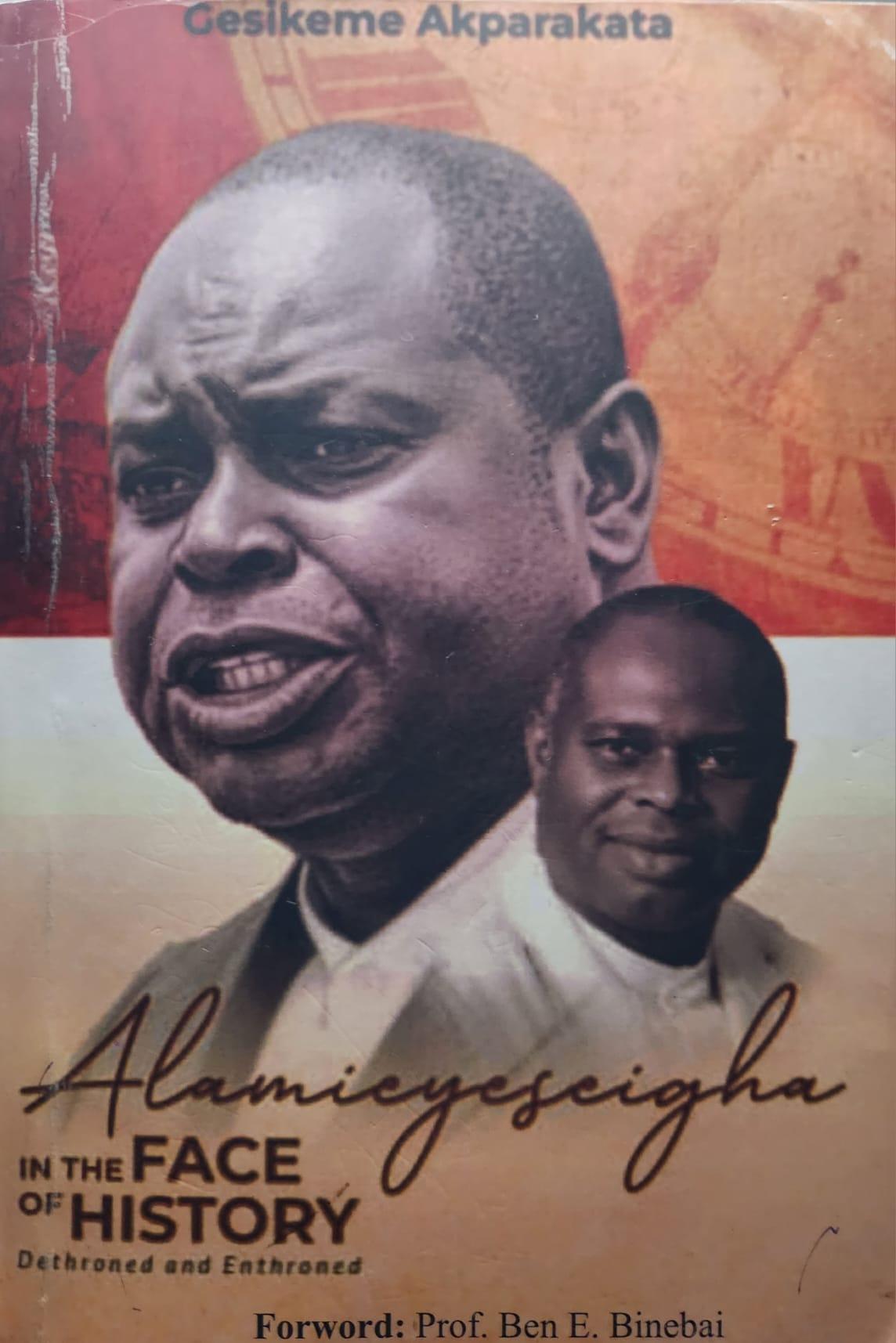
Publishers: Zilies Print ‘n’ Brands. Opposite Bayelsa Medical University, Imgbi Road, Yenagoa, Bayelsa State. Phone: 08036173557, 08089115294, 07083741065.
- +Book Review: Alamieyeseigha in the Face of History
- +Title: Alamieyeseigha in the Face of History
- +Akparakata: An Intellectual Militant Writer from a Besieged Homeland
- +An Allegorical Biography of Betrayal
- +Fearless Leadership and Strategic Intervention
Reviewer: Kabowei Akamande (Email: [email protected]; Phone: 0703 846 3111).
Title: Alamieyeseigha in the Face of History
Reviewer: Kabowei Akamande (Email: [email protected]; Phone: 0703 846 3111).
Akparakata: An Intellectual Militant Writer from a Besieged Homeland
The author published “Alamieyeseigha in the Face of History” in 2026. By this period the Ijaw nation is effectively under siege: The foremost Ijaw nationalist called Henry Emomotimi Okah, who prosecuted a just war to save imperiled Ijaws as well as other regional minorities, is a Prisoner of War, POW, in South Africa. Charles Okah, his sibling, is also serving life sentence in Nigeria and Timipre Sylva wanted for allegedly plotting a coup against President Bola Ahmed Tinubu. In the Southwark Crown Court of the UK, the Ijaw-born Diezani Alison-Madueke, Nigerian first female Minister of Petroleum Resources, faces a politically motivated trial as a way of stopping her former boss, Dr. Goodluck Ebele Jonathan, from contesting the 2027 Presidential Election.
Gesikeme Akparakata’s reader should bear in mind the harsh habitat that conditioned the palpable fear concealed in his works. The Niger Delta region of Nigeria, better still, the delineated Special Area of the 1958 report of the Henry Willink Commission, is home to the writer who is of the Ijaw ethnic stock. Consisting of endless mangrove forests, rivulets and rich alluvial soil suitable for agriculture, the Ijaw country is flooded yearly by seasonal rains.
His native land is the same primordial milieu talked about by JP Clark in the “Night Rain.” Its helpless inhabitants live under the constant threats of capricious floods that dislodge them from their thatched huts leaving them homeless much like messy owls and bats beaten by the rain. In 2012 Akparakata helplessly watched as the Ijaw country was submerged for weeks. For other Nigerians this catastrophe was just an echo from faraway land. It happened again and again as global warming precipitated exponential down pours forcing the Republic of Cameroon to open its Lagdo Dam.
It is also true that underneath Ijaw territories are some of the biggest oil and gas reserves in the world. But rather than being a source of prosperity, the resources turned out to be the very source of all the Ijaw man’s problems and the very reason why we must take seriously what the writer is saying. The contestation for the Ijaw mineral resources by internal and external aggressors means there was no period in post-colonial Nigeria when Ijaws were not pitted in resource war against their less endured neighbours.
The writer tends to believe the hegemons who illegally arrested, humiliated and killed Alamieyeseigha are still at work in the criminalisation of Ijaw nationalists. In that case, defending these leaders takes the center stage. He is not alone in this. High Court records show Ijaw intellectuals instituted class action suits against the Nigerian state over resource control, creation of 24 additional Local Government Areas, LGA, for Bayelsa State and the genocidal Nigeria-Morocco Gas Pipeline, NMGP. Additionally, The Ijaw Nation Forum, INF, is in the forefront of the call for the release of the Okah brothers.
My overwhelming impression after reading Akparakata’s work is that his thesis is consistent with the arguments of militant black writers who insist on the black man’s version of history, value, beauty, Christianity and progress. For instance, in the book under review he draws inspiration from the Ijaw folk musician called Barrister Smooth. He explains, “History often reveals that great leaders do not draw inspiration from politics alone. Many are sustained by art, poetry, faith, and music- forces that speak to the soul when words and strategies fall short” (p.235). For him music is not a passive but transformative experience. His commitment to the emancipation of his Izon ethnic group from the 21st Century internal colonialism remains irreducible.
An Allegorical Biography of Betrayal
“Alamieyeseigha” is the biographical sketch of a notable 21st Century Ijaw leader, Diepreye Solomon Peter Alamieyeseigha. One is tempted to believe the author is compelled by conscience to give the unheard side of the Alamieyeseigha tragedy. Akparakata unambiguously believes his hero and friend was singled out for destruction for defending Ijaw rights.
In his Foreword to the book, Professor Ben. E. Binebai essentially agrees with the author insisting the denigration of Alamieyeseigha by international conspirators did not deplete his messianic (the Olotu of Olutus) role in popular imagination, “He was the most consequential historical gadfly of his generation, a man upon whom the world turned its anger like a vengeful masquerade. Hated by predators and detractors, yet persistently honoured by the oppressed people of his homeland, he produced a distinct chapter in the Niger Delta freedom struggle” (p. ix).
At a deeper level, the book is an allegorical representation of an ethnic group shortchanged by civil rule more than it ever was by military dictatorship. Akparakata’s repudiation of Nigerian democracy under President Olusegun Obasanjo is damning. Everything capable of undermining a people was visited on Ijaws within the first six years,1999-2005, of Nigerian Fourth Republic.
The First casualty was Odi in Bayelsa State. The town was completely destroyed, with hundreds killed, by the military. Alamieyeseigha was the governor of Bayelsa during the Odi massacre. It was precisely the destruction of this community that angered Ijaw youths into armed militancy. From armed struggle the Ijaw nation led other regional minorities in an all-out 2009 Oil War against Nigeria and Western International Oil Multinationals, IOMs. Henry Emomotimi Okah led the Movement for the Emancipation of the Niger Delta, MEND, that prosecuted that joint venture in minority resistance.
Akparakata’s rendition of the Odi genocide completely exonerates Alamieyesigha even though the testimonies of Odi survivals tell a different story. Perhaps, that explains his humbleness in confessing his hero’s human weakness, “Alamieyeseigha was a man of enormous flaws- ego and pride among them- but he was equally a man of enormous generosity, courage, and compassion (p. 219).
Fearless Leadership and Strategic Intervention
On the sterner qualities of Alamieyeseigha, leadership comes top. Here is an exceptional genius who built the young state of Bayelsa he helped create (pp. 2-29). The writer cites three instances when as governor, Alamieyeseigha put his own life on the line for greater good:
One, Alamieyeseigha defended Ijaw people during the OPC crisis in Lagos and communal conflicts between Ijaws and Itsekiris in Delta State.