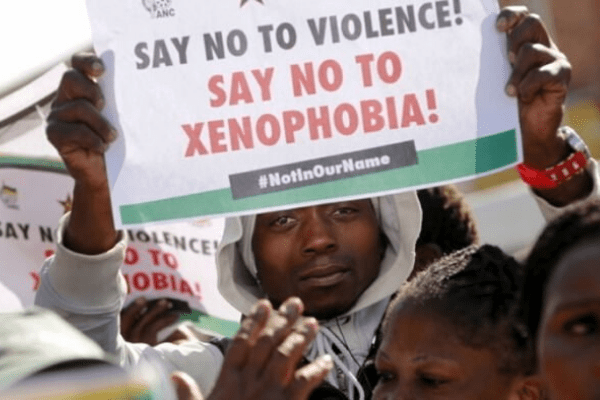
As economic hardship deepens in South Africa, migrants are increasingly being blamed for unemployment, pressure on public services, and the collapse of healthcare systems.
- +Inside the myths, realities shaping South Africa’s xenophobic crisis
But a new fact sheet released by Collective Voices for Health Access argues that much of the public debate is being driven by perception rather than evidence.
But a new fact sheet released by Collective Voices for Health Access argues that much of the public debate is being driven by perception rather than evidence.
The document, compiled by Rebecca Walker, states that the country’s economic and social crises have long predated current migration patterns and warns that scapegoating foreigners risks diverting attention from corruption, underfunding, and structural failures.
“South Africa’s economic and social pressures are real but the evidence does not show that non-nationals are the cause,” the report stated. “Acting on myth rather than evidence means treating the wrong problem and leaving the real causes unaddressed.”
According to the report, public frustration is often shaped by overcrowded clinics, poor service delivery, and rising unemployment, but these experiences do not necessarily prove migrants are responsible.
“A crowded clinic feels like proof that migrants are the cause,” the report noted. “But crowding existed before migration increased.”
The publication challenges several widely repeated claims about migrants in South Africa.
According to Statistics South Africa’s 2022 Census data, cited in the report, international migrants account for approximately 2.4 million people out of a population of 58.5 million, representing roughly 4.1 percent of the country’s population. Most are from neighbouring Southern African Development Community countries.
The report also disputes claims that migrants are taking jobs from South Africans. Citing World Bank research, it said each employed immigrant in South Africa creates approximately two jobs for citizens through economic activity and business formation. Many migrants, it added, work in informal sectors such as street trading, construction, and domestic work.
On healthcare, the report argues that corruption and weak governance are more significant drivers of collapse than migration. According to the Special Investigating Unit findings referenced in the publication, more than R2 billion was looted from Tembisa Hospital between 2020 and 2022 through fraudulent procurement schemes involving South African officials.
The document also pointed to the arrest of the national health department director general in March 2026 over alleged fraud linked to Global Fund resources meant for HIV, tuberculosis, and malaria programmes.
“Corruption and underfunding, not migration, are draining the system,” the report stated.
Claims that migrants are heavily dependent on social grants were also rejected. According to South African Social Security Agency administrative data for 2024 cited in the report, less than 0.5 percent of Child Support Grant recipients were refugee or permanent resident children combined.
The publication further argues that South Africa’s unemployment crisis is structural, rooted in decades of weak education outcomes, low investment, energy instability, and apartheid era inequalities.
South Africa’s unemployment rate stands at 32.4 percent, among the highest globally, according to the report. It added that the dominant migration flow inside the country is internal migration by South Africans moving between provinces rather than international arrivals.
The report also criticised what it described as enforcement-focused migration policies. According to the document, more than 109,000 deportations have taken place under Operation New Broom since 2024, yet economic conditions have not improved.
“Research across multiple countries shows enforcement-only approaches do not work,” the report said. “They make migration less visible, more dangerous, and create conditions for exploitation.”
Beyond statistics, the publication drew parallels with historical episodes of xenophobia and scapegoating, including violence in Rwanda, Nazi Germany, and repeated xenophobic attacks in South Africa. According to the report, xenophobic violence in South Africa in 2008 killed 62 people and displaced around 40,000 foreign nationals, yet unemployment and service delivery did not improve afterwards.
The document warned that economic hardship alone does not automatically lead to violence but becomes dangerous when political actors channel public anger toward visible outsiders.
“A cycle of blame and violence” emerges when economic hardship leads to scapegoating, violence, and further instability without resolving the underlying problems, the report said.