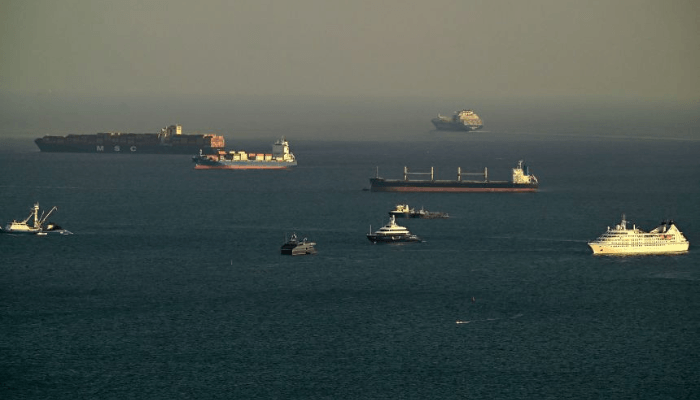
American warships have fanned out across the Indian Ocean and Southeast Asian seas to intercept Iranian oil tankers, boarding and redirecting vessels loaded with millions of barrels of crude far from the war’s front lines, shipping and security sources told Reuters on Wednesday.
- +US forces hunt Iranian tankers across Asian waters
At least three Iranian flagged tankers have been turned away from waters near India, Malaysia and Sri Lanka in recent days, as Washington tightens a naval blockade designed to choke off Tehran’s oil revenues while an uneasy ceasefire holds in the wider conflict.
At least three Iranian flagged tankers have been turned away from waters near India, Malaysia and Sri Lanka in recent days, as Washington tightens a naval blockade designed to choke off Tehran’s oil revenues while an uneasy ceasefire holds in the wider conflict.
The operation marks a significant expansion of American sea power beyond the Strait of Hormuz, where Iran has been firing on ships and seizing vessels trying to exit the Gulf. The strait, through which roughly a fifth of the world’s oil and gas passes, has been closed since the war between the United States, Israel and Iran began nearly two months ago, triggering a global energy crisis.
Among the vessels caught in the net was the Deep Sea, an Iranian flagged supertanker that was partly loaded with crude and last tracked off the coast of Malaysia about a week ago, accordbing to ship tracking data on the MarineTraffic platform. A smaller tanker, the Sevin, carrying 65 percent of its one million barrel capacity, was also intercepted after last being seen off Malaysia’s coast a month ago.
The largest seizure involved the supertanker Dorena, which was fully loaded with two million barrels of crude when it was stopped off the southern coast of India three days ago. U.S. Central Command confirmed the interception on Wednesday, saying on X that the Dorena had been placed under the escort of a US Navy destroyer in the Indian Ocean “after attempting to violate the blockade.”
A fourth vessel, the Derya, may also have been stopped, according to shipping sources. The tanker had been trying to offload its cargo of Iranian oil in India before a U.S. waiver allowing Indian buyers to purchase Iranian crude expired on Sunday. It was last tracked off India’s western coast on Friday.
US Central Command said that since the blockade began, American forces had directed 29 vessels to turn around or return to port. The military has not published a full list of intercepted ships and did not immediately respond to requests for comment about the Deep Sea or the Derya from Reuters.
One detail stood out to maritime security analysts watching the operation. According to a third Western security source who spoke to Reuters, the US military has been deliberately targeting Iranian vessels in open waters rather than near the strait, in order to avoid the threat of floating mines during interception operations.
Back in the strait itself, Iran showed no signs of backing down. Tehran confirmed on Wednesday that Revolutionary Guards forces had seized two container ships attempting to exit the Gulf, firing on them and a third vessel before escorting the ships to Iranian shores. It was the first time Iran had seized ships since the war began.
With no peace talks scheduled, no deadline attached to the current ceasefire and both sides expanding their operations at sea, the contest for control of the world’s most important oil route shows no sign of easing.