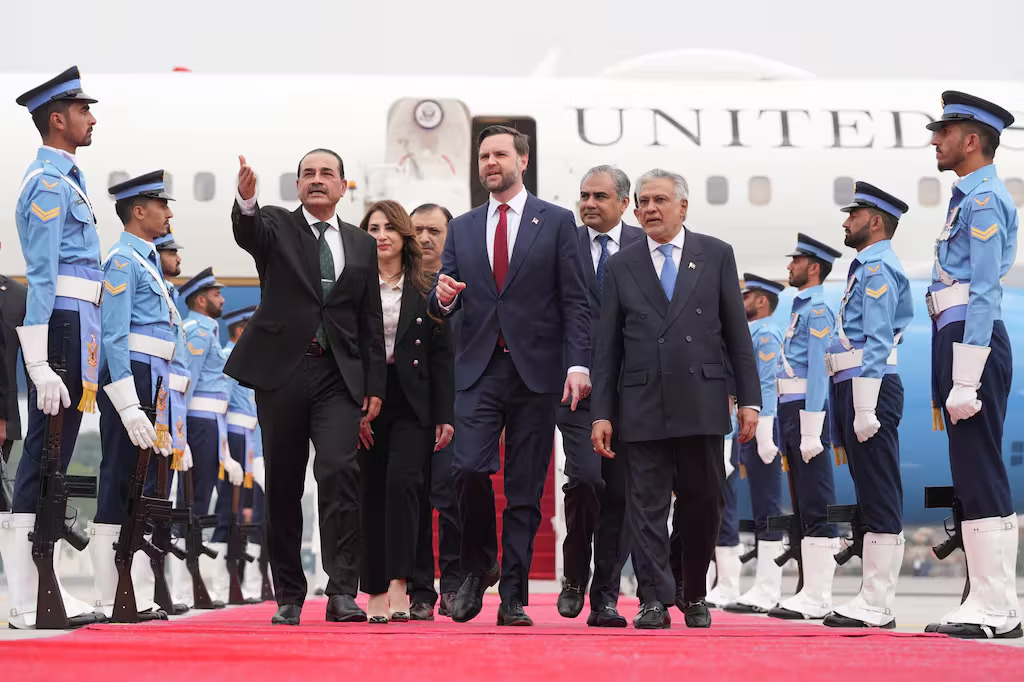
The United States and Iran have failed to reach an agreement to end the ongoing conflict in the Middle East following 21 hours of negotiations.
- +U.S., Iran fail to reach agreement after 21-hour talks in Pakistan
The talks, which ended in the early hours of Sunday, April 12, in Islamabad, Pakistan, were disclosed by U.S.
The talks, which ended in the early hours of Sunday, April 12, in Islamabad, Pakistan, were disclosed by U.S. Vice President JD Vance, who confirmed that both sides were unable to resolve key issues despite extended discussions.
The U.S. and Iran had earlier entered a two-week ceasefire agreement on April 8 in a bid to end the conflict between Iran and a combined force of Israel and the United States, which began on February 28 and has since disrupted global energy supply.
Negotiations began earlier in the weekend in Islamabad and were initially hailed as a major diplomatic step, bringing together senior U.S. officials, including Jared Kushner and Steve Witkoff, alongside an Iranian delegation led by Parliament Speaker Mohammad-Bagher Ghalibaf.
After 39 days of war, the U.S. and Iran agreed to a two-week ceasefire brokered with the help of Pakistan, with support from China.
The deal was widely considered fragile, especially amid claims by Pakistani officials that Lebanon, where heavy Israeli bombardments have continued, was included in the agreement, a position Israel denied.
The ceasefire came just hours before a deadline set by U.S. President Donald Trump, who had earlier warned of severe consequences if Iran failed to return to negotiations.
Providing further details, Vance noted that the negotiations spanned 21 hours and included “a number of substantial discussions” with Iran.
When asked by a CNN reporter about specific sticking points, Vance declined to negotiate publicly, stating that the core issue remained Iran’s nuclear ambitions.
He added that while Iran’s nuclear facilities had previously been targeted, the U.S. remains unconvinced about Tehran’s long-term commitment.
With negotiations now stalled, uncertainty surrounds the remaining 10 days of the ceasefire and whether hostilities could resume afterwards.
The conflict has already caused significant global disruptions, particularly in energy markets. Following the ceasefire announcement, oil prices dropped sharply, with Brent crude and WTI falling by more than 15%, after earlier surging to as high as $120 per barrel.
This volatility has had a notable impact on Nigeria. Reports indicate that the Dangote Refinery maintained its pricing structure at N1,200 per litre at the gantry and N1,153 per litre at the coast, compared to a pre-war pump price of around N799 per litre—representing a 50.19% increase.
The fluctuations were partly driven by Iran’s agreement to reopen the Strait of Hormuz, a critical route responsible for about 20% of global energy supply.