Nigeria attracted $10.37 billion in foreign capital during the first quarter of 2026, almost double the $5.64 billion recorded a year earlier and one of the strongest quarterly performances in recent history. At first glance, the numbers appear to validate the government’s economic reforms.
- +Nigeria is getting capital, but not the kind that creates jobs
- +The return of yield-seeking capital
After two years of currency liberalisation, fuel-subsidy removal and aggressive monetary tightening, foreign investors are returning.
After two years of currency liberalisation, fuel-subsidy removal and aggressive monetary tightening, foreign investors are returning. But they are not returning in the way policymakers would ideally want.
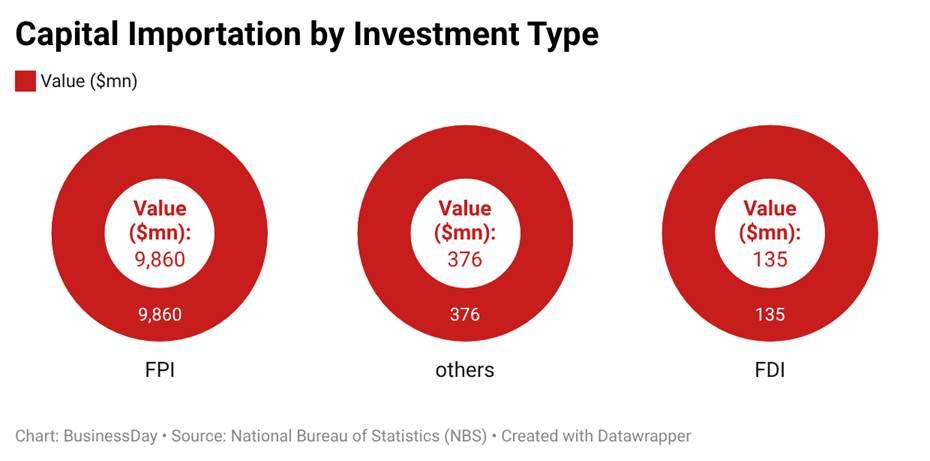
Nearly 95 percent of total capital importation came as foreign portfolio investment, according to National Bureau of Statistics data. Foreign direct investment accounted for just $135.08 million, representing barely 1.3 percent of total inflows. That distinction may be the most important story hidden beneath the headline numbers.
Muda Yusuf, chief executive officer of the Centre for the Promotion of Private Enterprise (CPPE), has consistently argued that while portfolio inflows can strengthen liquidity and improve investor confidence, sustainable economic transformation ultimately depends on productive investment.
For a country with a population exceeding 220 million people and growing by roughly five million annually, that distinction is critical. Nigeria does not simply need capital.
It needs the type of capital capable of creating jobs, expanding production, increasing exports and raising living standards at a pace that keeps up with one of the world’s fastest-growing populations. The first-quarter figures suggest foreign investors are increasingly willing to trade Nigeria’s reform story. They are not yet fully prepared to build on it.
The return of yield-seeking capital
The drivers behind the surge are not difficult to identify. Nigeria currently offers some of the highest interest rates among major frontier and emerging markets. Treasury bills and government securities provide yields approaching 20 percent, while foreign-exchange reforms have significantly improved investors’ ability to move capital in and out of the country compared with the restrictions that characterised much of the previous decade.
For global investors searching for yield in a world where inflation is moderating and interest rates are expected to decline across advanced economies, Nigeria has become attractive again. The composition of the inflows tells the story clearly.
Of the $9.86 billion recorded as foreign portfolio investment in the first quarter, money-market instruments accounted for $6.50 billion, while bonds attracted $3.23 billion. Portfolio equity investment amounted to only $131.81 million. This was not primarily a wave of foreign investors acquiring ownership stakes in Nigerian companies.
It was largely a wave of investors buying Nigerian financial assets. The sectoral breakdown reinforces the point. Banking attracted $7.55 billion, representing nearly three-quarters of total inflows, while financing received another $2.43 billion. Manufacturing attracted only $152.27 million. Agriculture received $37.28 million, while oil and gas attracted less than $1 million.
The money is flowing into Nigeria’s financial system. It is not yet flowing meaningfully into its productive economy.
The difference between portfolio investment and direct investment is not merely academic. Portfolio capital is often described as “hot money” because it can move quickly across borders in search of returns. It supports liquidity, deepens financial markets and can help stabilise exchange rates when inflows are strong.
Foreign direct investment serves a different purpose. Factories, industrial parks, logistics facilities, technology hubs, renewable-energy projects, export-processing zones and large-scale agricultural investments are typically financed through direct investment. These investments create jobs, transfer technology, improve productivity and expand an economy’s productive capacity.
For Nigeria, that distinction carries enormous implications. The country adds millions of people to its population every year. Meeting the needs of that population requires sustained growth in employment, manufacturing, infrastructure and exports. Those outcomes are rarely driven by short-term financial flows.
Treasury-bill purchases do not employ thousands of workers. Manufacturing plants do. Bond inflows do not expand industrial capacity. Productive investment does.
Sheriff Abdusallam, a corporate and alternative investment analyst, argues that the difference ultimately comes down to the type of confidence investors are expressing. “An investor purchasing treasury bills is expressing confidence in Nigeria’s yield environment. An investor building a factory is expressing confidence in Nigeria’s future,” he said.
That distinction helps explain why the latest figures are both encouraging and concerning. The first-quarter data suggest that foreign investors increasingly trust Nigeria’s financial markets. They remain far less convinced about Nigeria’s operating environment.
One reason for the divergence lies in the different risks faced by portfolio and direct investors. A portfolio investor buying government securities is primarily concerned with interest rates, exchange-rate stability and the ability to exit when conditions change.
A direct investor faces a far broader set of questions. Can raw materials move safely? Can finished products reach consumers efficiently? Can workers operate without security concerns? Will power supply remain reliable? Will regulations remain predictable over the life of the investment?
These questions become particularly important in an economy where insecurity continues to affect multiple regions. Kidnappings, attacks on transport corridors, farmer-herder conflicts, oil theft and pipeline vandalism increase operating costs in ways that financial investors can often avoid.
Abayomi Fashina, risk and enterprise lead at STL Asset Management, believes this difference is central to understanding Nigeria’s investment challenge. “A fund manager can sell a bond within days. A factory cannot relocate overnight. This helps explain why high yields can attract portfolio flows even when insecurity persists, while direct investment remains subdued,” he said.
Financial investors can often be compensated for risk through higher returns. Long-term investors require confidence that the operating environment itself is improving. That confidence remains fragile.
Nigeria’s reforms are restoring investor interest, but the most development-friendly form of capital remains largely absent. The latest figures show that foreign investors are increasingly willing to bet on the country.