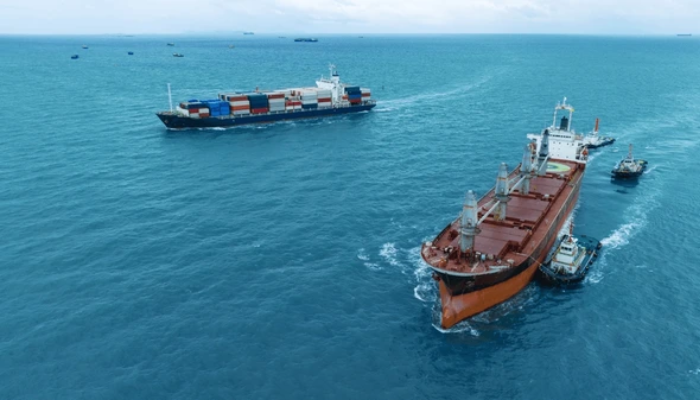
More than 500 vessels remain stranded in the Middle East Gulf as efforts to reopen the Strait of Hormuz continue to face delays despite the announcement of a peace agreement between the United States and Iran, raising fresh concerns over global energy supplies and maritime trade.
- +500 ships stuck as Hormuz reopening stalls despite US-Iran deal
Shipping data showed little change in vessel traffic through the strategic waterway following Sunday’s announcement of a US-Iran peace deal, suggesting that shipowners remain reluctant to resume normal operations until the agreement is formally signed and implemented.
Shipping data showed little change in vessel traffic through the strategic waterway following Sunday’s announcement of a US-Iran peace deal, suggesting that shipowners remain reluctant to resume normal operations until the agreement is formally signed and implemented.
The Strait of Hormuz is one of the world’s most critical energy corridors, handling roughly a fifth of global seaborne oil trade and a significant share of liquefied natural gas (LNG) exports from the Gulf region.
Industry observers said the lack of movement reflects continuing uncertainty over security conditions in the area, particularly concerns surrounding naval mines, insurance coverage and the absence of formal assurances from Iranian authorities.
Although the Indian LNG tanker Disha successfully navigated the strait near Iran’s Larak Island without incident, shipping analysts noted that the transit was likely planned before the ceasefire announcement and therefore does not signal a broader return of confidence among vessel operators.
Several smaller vessels also transited the waterway overnight, but there were no significant movements involving crude oil or refined petroleum tankers, indicating that major shipping companies are still adopting a wait-and-see approach.
US President Donald Trump had earlier announced that he had authorised the “toll-free” reopening of the Strait of Hormuz following progress in negotiations with Iran. However, Tehran has yet to formally confirm unrestricted access for commercial vessels, creating uncertainty over the practical implementation of the agreement.
As a result, vessels that continue to transit the strait are largely using shipping lanes closer to Iran’s Larak and Qeshm islands rather than the traditional central route, reflecting ongoing security concerns.
Jakob Larsen, chief safety and security officer at global shipping association BIMCO, warned that the threat posed by mines remains a major obstacle to restoring normal maritime operations.
“The threat of mines in the area remains a concern immediately as well as further down the line, and mine-free routes need to be established,” Larsen said. “We still consider it very risky to commence transits at this point.”
According to BIMCO, floating mines and unexploded ordnance could continue to restrict vessel movements even after a formal peace agreement is signed.
Marine insurers are also expected to maintain stringent coverage requirements until safe navigation corridors are established and verified by international authorities.
The United Kingdom has indicated that it will continue working with international partners to support the reopening of the waterway.
British Prime Minister Keir Starmer said the UK and France are leading efforts to coordinate a defensive multinational mission focused on maritime security and mine-clearance operations in the Gulf.
Market participants view the planned signing of the US-Iran agreement on June 19 as a potential turning point that could trigger a broader recovery in shipping activity.
However, even under favourable conditions, analysts warn that normalisation could take several weeks.
With more than 500 ships currently waiting in the region, the process of clearing the backlog is expected to be gradual, particularly as vessels will initially be required to follow restricted routes while mine-clearance operations continue.
The prolonged disruption has significant implications for global energy markets.
Any delay in restoring unrestricted access through the Strait of Hormuz could affect crude oil exports, LNG shipments and refined product flows from key Gulf producers, potentially sustaining volatility in international energy prices.