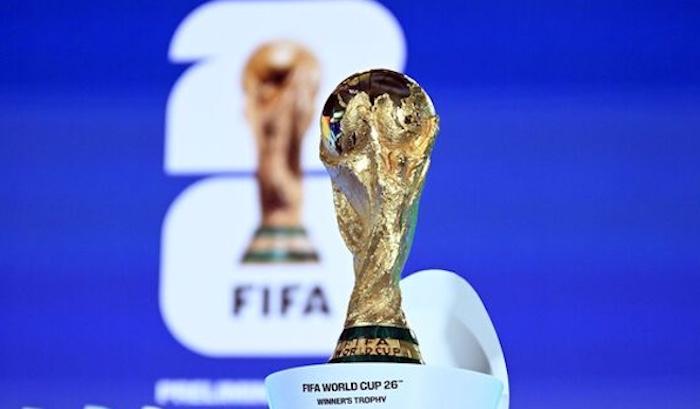
2026 World Cup: Favourites, Dark Horses And Stars Set To Shape Football’s Biggest Stage
- +Spain Lead The List Of Favourites
- +Argentina’s Pursuit Of Back-To-Back Titles
- +Brazil Seeking A Return To The Summit
- +Dark Horses Capable Of A Deep Run
- +Players Who Could Define The Tournament
Spain, France, Argentina and Portugal lead contenders as emerging nations and global stars prepare for football’s biggest tournament.
Spain, France, Argentina and Portugal lead contenders as emerging nations and global stars prepare for football’s biggest tournament.
The 2026 FIFA World Cup is unlike any edition before it. For the first time, 48 nations will compete for football’s biggest prize, with 104 matches played across three host countries; the United States, Canada and Mexico.
The expanded format brings new opportunities for emerging nations and increases the possibility of surprise runs deep into the tournament. Yet while the field is larger than ever, the battle for the trophy is still expected to revolve around a familiar group of football heavyweights.
From established powers seeking another title to rising nations hoping to make history, the tournament promises compelling storylines from the opening match to the final.
The competition begins on Thursday with Mexico facing South Africa in the opening match in Mexico City. The opening ceremony features performances from some of Latin America’s biggest musical acts, alongside global stars including Shakira and Nigeria’s Burna Boy, who is set to perform the tournament’s official song.
Beyond the football, FIFA is introducing several technological and regulatory innovations aimed at improving the flow and accuracy of matches.
Enhanced semi-automated offside technology will operate alongside a sensor-equipped match ball capable of transmitting real-time data to video officials. VAR powers have also been expanded to allow reviews of certain clear errors, including mistaken identity and some disciplinary decisions.
Visible countdowns for throw-ins and goal kicks have been introduced to discourage time-wasting, while substitution procedures have been tightened.
One of the most debated changes is the introduction of mandatory three-minute hydration breaks midway through each half. FIFA says the measure is necessary to protect players from high temperatures that could be experienced in several host cities during the summer. Critics, however, argue the policy is too broad and could interrupt the rhythm of matches in cooler venues.
Spain Lead The List Of Favourites
If there is one team entering the tournament with the strongest momentum, it is Spain.
The European champions have developed into one of the most complete sides in international football. Their midfield remains among the strongest in the game, while their attack combines creativity, pace and tactical flexibility.
Unlike previous Spanish generations that relied almost exclusively on possession football, this side can dominate through multiple approaches. They can control matches through the ball, press aggressively without it and attack quickly in transition.
The emergence of young stars alongside experienced leaders has made Spain the team many analysts believe is best equipped to win the tournament.
France arrive with arguably the deepest squad in world football.
Few nations can match their strength across every position. Their blend of experience, athleticism and elite attacking talent makes them one of the strongest contenders.
The tournament also carries extra significance for coach Didier Deschamps, who is expected to step down after the World Cup. Winning a second World Cup as manager would cement his place among football’s most successful coaches.
With several players entering their prime years, France possess the quality required to reach another final.
Argentina’s Pursuit Of Back-To-Back Titles
Defending champions Argentina understand better than most how to navigate World Cup football.
The core of the squad that triumphed in Qatar remains intact, bringing invaluable tournament experience and a proven ability to perform under pressure.
While some key figures are older than they were four years ago, Argentina continue to possess a winning mentality and tactical discipline that make them dangerous opponents in knockout football.
Much of the spotlight will naturally fall on Lionel Messi. At 39, this is widely expected to be his final World Cup appearance, adding further significance to Argentina’s campaign.
Portugal may have assembled the most balanced squad in their history.
Cristiano Ronaldo remains the face of the team and enters what is likely his final World Cup with one major objective still missing from his remarkable career: lifting football’s biggest trophy.
Yet Portugal’s strength extends far beyond their captain.
Bruno Fernandes continues to drive the team’s creativity, Vitinha has become one of Europe’s most influential midfielders, while Rafael Leão and Bernardo Silva provide attacking quality capable of troubling any defence.
Many observers believe Portugal possess the depth and balance needed to make a serious run at the title.
Brazil Seeking A Return To The Summit
Brazil enter the tournament with less hype than previous generations, but that may work in their favour.
The five-time champions still possess immense attacking quality and remain one of football’s most talented nations.
Much will depend on Vinícius Júnior, whose pace, dribbling and ability to create decisive moments make him Brazil’s most important attacking player alongside. eteran talisman Neymar, red-hot forward Raphinha, and Premier League standouts like Bruno Guimarães, Gabriel Magalhães, Alisson Becker, Gabriel Martinelli and Matheus Cunha.
Head coach Carlo Ancelotti has blended experienced leaders with the next generation of attacking talent.
Brazil have not won the World Cup since 2002, and ending that drought remains one of the major storylines of the tournament.
Dark Horses Capable Of A Deep Run
Germany’s rebuilding process appears to be bearing fruit.
A younger generation has emerged alongside experienced leaders, creating a squad capable of competing with the world’s best if consistency can be maintained throughout the tournament.
England continue to boast one of the strongest collections of young talent in world football.
Despite repeated near-misses in recent major tournaments, they remain genuine contenders and possess enough quality to challenge for the title.
Colombia arrive with confidence after impressive performances in qualification and recent international competitions.
Their attacking talent and tactical organisation could make them one of the tournament’s most dangerous outsiders.
Morocco have transformed perceptions of African football on the global stage.
After becoming the first African nation to reach a World Cup semi-final in 2022 and their success in the 2024 AFCON, they enter 2026 believing another historic run is possible.
Players Who Could Define The Tournament
Still a teenager, Yamal has already established himself among football’s elite talents. His creativity, confidence and ability to influence major matches make him one of the most exciting players in the competition.