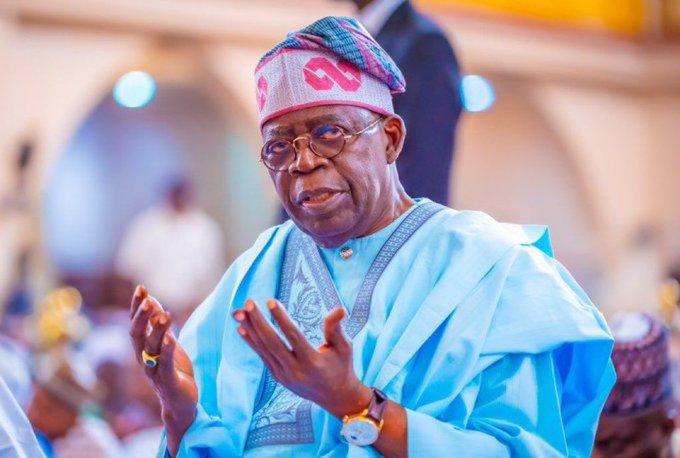
President Bola Tinubu on Thursday said Nigeria is on course to attract close to $20 billion in foreign direct investment in 2026 alone.
- +Nigeria attracting $20bn FDI in 2026, says Tinubu
He attributed the figure to his administration’s systematic removal of regulatory bottlenecks, macroeconomic stabilisation, and transparency reforms.
He attributed the figure to his administration’s systematic removal of regulatory bottlenecks, macroeconomic stabilisation, and transparency reforms.
Tinubu stated this while making a case for African self-reliance and continental resource integration at the Africa CEO Forum in Kigali, Rwanda.
Speaking on a presidential panel moderated by British journalist Zainab Badawi alongside Gabonese President Brice Clotaire Oligui Nguema, Tinubu asserted that Africa must refuse to export raw materials while importing finished products.
He also argued that the continent must finance its own development from its resources.
Tinubu said, “Removing all the bottlenecks gives you the necessary incentives for direct foreign investment into the country.
“This year alone, I can beat my chest that Nigeria is attracting close to $20 billion in foreign direct investments.”
Fielding questions on value addition and Africa’s longstanding challenge of selling raw commodities cheaply while buying back finished goods at higher costs, Tinubu said the era of exporting unprocessed resources from Nigeria was over.
He said, “No one can take metal out of Nigeria without adding value.
“You can excavate the dust, all the minerals, and go, but no. I can produce batteries for cars with my minerals.
“Rare earth minerals are valuable, but if we value what is on the ground as a balance sheet item capable of funding and raising capital for exploration and production of our resources, why not do it for ourselves?”
On the Dangote Petroleum Refinery, which Badawi noted produces 650,000 barrels per day and meets roughly 70 per cent of Nigeria’s fuel needs, Tinubu said only a government-private sector partnership could enable such an outcome.
“Nigeria could not survive with over 200 million people in peace without a refinery. A risk-taker like Dangote must be encouraged by the government.
“What I did was support him, give him free trade, his own licence, support him in sourcing the crude that is necessary.
“Today he is a net exporter of petroleum motor spirit, aviation fuel, and other commodities,” he stated.
Speaking on cross-border payment challenges involved in supplying crude to the domestic refinery in naira, he said, “My formula is: what is the denominated currency in Nigeria? That is the naira. I have crude that you expect me to export, so I give you, as my local refinery, crude in naira. No letter of credit, no bank scrambling, no exchange rate instability.”
He also challenged the dominance of Western credit rating agencies, arguing that they consistently undervalued African economies.
“I wrote an article in the Financial Times. Have the rating agencies visited Rwanda and seen the potential, the tourism, the 9.4 per cent growth last year?
“Investment is very cowardly, unless you are transparent, accountable and forthright. That is why we must recapitalise all our financial institutions,” he stated.
On tax reform, Tinubu cited what he described as the Lagos model, noting that Lagos is now the fifth-largest economy in Africa and that the reforms were being replicated at the national level.
“Tax reform must be written in English, understandable and not Japanese in English, a standard that everyone is able to pay.
“Not for avoidance, but for the genuine commitment of citizenship. Write it simple but not stupid. I have reformed that in Nigeria.
“You can pay your taxes from your telephone. You can access and evaluate yourself so easily from your phone,” he stated.
On agriculture, Tinubu pointed to 6,000 mechanised agricultural zones across Nigeria, a government buy-back programme for farmers, and the Sokoto-Badagry road, a 1,000-kilometre concrete highway linking parts of the West African corridor, as evidence of infrastructure investment aligned with agricultural logistics.
He said, “Gone are the days when agriculture is no longer sexy. Government must identify energy sources for preservation of items, buy back from farmers when prices are very low and frustrating, have storage silos and when the market is better, help the farmers.
“It is not possible for the farmers to take a loan and think it will be profitable without high-yield seedlings being provided to them.”
On infrastructure, Tinubu disclosed that Nigeria had already laid over 90,000 kilometres of fibre optic network across the country.
“That is the only way we can bring lessons to children and communicate with farmers and ordinary traders. Africa must be able to put funding together to surpass the level of primitive telecommunication, bring in AI, e-commerce; we need to leapfrog,” he noted.
Speaking on Nigerian youths, he said, “I am a politician. If I don’t get them ready for that (digital revolution), they’ll vote me out.”
“Africa needs to put its money where its mouth is. The African Continental Free Trade Area should not be left on the drawing board; it should be activated properly, with regional collaboration and effective utilisation of our resources, not working in silos but in collaboration with one another. I believe in Africa first, because I started with Nigeria first,” he added.
The Africa CEO Forum, which runs through Friday in Kigali, is the continent’s largest gathering of business leaders and heads of state, convened annually to deliberate on African economic integration and private sector growth.