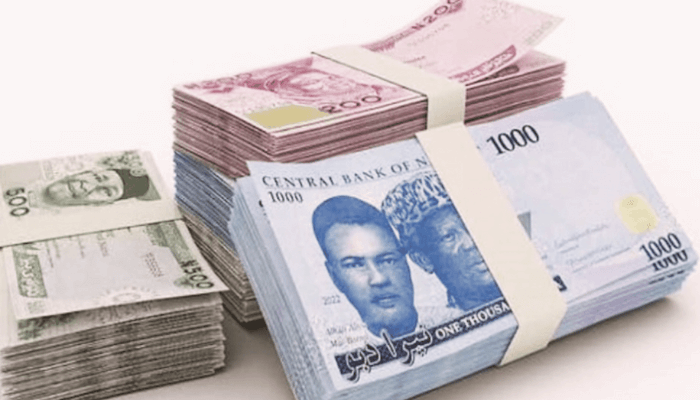
The naira closed July with a modest gain in the official foreign exchange (FX) market, supported by sustained dollar liquidity and stronger external reserves.
- +Naira records slight gain in July on sustained dollar liquidity
Data published by the Central Bank of Nigeria (CBN) showed that the naira appreciated by N4.19, with the dollar closing at N1,368.22 on Friday, the last trading day of July 2026, representing a 0.3 per cent gain from N1,372.41 recorded at the beginning of the month on the Nigerian Foreign Exchange Market (NFEM).
Data published by the Central Bank of Nigeria (CBN) showed that the naira appreciated by N4.19, with the dollar closing at N1,368.22 on Friday, the last trading day of July 2026, representing a 0.3 per cent gain from N1,372.41 recorded at the beginning of the month on the Nigerian Foreign Exchange Market (NFEM).
Every week, however, the local currency weakened by N6.13, or 0.5 percent, compared with N1,362.09 traded at the official market a week earlier.
In the parallel market, also known as the black market, the naira ended the month at N1,415 per dollar, reflecting a N7 or 0.5 percent depreciation from N1,408 at the start of July. Consequently, the gap between the official and parallel market exchange rates widened to 3.45 percent.
Activity at the interbank FX market strengthened during the month. Total turnover rose by 26.97 percent month-on-month to $3.39 billion at the close of July from $2.67 billion recorded in June. However, the number of deals declined by 10.41 per cent, from 2,538 to 2,274, compared with the previous month.
Although NFEM data for the final trading day of July were unavailable at the time of reporting, market data up to July 30 showed total turnover eased by 3.56 percent to $12.46 billion from $12.92 billion at the end of June. The number of deals also declined by 4.64 percent to 6,332 in July from 6,640 recorded in June.
Nigeria’s external reserves, which provide the CBN with the capacity to support the naira and meet external obligations, closed the month at $51.92 billion as of July 30, 2026. This represented a 0.89 percent increase from $51.46 billion recorded on June 30, according to data on the CBN website.
A report by FSDH Merchant Bank said Nigeria’s external reserves climbed to $51.7 billion as of July 9, 2026, the highest level recorded in more than 17 years. It noted that reserve accumulation accelerated in the second half of 2025 after a period of relative stagnation, providing the CBN with a stronger buffer to manage external shocks, meet foreign currency obligations and reinforce confidence in the FX market.
According to the report, the improvement in reserves was driven by sustained trade surpluses, stronger foreign capital inflows and ongoing reforms that have enhanced FX market liquidity.
FSDH also noted that autonomous inflows remained the dominant source of FX supply, supporting market liquidity, exchange rate stability and stronger external buffers. The report added that CBN interventions moderated as market-based inflows improved, reflecting increased investor confidence and continued normalisation of the foreign exchange market.
While positive net FX flows strengthened external liquidity, the bank said the composition of inflows remains important, given the continued reliance on portfolio capital. It added that achieving durable exchange rate stability would require a combination of sustained portfolio inflows, stronger export earnings and increased long-term capital inflows.
The CBN’s 2025 Annual Report and Statement of Accounts showed that autonomous sources accounted for the largest share of Nigeria’s foreign exchange inflows as total inflows into the economy increased by 13.81 percent to $109.86 billion in 2025.
According to the report, FX inflows from autonomous sources rose by 25.12 percent to $70.54 billion in 2025 from $56.38 billion in 2024, accounting for 64.21 percent of total foreign exchange inflows during the year. The CBN attributed the increase largely to higher non-oil export receipts and stronger over-the-counter purchases, particularly capital importation.