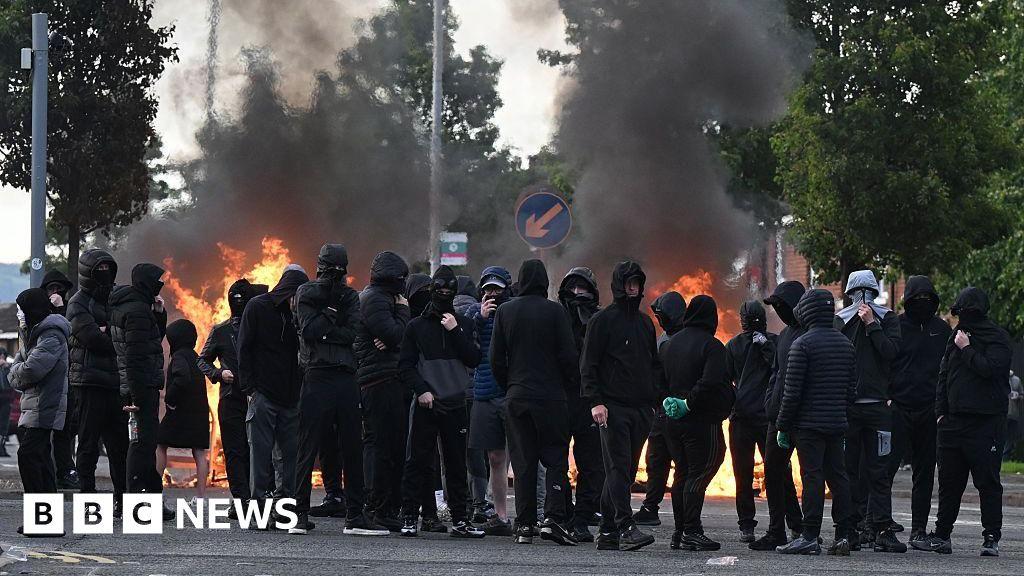
Discussion is needed on the impact of migration on the UK's national security after disorder that followed a knife attack in Belfast, the government's independent reviewer of terrorism legislation has said.
- +Belfast knife attack disorder 'destabilising', says terror adviser
Jonathan Hall KC made the comments after it emerged a Sudanese man, 30, who was charged with attempted murder, had entered the UK in 2023 and was given refugee status.
Jonathan Hall KC made the comments after it emerged a Sudanese man, 30, who was charged with attempted murder, had entered the UK in 2023 and was given refugee status.
He told BBC Radio 4 Today programme it was "absolutely legitimate to talk about immigration in the context of national security".
"If you look at state threats and people who have been willing to act as proxies or carry out attacks on behalf of Iran... I'm interested in the question of whether or not foreign nationality, particularly recent migrants, is becoming more relevant to the overall national security picture," he said.
Hall said although it does not appear the Belfast attack was a national security incident, "it has had huge ramifications... not least for people who happen to be black and brown who appear to have been driven out their houses, so it's extraordinarily destabilising".
The barrister said there has also not been a response to Donald Trump's National Security Strategy, released in November, which accused Europe's migration policies of "transforming the continent and creating strife". No European leaders have publicly accepted his assertion.
Trump has warned many countries in Europe "will not be viable countries any longer" if they keep on the way they are going, adding: "What they're doing with immigration is a disaster."
"Now you may not have agreed with the language, but I think it does raise the question if certain countries are more likely either to commit very serious offences, or particular offences, or to get involved with state threat activity," Hall said.
"Do we need to start thinking about migration now not simply in terms of the economy and housing, but also in terms of national security?"
Asked if there are also questions about people coming here particularly from war-torn places, Hall drew comparison to the work of the security services, who he said assess the potential risk of those in Syrian camps who left the UK to join the Islamic State group.
"One of the key features is that they were involved in, either witnessed or they perpetrated really serious violence and the assessment is that affects the risk that they present were they to return to the UK, so I think it is a relevant factor, yes," he said.
"Ultimately national security is the health of the nation."
In the government's cohesion strategy published in April, Prime Minister Sir Keir Starmer said that social cohesion was "a vital front in the resilience of our national security".
In the strategy, the government said "we know that migration needs to be managed to support communities and cohesion".
Meanwhile, this week the EU is putting into force its Pact on Migration and Asylum, which introduces new asylum procedures. It has been criticised by the right for not going far enough and from the left for putting the human rights of refugees at risk.
The Ministry of Justice does not collect statistics on the immigration status of those convicted of crimes, but it does collect data on nationality.
Researcher from the University of Oxford's Migration Observatory Ben Brindle said that in 2024 the foreign national share of convictions and those in prison in England and Wales was about the same as the foreign national share of the wider population at 13%.
Speaking to the BBC Radio 4's World at One programme, he said conviction rates do vary by nationality and several of the nationalities that have high shares of asylum seekers, like Afghans or Iraqis, appear to be "over-represented" in the criminal justice system.
"That's not just going to be about somebody's nationality but it's also driven in part by somebody's' socioeconomic status, or age and sex as to whether somebody commits a crime," he said, adding that young men are more likely to claim asylum and regardless of nationality young men are more likely to commit crimes.
Brindle went on to say that it was "very difficult to tell at the outset when granting asylum as to whether somebody is going to go on to commit crime or not".
Speaking during an urgent question in the House of Commons on the issue, Home Office minister Dan Jarvis said there have been 67,000 deportations and removals under the current government
"This government will do everything that we can, everything in our powers, and if there are further powers required, we'll make sure that we have them to deport and remove those people who raise a threat to the public," he said.
Shadow home secretary Chris Philp said the UK should leave the European Convention on Human Rights to allow illegal migrants to be deported on arrival and that this would stop illegal immigration and "all appalling crimes with it".
On Wednesday, 30-year-old Hadi Alodid was charged with attempted murder after a knife attack in north Belfast on Monday night. He was also charged with possession of a knife in a public place and threats to kill an NHS worker.
The victim named as Stephen Ogilvy, who is in his 40s, remains in hospital. The court heard heard he has lost his left eye and has damage to his right eye.
He also has injuries to his neck and back.
Alodid has been remanded in custody.