African investors accounted for 45% of total venture fund commitments in 2025, up from an average of 23% between 2022 and 2024, according to the African Private Capital Association.
- +timbuktoo’s Joanne Manda on building Africa’s innovation engine from within
- +For the uninitiated, what does timbuktoo do?
- +What is the fundamental thinking that drives the work you do at timbuktoo?
It is the highest domestic participation rate the continent has recorded.
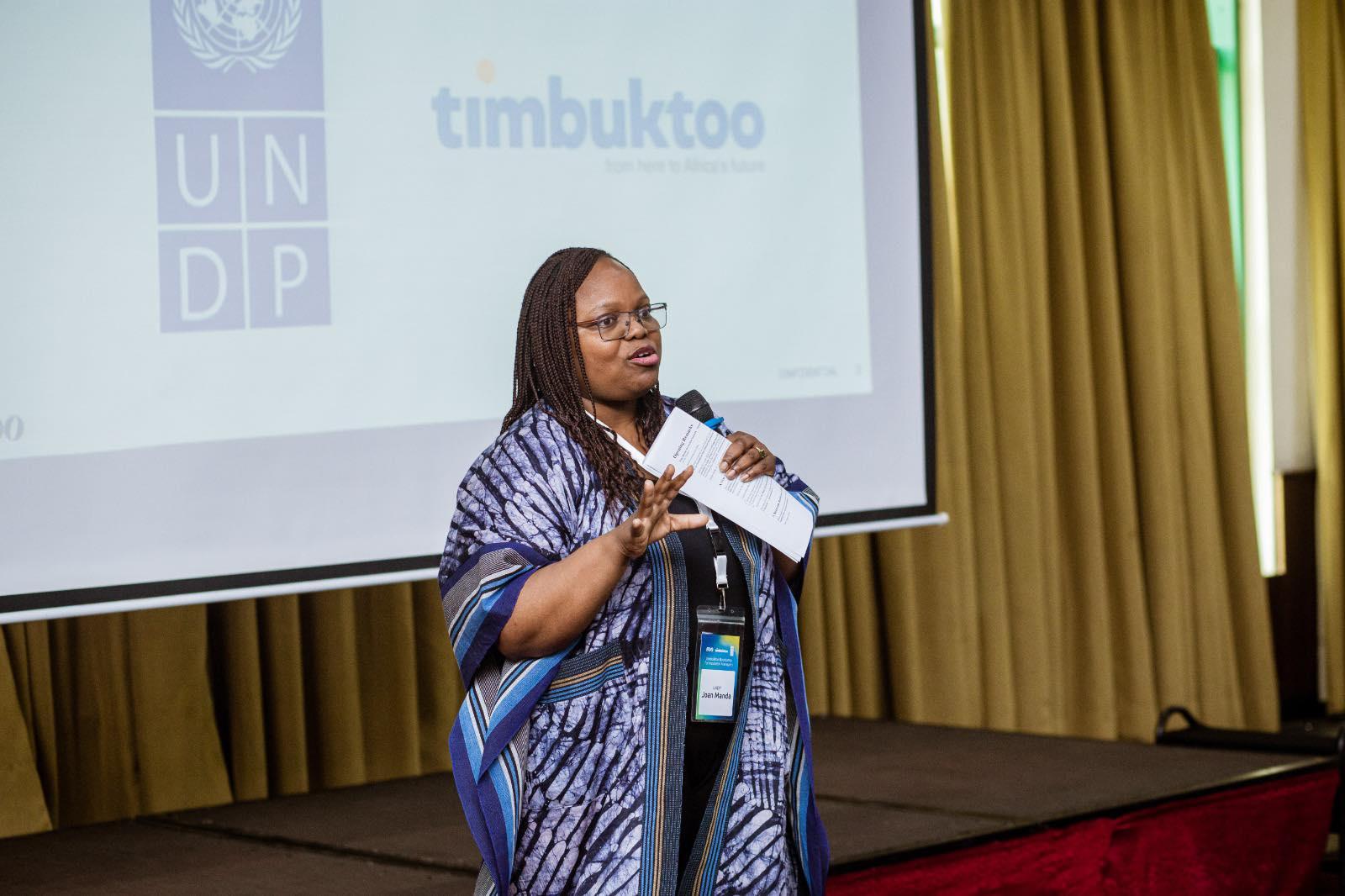
It is the highest domestic participation rate the continent has recorded. For Joanne Manda, timbuktoo’s Global Lead, it is evidence of a deeper shift in how Africans think about their own economies.
“We are no longer waiting for handouts,” she told TechCabal on the sidelines of the Africa CEO Forum in Kigali, Rwanda’s capital, on May 15. “We are getting our hands dirty and actually doing the work.”
Manda leads timbuktoo, the United Nations Development Programme (UNDP)-backed initiative that describes itself as the “world’s largest platform supporting Africa’s innovation ecosystem.” It currently runs six pan-African thematic hubs and has trained 3,480 innovators, according to its Q1 2026 report seen by TechCabal. timbuktoo also operates 16 University Innovation Pods across the continent with 12 more in the pipeline to address what investors consistently name as their biggest barrier to growth: talent.
TechCabal sat with her in Kigali to talk through what building innovation infrastructure at continental scale actually looks like, including the capital architecture that does not yet fit African markets, the shifting posture of African governments, and why she believes Africa’s technology transformation, when it arrives, will not be gradual.
This interview has been edited for length and clarity.
For the uninitiated, what does timbuktoo do?
timbuktoo is a partnership platform. We work with a range of stakeholders from governments to private sector corporates, and our own timbuktoo Foundation to build an ecosystem of startups and innovators across Africa. We have operations now across the continent, and we are really aiming to operate at scale across 54 countries. That’s massively ambitious, because every country has its own market, culture, language, and peculiarities. As a pan-Africanist myself, I think it’s really important that a sense of solidarity comes through in our programming.
What is the fundamental thinking that drives the work you do at timbuktoo?
For me, it is about making sure Africa takes its future into its own hands. We recognise that the narrative of Africa needs to change, and it is changing. Africans are changing it daily. We are no longer waiting for handouts. We are getting our hands dirty and actually doing the work. We have a young population that is restless but also innovative, creative, and capable, and we need to start nurturing that with real intention.
Africa has a young population that it needs to train and create opportunities for, but driving innovation at that scale requires a lot of money. How does timbuktoo think about capital?
Capital flows in different ways, and you have to understand what kind of capital you need and at what point in the startup journey. It goes back to what I said about partnerships. You have angel investments that kick you off at the very beginning, all the way to institutional capital. We really need to be putting money into the infrastructure and rails that will actually grow these businesses, and that means getting everybody to come together.
I don’t think there is a shortage of capital at all. I think the challenge is in how the financial architecture is structured; it doesn’t account for the nature of African markets, where 80% of economic activity is informal, and startups are coming from very unconventional places. We really need to start rethinking how we deploy capital, how we blend it, and how we actually use it to grow businesses.
There’s been a growing conversation around domestic capital, particularly the idea that Africa cannot depend on the rest of the world to fund the ecosystem at the scale we want. Venture capital has been declining, only picking up recently, which shows how little control we have over the kind of capital that flows on the continent. What are your thoughts on the push for more local investment?
There are several layers to this. The first is that we can be optimistic. About two years ago, domestic capital was around 23%; it has now grown to 40%. So it’s moving in the right direction. High-net-worth individuals across Africa are recognising the importance of putting money back into their own economies. If you park your money in Switzerland, your returns are considerably lower. Capital must go where it should.
The second layer is recognising that if we start having the right conversations with governments around wealth creation and keeping value on the continent, we open the door to a bigger conversation about institutional investors such as pension funds and insurance firms that are collectively holding over $3 trillion in assets across Africa. How do we unlock that for infrastructure, development, and ecosystem support? Some rules and regulations mandate a certain amount of money be held outside the continent, and that’s driven by a perception of risk that isn’t always real. We have to change some of those rules.
The final piece is investing in our capital markets. There are many young Africans who do have some capital to deploy. Rwanda is a good example: when they issued their sustainability-linked bond in 2024, it was oversubscribed by domestic retail investors. Young people want to put money into sustainability, and they know they can get returns locally. Deepening our capital markets in that direction is really important.
Let’s turn to regulation, because having government on your side is critical. How would you rate the readiness of African governments to genuinely support technology as a driver of the continent’s future?
Our governments are turning around. Some of the things we’re seeing at timbuktoo is governments coming to the table and saying, “We want to invest in our youth; we recognise that they are not a challenge but an opportunity.” That’s a real shift. Several governments have come alongside timbuktoo to champion the different themes we’re building: fintech in Nigeria, healthtech here in Rwanda, minetech in Zambia. Governments are putting money into innovation and wanting to be involved not just in pipeline development but in investment further down the line.
And I think it is not just about capacity building, which is what we always talk about. It’s about understanding a vision and finding pathways to make that vision real. timbuktoo gives people options, and once they can see a pathway, governments are willing to come on board.
That said, there is a real challenge around the lack of digital infrastructure, and governments need to do a lot more there. How do we expect to participate in the fourth industrial revolution or the one coming after it if governments are not already investing, not just in infrastructure, but in the human capital that will actually drive it?