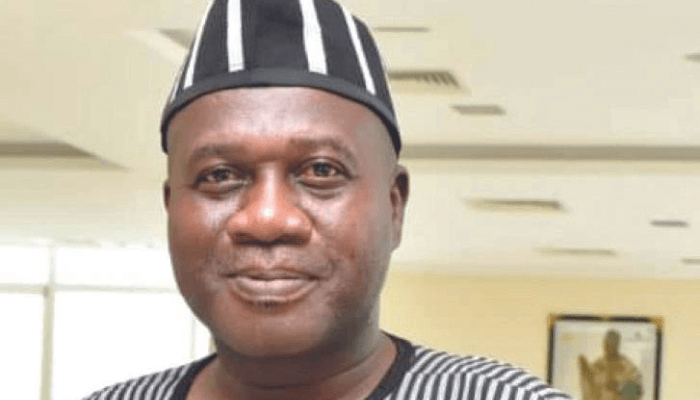
The primary elections of the two leading political parties in Ogun State have come and gone, leaving behind a political landscape charged with anticipation, calculation and consequence. On the platform of the People’s Democratic Party, Ladi Adebutu, the familiar and perennial contender, has once again emerged, although the lingering factional disagreements within his party – and the question of whether his candidacy will ultimately receive the full imprimatur of INEC – remain matters of speculation.
On the platform of the All Progressives Congress, Senator Solomon Olamilekan Adeola, popularly known as Yayi, has secured the ticket.
On the platform of the All Progressives Congress, Senator Solomon Olamilekan Adeola, popularly known as Yayi, has secured the ticket. Naturally, all eyes are now on him.
But this moment must not be reduced to personalities, slogans or partisan triumphalism. It is bigger than ambition. It is about the destiny of Ogun State. It is about whether the developmental compass already set under Governor Dapo Abiodun’s ISEYA agenda – Infrastructure, Social Welfare, Education, Youth Empowerment and Agriculture – can be refined, expanded and elevated into a durable roadmap for inclusive prosperity.
It is about whether governance in Ogun will continue as a relay race, where one administration hands the baton to another in good faith, or whether the state will once again be dragged into the familiar Nigerian tragedy of policy summersaults, abandoned projects and wasted public investments.
For Yayi, the challenge is even more profound. His steady strides and visible dividends of democracy to the people of Ogun West in particular – and across the other two senatorial zones – have heightened public expectation. He has come to represent, for many, the possibility of long-awaited political justice, infrastructural balance and purposeful development. Having raised hope, he cannot afford to let down the people.
Ogun West expects inclusion. Ogun Central expects consolidation. Ogun East expects continuity and expansion. Ogun State, as a whole, expects leadership that is bold, competent, fair and future-facing. That is the real burden of this moment.
Ogun State has never been short of ideas, intellect or ambition. It has always been a crucible of policy innovation and enlightened public engagement. From Chief Obafemi Awolowo’s audacious free education policy in the 1950s to the industrial corridors that today bind Lagos and Ogun in a powerful economic embrace, the state has consistently demonstrated that sub-national governance can be a theatre of transformation.
The people of Ogun do not merely want administration; they demand vision. They do not applaud motion without movement. They expect planning, execution, accountability and continuity. They understand development when they see it, and they lampoon drift when they experience it. Ogun people are that sophisticated.
When Governor Dapo Abiodun introduced the ISEYA framework in 2019, it was not meant to be a campaign chant. He had already been voted into office. It was conceived as a diagnostic and developmental instrument to address Ogun’s structural vulnerabilities: weak rural-urban connectivity, deficits in human capital, youth unemployment, gaps in social protection, and an agricultural sector that had not yet fully delivered its potential.
In conception, ISEYA was pragmatic. In implementation, it gave governance a coherent direction. In its successes, it demonstrated that progress is possible when policy is anchored on clear priorities. And in its unfinished components, it has revealed the next frontier of transformation.
Therefore, as Ogun approaches another political cycle, the question should not be whether ISEYA worked. It did. The more important question is: how can it be deepened, institutionalised and made irreversible?
The next administration must move ISEYA from a governing philosophy to a codified state development architecture – backed by legislation, funded through realistic budgeting, measured through verifiable performance indicators, and protected from the whims of political transition.
Ogun needs not a demolition of the past, but a disciplined improvement upon it. Governance is not about reinventing the wheel every four or eight years. It is about honouring institutional memory, completing viable projects, discarding waste, adapting old ideas to new realities and ensuring that public money already spent does not become a monument to abandoned ambition.
There are, indeed, many unfinished chapters. To mention a few: a film village on the Lagos-Ogun border was once envisioned to harness the creative power of Nollywood, attract investment, generate employment and position Ogun as a major player in Nigeria’s creative economy. It was one of Prince Dapo Abiodun’s early policy declarations. The idea remains sound. In an era where the creative industry is no longer entertainment alone but a serious economic sector involving technology, tourism, fashion, music, film, logistics and digital distribution, Ogun cannot afford to sleep on such an opportunity.
The film village should be revived, but not as a ceremonial project. It should be reconceptualised as a full creative economy hub: studios, post-production facilities, animation labs, training schools, equipment leasing centres, performance spaces, hotels, digital content incubators and tourism linkages. Properly designed, it can create thousands of direct and indirect jobs for young people.
Similarly, on May 24, 2021, Governor Abiodun and Governor Babajide Sanwo-Olu of Lagos State signed a Memorandum of Understanding to establish the Lagos-Ogun Joint Development Commission. That agreement recognised a basic truth: Lagos and Ogun are no longer separate economic islands. Their roads, industries, labour markets, housing demands, transport networks and environmental challenges are deeply interconnected.
People live in Ogun and work in Lagos. Factories operate in Ogun and serve Lagos. Lagos congestion spills into Ogun. Ogun’s expansion relieves Lagos. The two states share a destiny that must be planned, not improvised.
The Lagos-Ogun Joint Development Commission must, therefore, be reactivated with seriousness and urgency. It should not remain a document in government archives. It should become a functional institution for joint planning in transportation, rail connectivity, road infrastructure, water systems, waste management, industrial zoning, border communities, security, housing and climate resilience.
If properly implemented, the commission can transform areas such as Mowe, Ibafo, Arepo, Akute, Alagbole, Ota, Agbara and the entire Lagos-Ogun border corridor into organised economic zones rather than chaotic settlements struggling under the weight of unplanned growth.