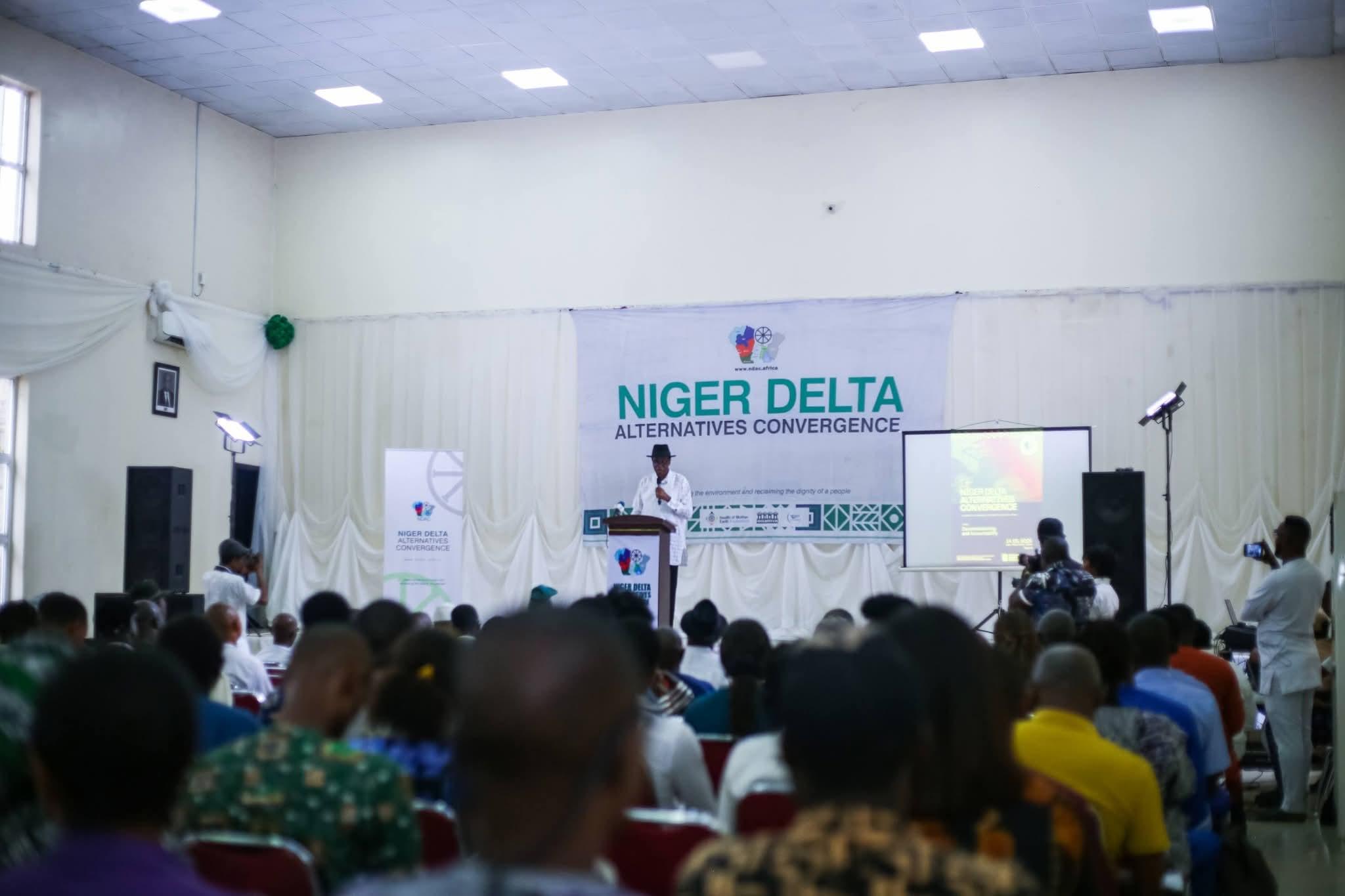
Civil society groups, labour unions, environmental activists and community leaders from across the Niger Delta have demanded the immediate publication of payments made into oil and gas decommissioning and abandonment funds, accusing regulators and oil companies of operating opaque accountability systems.
- +Niger Delta groups demand audit of abandoned oil wells
The demand formed part of resolutions reached at the end of the 5th Niger Delta Alternatives Convergence (NDAC) held on Thursday in Uyo, Akwa Ibom State, under the theme: “Decommissioning and Accountability.”
The demand formed part of resolutions reached at the end of the 5th Niger Delta Alternatives Convergence (NDAC) held on Thursday in Uyo, Akwa Ibom State, under the theme: “Decommissioning and Accountability.”
The participants also called for a comprehensive audit of all abandoned oil wells and petroleum infrastructure in the Niger Delta, alongside urgent remediation and ecological restoration of polluted communities.
In a communiqué issued at the end of the meeting, the stakeholders said every abandoned and leaking oil well in the region should be treated as a “crime scene” because of the continued danger posed to communities and the environment.
The convergence was convened by the Health of Mother Earth Foundation in collaboration with civil society organisations, labour groups, researchers, environmental experts, women and youth groups, and traditional institutions across the nine states of the Niger Delta.
Participants expressed concern over what they described as decades of environmental devastation caused by oil exploration activities and the failure of both regulators and operators to enforce decommissioning obligations after the end of oil production.
They cited incidents including the abandoned wells in Otuabagi, Bayelsa State, the 2007 eruption at the Shell Petroleum Development Company well, Ibibio-1 well, in Ikot Abasi Local Government Area of Akwa Ibom State, the Ororo-1 well fire in Ondo State which has reportedly been burning since 2020, and the Alakiri wellhead fire in Rivers State, ongoing since 2024.
According to the communiqué, these incidents expose the “persistent failure” of operators and regulators to take responsibility for abandoned facilities and implement urgent remedial measures.
The stakeholders criticised the Nigerian Upstream Petroleum Regulatory Commission and the Nigerian Midstream and Downstream Petroleum Regulatory Authority, accusing both agencies of weak oversight and poor enforcement of environmental accountability frameworks.
They also faulted the failure of oil companies and the Nigerian government to disclose payments made into decommissioning and abandonment funds in the annual reports of the Nigeria Extractive Industries Transparency Initiative (NEITI).
Section 233 of the Petroleum Industry Act (PIA) 2021 provides for the establishment of the Decommissioning and Abandonment Fund, a dedicated fund to be held in an escrow account by a financial institution not affiliated with the oil and gas company.
“Immediate identification, audit, and public disclosure of all abandoned oil and gas wells and facilities across the Niger Delta region” was among the key demands contained in the communiqué.
The stakeholders further demanded immediate cleanup, remediation, restoration and reparations for polluted communities affected by oil extraction and abandoned facilities.
They also called for amendments to the PIA to strengthen environmental responsibility provisions, decommissioning obligations and corporate accountability.
According to the communiqué, the current provisions of the PIA do not adequately protect host communities or guarantee accountability for environmental destruction.
The participants accused multinational oil companies of exploiting regulatory loopholes and corporate restructuring arrangements to evade environmental liabilities through asset divestments.
They said domestic firms acquiring divested oil assets should also be held accountable for environmental damage from such facilities.
“The federal government should make public specific details of divestment deals, especially the liabilities inherited by domestic companies,” the communiqué stated.
The convergence also demanded increased participation of host communities, women, youth and indigenous groups in environmental governance and decision-making processes.
Participants further asked the National Assembly to review the PIA to centre community perspectives in decommissioning and abandonment processes.
They argued that communities are currently excluded from meaningful engagement under Nigeria’s decommissioning and abandonment regulations.
The groups warned that climate change impacts, including flooding, displacement, food insecurity and loss of livelihoods, are worsening the vulnerability of Niger Delta communities already affected by decades of environmental degradation.
They also criticised the management of the Ecological Fund and other intervention mechanisms, alleging that resources meant to address environmental crises in the Niger Delta have not reached grassroots communities most affected by pollution.
The communiqué, however, commended the Akwa Ibom State Government for indicating readiness to partner with NDAC on decommissioning measures and urged other Niger Delta states to adopt similar commitments.