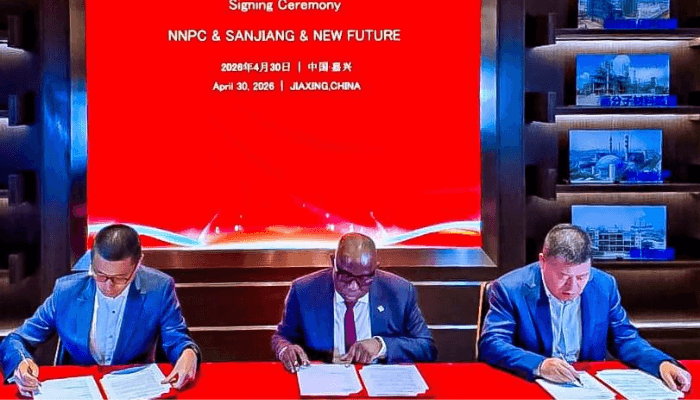
The Nigerian Petroleum Company (NNPC) Limited’s recent move to enlist Chinese firms to rehabilitate the Warri and Port Harcourt refineries has sparked debate among energy experts, with many questioning the deal’s commercial viability and the state-owned oil firm’s track record.
- +Economics, visibility concerns trail NNPC/China refineries deal
The deal, structured as a Technical Equity Partnership (TEP) with Sanjiang Chemical Company Limited and Xingcheng Industrial Park, aims to restart and expand the long-dormant facilities.
The deal, structured as a Technical Equity Partnership (TEP) with Sanjiang Chemical Company Limited and Xingcheng Industrial Park, aims to restart and expand the long-dormant facilities. However, stakeholders are divided on whether this represents a sustainable financing model or another addition to the “N11 trillion rehabilitation money pit.”
Speaking with BusinessDay, Kelvin Emmanuel, managing partner at Dairy Hills, noted that the refineries’ outdated machinery, which he said limits the crack spread to just 20 percent.
He added that with a margin of at least 40 percent to 45 percent required to reach the break-even point, the project remains commercially unviable.
Emmanuel stressed that these facilities lack the complexity of modern plants, as they were originally constructed with only secondary distillation capabilities rather than the full-scale processing power required today.
“So, your crack spread is not more than 20 percent. What exactly are you doing? Now they are telling you they are bringing Chinese. The crack spread for that refinery, because of how old the machines are, cannot be more than 20 percent. For you to break even, you need crack spread at least above 40 percent, 45 percent to break even. Those refineries were actually built with secondary distillation.
“So, NNPC has a history of making terrible decisions, and this one is not an exception. The same NNPC that fought against the sale of Kaduna Refinery to the same Chinese in 2006. They fought against the sale of the Kaduna Refinery. The Chinese wanted to build an export pipeline from the Niger Republic to Kaduna because they figured that it’s safer for them to have a crude export pipeline supplying crude from the Niger Republic to Kaduna than from the Niger Delta to Kaduna.
“So, it’s like an anomaly, and it’s confusing that we are bringing the same Chinese back exactly 20 years after they fought against the Chinese taking up the Kaduna Refinery. Maybe if they had allowed them then, they would have figured it out,” he said.
Also speaking on the issue, Ayodele Oni, an energy lawyer, said that while the proposed technical and equity hybrid model could be advantageous, the lack of specific details in the agreement and the government’s track record of expensive, unsuccessful refinery repairs render the deal vulnerable to corruption without the urgent implementation of clear transparency measures and robust protections.
He said that the legacy of abandoned projects and persistent allegations of graft justifies the public’s scepticism regarding the sincerity and potential success of this latest initiative; its true impact remains to be seen.
“The new arrangement, structured as part technical/ part equity, can be an opportunity if structured transparently with enforceable governance and oversight. As currently framed (blank-slate MoU plus a history of failed, costly state rehabilitation), it presents significant corruption risk unless immediate transparency and strong safeguards are imposed. Also, there is a history of failure and strong suspicion of corruption so everyone is well within their rights to be doubtful of the success and genuineness of current efforts. Only time will tell, ultimately,” he said.
This also aligns with the stand of former President Olusegun Obasanjo, who in a television interview said that the refineries could never operate optimally.
He said, “One of the lessons that I learnt is that PPP (public-private partnership) works. Look, one project that has not been destroyed by the government in Nigeria is the NLNG (Nigeria Liquefied Natural Gas), where the private sector has 51 per cent, and the Nigerian government has 49 percent.
“See what we did with Nigerian railways. See what we did with the national shipping company. See what we are doing now, even with the NNPC. The NNPC has refineries, and I said to people that it will never work. And a man dared to say, ‘Am I a chemical engineer?’
“Look, when I was there, I called Shell. I said, ‘Look, please, I beg you, come and take 10 per cent equity and run the refinery for us.’ They said no. I said, ‘Okay, if you don’t want to take equity, don’t take equity. Come and run the refineries.’ They said no,” he stated.
The former president narrated how he invited a top official of Shell for a one-on-one conversation to know why his offers were turned down.
“So, I called him, and I said, ‘Tell me, be honest with me. Why don’t you want to handle this?’ He said first, they want to let me know that they make most of their profits on the upstream, not the downstream.
“Number two: he said our refineries are too small. This was when I was an elected President. He said our refineries are too small. One is 60,000 barrels, and another is 100,000 barrels. He said refineries at that time were in the range of 250,000 barrels to 300,000 barrels. Number three: he said our refineries are not well-maintained. We call quacks and amateurs to come and maintain our refineries. The refineries are not in good order. He said, ‘Number four, there’s too much corruption around our refineries, and they don’t want to be part of that,’” Obasanjo explained.
However, Ken Ife, a development economist, suggests that the deal may signal a departure from the debt-heavy models of the past. He notes that the arrangement appears to be an asset-based financing structure via a Special Purpose Vehicle (SPV), shielded from the federal government’s balance sheet.
Ife explained that should the Chinese firms utilise state-backed funding for this investment, the internal consequences for failure in their home country would be severe. He, however, stressed that the immediate priority for Nigeria remains to understand the specific, granular terms of the current agreement.
He said, “It will not be a financial liability to the federal government. That’s what I understand. It’s not like we are going to be funding it. That’s the whole idea, because the new Group Managing Director made it clear that that thing is a drain on federal resources. I’m sure they will be looking for asset-based financing rather than debt-based financing. Rather than borrowing 3.5 billion, they borrowed and sank it, and nothing happened.
“They will bring partners that will bring the funding, and then do it, and then run it. That was the plan we understood at the beginning, but you never know how they will complete it. If that is what they did, then it’s good news because those assets cannot just go to waste like that,” Ife said.