Beyond Football: How missing the World Cup reflects Nigeria’s structural governance crisis
- +Strategic Investment & Policy Alignment
- +Macroeconomic Outlook and Institutional Reform
- +Reaffirming Commitment to National Development
Nigeria’s consecutive failures to qualify for major global sporting spectacles are not mere athletic slumps, but direct symptoms of institutional governance deficits, severe human capital underinvestment, and compounding national insecurity.
Nigeria’s consecutive failures to qualify for major global sporting spectacles are not mere athletic slumps, but direct symptoms of institutional governance deficits, severe human capital underinvestment, and compounding national insecurity.
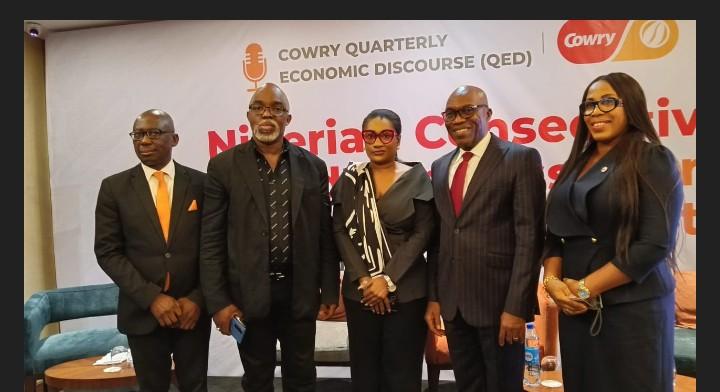
This was the consensus reached by economists, financial analysts, public policy experts, and sports administrators who gathered in Lagos for the Cowry Asset Management Quarterly Economic Discourse, themed “Nigeria’s Consecutive Worsening World Cup Misses and Worsening Insecurity: The Economic Performance Nexus.”
Panelists concluded that Nigeria’s failure to qualify for major international sporting events is not an isolated athletic slump, but a direct reflection of structural governance deficits, underinvestment in human capital, and compounding insecurity across the country.
In his opening address, Johnson Chukwu, Managing Director of Cowry Asset Management, underscored that sports must be viewed as an economic driver—capable of driving job creation, entrepreneurship, and youth empowerment—rather than mere entertainment.
“Development is not a happenstance,” Chukwu stated. “Countries that attain sustainable development deliberately nurture their human capital from childhood, investing in education, skill acquisition, and talent development long before the results become visible.”
Chukwu highlighted a stark contrast in national resource management: while Nigeria failed to qualify for the World Cup, 16 players of Nigerian descent competed under the flags of nine other nations.
He noted that while competing nations restructure immediately after major tournaments to prepare for future cycles, Nigeria’s lack of deliberate, long-term planning leaves its 240-million-strong population—42 percent of whom are youth—economically underutilized.
He further identified widespread insecurity (ranging from banditry and terrorism to kidnapping and pipeline vandalism) as a severe drag on national competitiveness that drives brain drain and deters local and foreign direct investment.
Strategic Investment & Policy Alignment
Amaju Pinnick, Former President of the Nigeria Football Federation (NFF), reinforced the economic interplay between sports and national policy, pointing to global models in England and Morocco where intentional state support yields massive economic returns.
Pinnick noted that while Nigeria’s education sector ranks 112th globally, its sports sector ranks 26th—demonstrating massive untapped economic potential.
He urged stronger public-private partnerships, noting that the national team’s successful 2018 World Cup campaign was driven by player confidence, structural support, and strategic brand partnerships with global names like Nike and Adidas.
Macroeconomic Outlook and Institutional Reform
Addressing broader economic indicators, Chinwe Egwim, Nigerian Economist and Banker, noted recent exchange rate stability and strong performances in the stock market (ranking 4th globally), but urged the government to direct policy support toward productive sectors such as agriculture, manufacturing, real estate, and the creative economy.
On his part, Bongo Adi, Economist and Data Analyst, highlighted how severe infrastructure gaps, high operational costs, and non-state “taxation” (extortion that bypasses public coffers) stifle business productivity.
While Dakuku Peterside, Public Policy Expert, delivered a sharp assessment of the structural issues: “Football is a reflection of everything right and wrong with our nation.
There are no long-term plans, no systems, no structures. Our failure in football is not a coincidence, but a mirror of everything wrong at home.” Peterside emphasized that Nigeria requires enduring institutions capable of outlasting individual political administrations.
Reaffirming Commitment to National Development
Through its Quarterly Economic Discourse, Cowry Asset Management continues to provide a strategic platform for evidence-based discussions on investment, governance, and macroeconomic policy.
The institution remains dedicated to fostering dialogues that encourage policy reforms capable of enhancing Nigeria’s global competitiveness and creating sustainable, long-term value for investors and the broader economy.