SPECIAL REPORT: The secrecy, unanswered questions about Akwa Ibom Assembly’s N15.47bn project
On a sunny Thursday afternoon in June in Uyo, silence hung over the Akwa Ibom State House of Assembly complex, which ought to be under rehabilitation.
On a sunny Thursday afternoon in June in Uyo, silence hung over the Akwa Ibom State House of Assembly complex, which ought to be under rehabilitation.
The legislative headquarters of one of Nigeria’s richest oil-producing states, with a revenue of N2.53 trillion in 32 months, should have been buzzing with engineers, artisans and construction workers.
Instead, only eight security personnel were visible inside the sprawling premises.
There were no labourers, masons, welders, carpenters, engineers and no sounds of construction.
At the entrance gate, a notice informed visitors that both the Akwa Ibom State House of Assembly and the Akwa Ibom House of Assembly Service Commission had temporarily relocated their offices to Luton Park Hotel, Uyo, owned by a former state lawmaker, pending the completion of rehabilitation works at the complex.
The sign served as a reminder that for more than seven months, the state’s legislature and its administrative machinery have operated away from their permanent headquarters.
What stood before PREMIUM TIMES at the assembly complex was an eerily quiet complex at the centre of a multi-billion-naira rehabilitation project that has already displaced lawmakers from their chambers, triggered political controversy and raised fresh questions about transparency, procurement and the independence of the legislature.
Budget documents reviewed by PREMIUM TIMES show that between 2025 and 2026, the Akwa Ibom State Government approved a total of N15.47 billion for the rehabilitation and remodelling of the assembly complex.
Yet more than seven months after legislative and administrative activities were relocated to pave the way for the project, the complex remains unfinished.
The delay has changed what began as a renovation exercise into a test of public accountability.
The rehabilitation project gained attention after Governor Umo Eno visited the assembly complex on 1 July 2024 and publicly expressed concern about its condition, promising to ensure its rehabilitation.
In the revised 2025 budget, N2.95 billion was provided for architectural design, construction of a multi-purpose hall, reroofing, replacement of ceilings, tiling and painting of the Assembly complex.
By 2026, the scope had expanded.
Budget documents show provisions for reroofing, ceiling replacement, extensive tiling, painting, structural remodelling, decking, and construction of new office buildings, office finishing, woodwork, cabinets, library facilities, marble flooring, parking lots and installation of an electric security perimeter fence. The allocation for these works totalled N12.52 billion.
Combined with the 2025 provision, the project attracted a total budgetary allocation of N15.47 billion within two years.
The lawmakers have been conducting plenary sessions at a facility within the Government House, Uyo, for months, pending the completion of the renovation.
That arrangement recently sparked controversy after lawmakers and security operatives clashed over access procedures at the Government House.
PREMIUM TIMES reported that the disagreement disrupted legislative proceedings and forced the assembly to suspend sitting on 2 June.
The current state of the project contrasts with assurances given before work commenced.
In a circular dated 24 October 2025, referenced AKHA/ADM/087/225, the Clerk of the House, NsikakAbasi Orok, directed lawmakers, assembly staff and other occupants to vacate the complex ahead of rehabilitation works scheduled to begin on 27 October.
Before the relocation, the Akwa Ibom House of Assembly Services Committee met with representatives of the contractor to discuss implementation plans.
According to reports of the meeting reviewed by PREMIUM TIMES, the contractor’s representative, Ochemba Lee, described the project as a comprehensive overhaul of the Assembly complex.
Mr Lee informed lawmakers that the contractor had already been mobilised and that equipment had been deployed to the site. He announced a completion period of six months.
That timeline expired in April 2026, while the lawmakers remain displaced.
More than seven months after the relocation order took effect, a notice posted at the assembly gate still directs visitors to temporary offices at Luton Park Hotel, underscoring the prolonged displacement of both lawmakers and the assembly bureaucracy from the complex.
The prolonged relocation also raises questions about the cost to taxpayers. While government officials did not disclose the terms of the arrangement with the hotel, the continued use of the private facility as a temporary administrative headquarters for the legislature and the Assembly Service Commission is likely attracting significant public expenditure.
PREMIUM TIMES requested details of the arrangement, including its cost implications, but received no response before this report was filed.
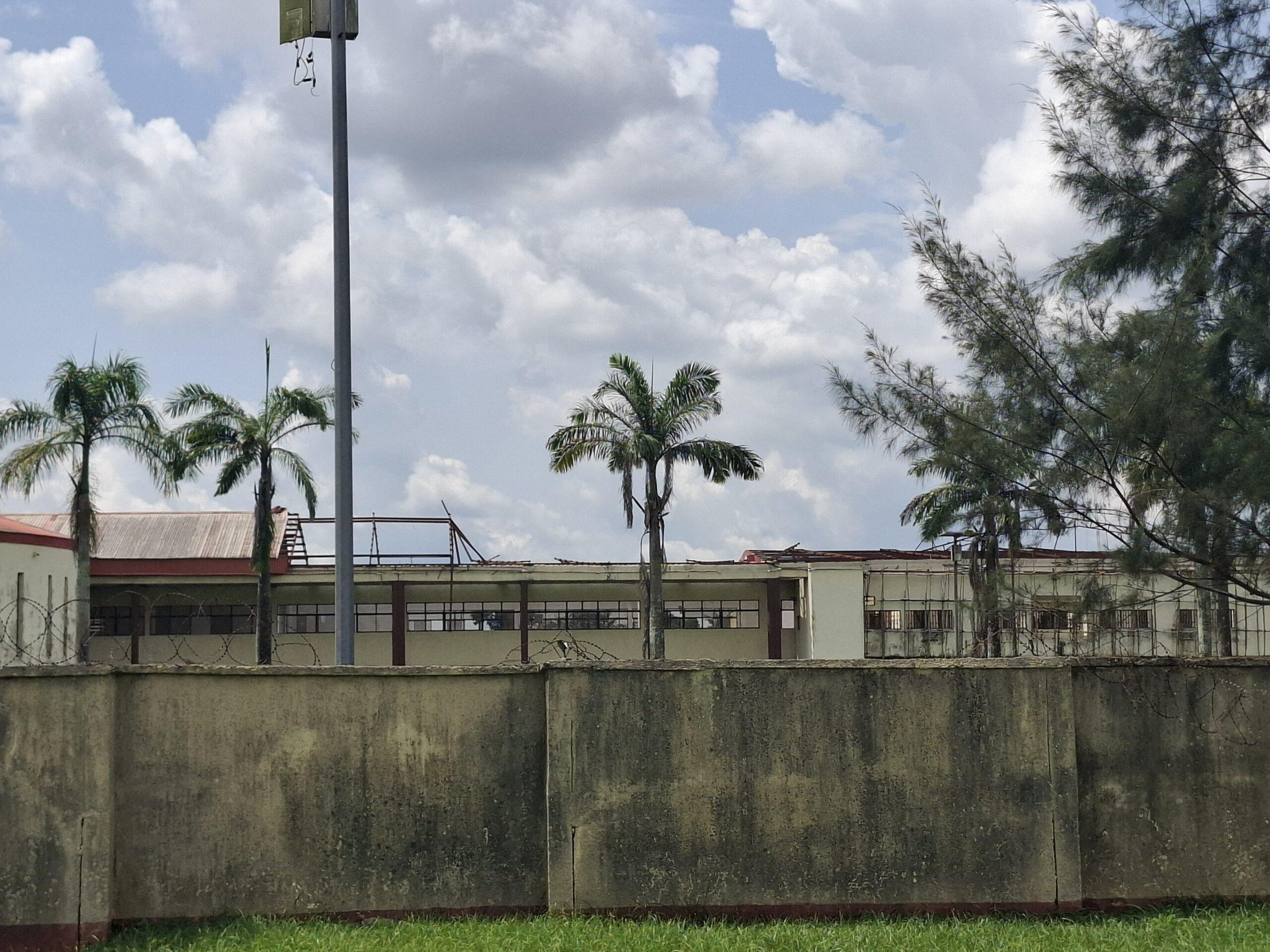
A visit to the assembly complex on 4 June revealed little visible evidence of substantial progress. A large section of the roof covering parts of the reception area and offices had been removed.
The assembly’s chambers appeared largely untouched. The most visible ongoing work was a parapet roof structure around part of the entrance section.
The only major equipment sighted was a mobile crane and a concrete mixer. No construction work was taking place during the visit.
Security personnel stationed at the facility told PREMIUM TIMES that contractors had not been actively working on the site for more than three months.
Residents and business operators around the assembly complex gave similar accounts.
One resident who requested anonymity said workers were last seen consistently at the site between February and March.
“The workers only came to remove the roof. They brought a concrete mixer and worked on the parapet at the entrance for about four days before leaving. We kept hearing them complain that funding was the problem and that was why work was not steady,” the resident said.
PREMIUM TIMES could not independently verify the claim.
The contractor’s identity has also caused confusion.
The October 2025 relocation circular identified the contractor as JDP Construction Nigeria Limited. Yet the project signage at the assembly complex names CLAD Construction Nigeria Limited as the contractor. Also, it was the representatives of CLAD Construction who appeared before the House Services Committee to brief lawmakers about the project.
The discrepancy remains unexplained. The confusion is particularly significant because the state’s procurement law requires greater transparency.
Section 54(5) of the Akwa Ibom State Public Procurement Law, Volume V, Cap 122 of the laws of Akwa Ibom State 2022 mandates the Bureau of Public Procurement and procuring entities to routinely publish procurement information on the state’s electronic procurement portal.