'OCD made me think I was a monster'
- +Warning: This article discusses distressing themes
Every day, mother-of-three Sarah imagines her perfectly healthy young children are going to die in a car crash or fall fatally ill.
Every day, mother-of-three Sarah imagines her perfectly healthy young children are going to die in a car crash or fall fatally ill.
Distressing images thunder into her head uninvited, whirling around and around until she feels like she is drowning in them.
"I get severely depressed because no one wants to think of their children dying," she says, of the intrusive thoughts that routinely shatter the joys of family life.
"It's something [most people] won't think of. Whereas I think it every single day because my brain won't let me think of anything else."
The 34-year-old, from Redditch, Worcestershire, is one of around 750,000 people in the UK who suffer from Obsessive Compulsive Disorder, or OCD.
It is ranked by the World Health Organisation as one of the top 10 most debilitating illnesses and can form such a grip on an individual that it controls their entire life.
The overwhelming public perception of OCD is that it is an obsession with cleaning, tidying and symmetry, a fastidiousness seen in characters like Monica Geller from Friends.
But the reality is far more complex, with sufferers experiencing obsessive thoughts and compulsive behaviour they have no control over.
Obsessive, intrusive thoughts can paralyse sufferers with anxiety, fear, disgust or shame - and many will not realise the images they are experiencing in their head are due to OCD.
Compulsions are the repetitive acts that can be mental or physical that the individual feels compelled to do to temporarily relieve the stress of obsessions.
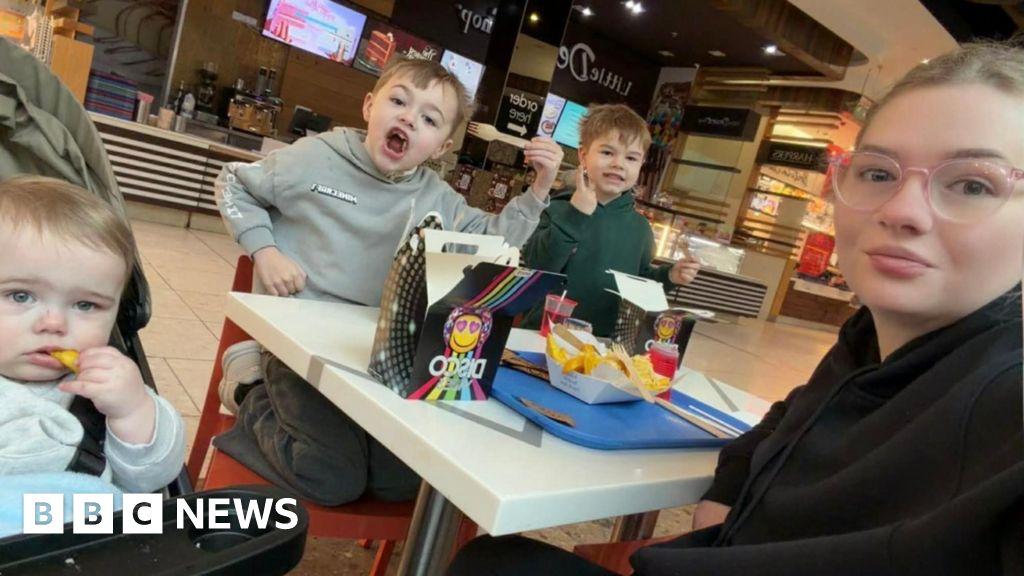
This is partly why Sarah decided to homeschool her children - by knowing she could see them all the time, the images of them being fatally injured or catching a terrible disease were diminished somewhat.
The intrusive thoughts of OCD, often called Pure-O or Pure OCD, are sometimes so insidious and about taboo subjects that sufferers do not admit to experiencing them.
But five people living with the condition spoke to the BBC about their ordeals, which left them feeling like they were going mad or like monsters.
All say awareness is vital so that those who may not realise they have OCD can go and seek help.
Sarah first began experiencing intrusive thoughts after the birth of her second son in early 2020.
Out of nowhere she began to imagine her family would die if they left the house, that food she was eating was poisoned or aeroplanes would fall out of the sky.
Her time with her new baby became eclipsed by the darkness of the developing condition.
"I feel awful thinking about it now, but there was a time where I'd just look at him and [think] I don't want you here," she says.
She now knows she was suffering from postnatal OCD and it flared up again when she had her third son.
This time the obsessions had the opposite effect.
"The love for my baby went into full-on overdrive. I wouldn't let anyone hold him or go near him – even my husband struggled to bond with his own child because of these thoughts that he's safest with me."
In the grip of her illness, Sarah began homeschooling her children.
When they started asking to attend mainstream school, she realised she needed to get help.
"They will go to school because that's what they want," she says.
"It had started affecting their life just as much as mine, so that's when I was like no, I need help now - like serious help."
Medication - she takes an antidepressants and anti-psychotic tablets - has helped her begin to enjoy some "normal" activities.
"It was my son's birthday in January and we went out and I actually took them to a soft play," she says.
"And I never, ever, thought I'd be able to do that."
One of the lesser-known subtypes of the condition is paedophilia OCD, also known as POCD, where sufferers are wracked with intrusive thoughts that they might secretly be sexually attracted to children.
A person, confused and distressed by unwanted images they cannot control, can be left feeling like a predator, extremely isolated and overcome with shame.
But these thoughts are known as ego-dystonic, which means they are in direct conflict with that person's beliefs and moral compass.
Molly Lambert, 22 and from Manchester, campaigns on TikTok to raise awareness after experiencing it as a teenager.
After thinking a young girl's outfit in an airport was inappropriate, she started to ruminate over why those beliefs appeared in the first place.
Within a year, she was consumed by intrusive thoughts that she was attracted to children.
"Every second of every day I was worrying about being a paedophile," Lambert says.
"It ricocheted from that thought to - would I hurt someone? Am I attracted to my family members? Or dogs – I don't even like dogs."
The number of 16-24 year olds in England reporting symptoms of OCD has more than tripled in a decade, so speaking out on TikTok is important for her.
"I thought [I'd have to] either confess these thoughts to my family, maybe the police talk to me, or I kill myself," she says.
"Looking back, that terrifies me. That's why I do all the advocacy on TikTok – I'm thinking about the people going through that."
Lambert eventually told her family what she had been battling and had therapy.
"I spoke out loud for the first time about paedophilic OCD. I cried and cried and cried," she says.
"[The counsellor] said this is completely normal, it happens all the time. More than you think."
Lambert has also highlighted something called the groinal response on her videos.
Also known as arousal non concordance, it means a person may feel sensations in their genitals as a result of increased blood flow, as sufferers feel anxiety at intrusive thoughts that distress them.
It may cause some to believe they are genuinely aroused by the thoughts they are having, when in fact they are repulsed by them.
Julie, 54 and from East Sussex, says living with the condition was "pure hell".
She remembers being seriously affected by the impactful but shocking AIDS advert of the 1980s as a young girl, which led her to fear she had the disease or could be pregnant.
Obsessive thoughts have now been a part of her life for four decades, imagining people being hit by cars, or, like Molly Lambert, feeling she has the propensity to abuse a child or even be attracted to her own dog.
"It affects every minute of your life, it's not just some quirk," she says.
"The whole condition is debilitating. People take their own lives. It's a pure hell."
She said the condition had worsened while going through the menopause, amplifying her anxiety levels.
After undergoing four rounds of cognitive behavioural therapy (CBT), she is now paying for weekly private therapy and attends a support group.
One solace for her is volunteering as a search and rescue coast guard.
"It helps to know I'm helping other people," she said.