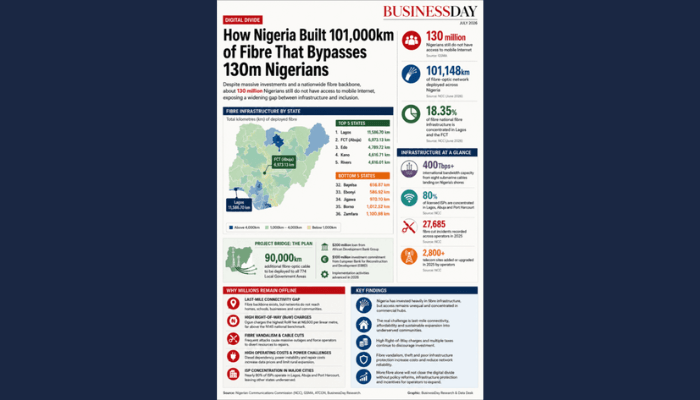
Nigeria has built one of Africa’s largest fibre-optic networks, stretching more than 101,000 kilometres across its 36 states and the Federal Capital Territory (FCT).
- +How Nigeria built 101,000km of fibre that bypasses 130m Nigerians
It has welcomed eight international submarine cables carrying more than 400 terabits of internet capacity to its shores.
It has welcomed eight international submarine cables carrying more than 400 terabits of internet capacity to its shores. Telecom operators invested more than N2.5 trillion in network expansion last year alone.
Yet about 130 million Nigerians still do not have access to mobile internet, according to a new report by the GSMA, exposing a striking disconnect between massive infrastructure investment and meaningful digital inclusion.
The figures point to a deeper structural problem. While Nigeria has spent years expanding broadband backbone infrastructure, much of that capacity remains concentrated in a handful of commercial centres, leaving millions of people in smaller cities and rural communities disconnected from the digital economy.
State-by-state infrastructure data released by the Nigerian Communications Commission (NCC) shows Nigeria has deployed 101,148.36 kilometres of fibre nationwide. However, Lagos and the FCT alone account for 18,559.83 kilometres, or 18.35 percent of the country’s total fibre infrastructure.
Lagos remains Nigeria’s fibre capital with 11,586.70 kilometres of fibre, representing 11.46 percent of the national network. Abuja follows with 6,973.13 kilometres, or 6.89 percent.
The two cities have attracted more fibre investment than many geopolitical zones combined because they host the country’s largest concentration of banks, multinational companies, government institutions, hyperscale data centres and internet exchange points.
Behind them are Edo with 4,789.72 kilometres, Kano with 4,616.71 kilometres, Rivers with 4,616.01 kilometres, Kaduna with 4,339.85 kilometres and Ogun with 4,246.48 kilometres.
At the opposite end are Bayelsa with just 656.87 kilometres of fibre, Ebonyi with 586.92 kilometres, Jigawa with 970.10 kilometres, Borno with 1,012.52 kilometres and Zamfara with 1,100.98 kilometres.
More than a dozen states still have less than 2,000 kilometres of fibre infrastructure, limiting broadband availability, network resilience and internet quality.
The uneven spread of infrastructure has reinforced a two-speed digital economy where businesses and households in Lagos and Abuja increasingly enjoy high-capacity broadband while many communities outside major cities continue to rely on slower and less reliable mobile connections.
The imbalance comes despite growing demand for digital services driven by remote work, artificial intelligence, cloud computing, digital payments, online education and streaming services.
For Aminu Maida, executive vice chairman of the NCC, the debate is no longer about whether Nigeria needs broadband.
“We have crossed a threshold where internet connectivity is no longer a luxury or a secondary utility. It is now central to how people learn, work, trade, access services and participate in society,” he said during the Association of Telecommunications Companies of Nigeria (ATCON) forum on Fibre-to-the-Home in Lagos.
According to him, internet use in Nigeria continues to grow rapidly.
As of April 2026, Nigeria recorded 154.72 million active internet subscriptions, up from 141.99 million a year earlier. Broadband penetration also increased from 48.81 percent to 55.67 percent over the same period.
Nigerians now consume an average of about 1.4 million terabytes of internet data every month.
“The home is no longer only a place of residence. It is also becoming a place of learning, work, business, entertainment and service delivery. That is why Fibre-to-the-Home is so important. The home has become a critical access point to the digital economy,” Maida said.
Despite this growing demand, fixed broadband remains largely underdeveloped.
Nigeria has only about 265,000 active Fibre-to-the-Home subscriptions nationwide, far below the African average and significantly behind more mature broadband markets.
“This low base should not discourage us. It should focus us. It shows the scale of the opportunity before Nigeria and reinforces the need to create the right conditions for fibre infrastructure to expand more rapidly, more sustainably and more widely across the country,” Maida said.
Industry experts say Nigeria’s broadband challenge is no longer simply about building more fibre backbone.
Instead, the country faces what many describe as a last-mile problem, that is, getting existing fibre infrastructure from major transmission routes into homes, schools, hospitals, businesses and underserved communities.
Josephine Sarouk, managing director of Bayobab Nigeria, said Nigeria already has more than enough international internet capacity.
“The challenge isn’t the backbone. It is the last mile, bringing that capacity to homes, schools and small businesses. With eight submarine cables and over 400 terabits of international capacity, Nigeria has broadband abundance at the coast and scarcity inland,” she said.
The problem is particularly evident among Internet Service Providers (ISPs).
According to the NCC, nearly 80 percent of licensed ISPs remain concentrated in Lagos, Abuja and Port Harcourt despite the country’s nationwide fibre backbone.
Earlier this year, Maida admitted the imbalance was limiting competition and affordability.
“We currently have about 101,000 kilometres of fibre optic backbone, but nearly 80 percent of ISPs are concentrated in Lagos, Abuja and Port Harcourt. That must change. Our target is to ensure every state has at least two or three ISPs delivering fibre-to-the-home and fibre-to-the-business services,” he said.
He warned that relying almost entirely on mobile broadband would not support Nigeria’s long-term digital ambitions.
“Even in advanced economies, living your full digital life via mobile is expensive. Nigeria needs a strong fixed-fibre foundation to truly live digital lives in homes, schools, hospitals and public institutions.”
Industry executives argue that the economics of broadband expansion remain one of the biggest barriers.
Oyaje Idoko, founder and chief executive officer of Layer3, said operators naturally invest where returns are strongest.
“As a private investor, before we extend service to a new community, we must ask whether it is commercially viable. If a community cannot afford the service or power is unreliable, the business won’t survive,” he said.
In Lagos and Abuja, where businesses consume large volumes of data and enterprise customers pay premium prices, operators can recover investments much faster.
In many rural communities, however, lower incomes, unreliable electricity and weaker demand make expansion commercially difficult.
Operators say one of the biggest obstacles remains Right of Way (RoW) charges imposed by state governments.