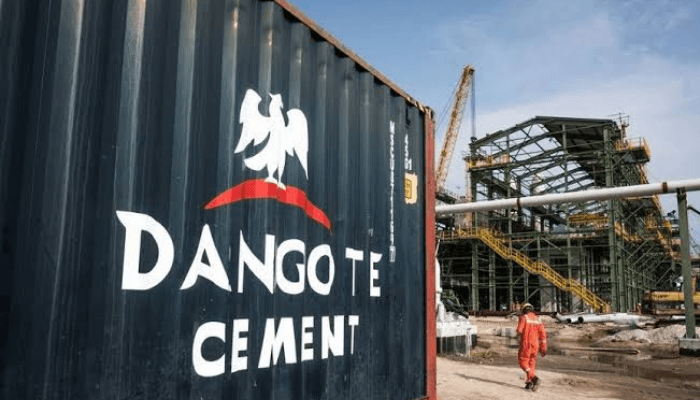
Dangote Cement Plc recorded a strong performance in the first quarter of 2026, growing its cement and clinker exports from Nigeria by 71.6 per cent, as the group’s total installed production capacity reached 55 million tonnes per annum (MTA) across Africa.
- +Dangote Cement grows exports by 71.6% in Q1 2026 as capacity hits 55MTA
Data from the cement manufacturer’s financial statement for the period ended March 31, 2026, revealed that the strong bottom-line performance was supported by higher volumes, improved pricing, and operational efficiencies as the company scaled production capacity and deepened export penetration across its markets.
Data from the cement manufacturer’s financial statement for the period ended March 31, 2026, revealed that the strong bottom-line performance was supported by higher volumes, improved pricing, and operational efficiencies as the company scaled production capacity and deepened export penetration across its markets.
According to the company’s unaudited Q1 2026 financial results, total sales volumes increased by 13.8 per cent year-on-year, driven by growth of 11.5 per cent in Nigeria and 19.5 per cent across its pan‑African operations.
For the quarter, Dangote Cement reported a profit before tax of N421.1 billion, representing a 35 per cent increase from N311.9 billion recorded in the corresponding period of 2025. Earnings per share rose to N19.14, up from N12.29, underscoring sustained value creation for shareholders.
Gross profit increased to N749.3 billion from N587.4 billion, while operating profit climbed to N506.2 billion from N397.4 billion, underscoring margin resilience despite cost pressures.
Commenting on the performance, Arvind Pathak, the group Managing Director and Chief Executive Officer of Dangote Cement Plc, said the results reflected the strength of the company’s operating model and its disciplined execution across markets.
“We have delivered an outstanding start to 2026, with revenue up 20.4 per cent year‑on‑year to N1.198 trillion, driven by a strong rebound in volumes which grew 13.8 per cent across our markets. EBITDA increased by 22.8 per cent to N567.1 billion, demonstrating the strength of our operating model, disciplined cost control, and our ability to convert growth into superior profitability,” he said.
On exports and expansion, Pathak noted the rapid scaling of Dangote Cement’s export business and progress across key growth projects.
“Our export business continues to scale rapidly, with volumes from Nigeria up 71.6 per cent and 10 clinker shipments completed in the quarter. This performance reinforces our strategic position as Africa’s leading cement exporter,” he said.
“Following the commissioning of our 3Mta grinding plant in Côte d’Ivoire, we are progressing well with our expansion projects in Itori and Ethiopia, alongside other growth initiatives across the continent. These investments will further strengthen our footprint and keep us firmly on track to reach 80Mt of production capacity by 2030.”
Looking ahead to the rest of the year, Pathak expressed confidence in the company’s growth outlook.
“We have entered the year with strong momentum and a clear strategic focus. Demand across our markets remains resilient, our expansion pipeline is delivering, and our operational discipline continues to drive margin improvement. We remain confident in sustaining this growth trajectory and in consistently delivering long‑term value to our shareholders.”
Dangote Cement is Africa’s leading cement producer, with 55.0MTA installed capacity across the continent. A fully integrated quarry‑to‑customer producer, the company operates 35.25MTA capacity in Nigeria, where its Obajana plant in Kogi State—the largest in Africa—has 16.25MTA capacity across five lines. The Ibese plant in Ogun State has 12MTA, Gboko plant in Benue State has 4MTA, while the Okpella plant in Edo State has 3MTA.
Through sustained investments, Dangote Cement has eliminated Nigeria’s reliance on imported cement and transformed the country into a net exporter of cement and clinker, supplying markets across West and Central Africa.