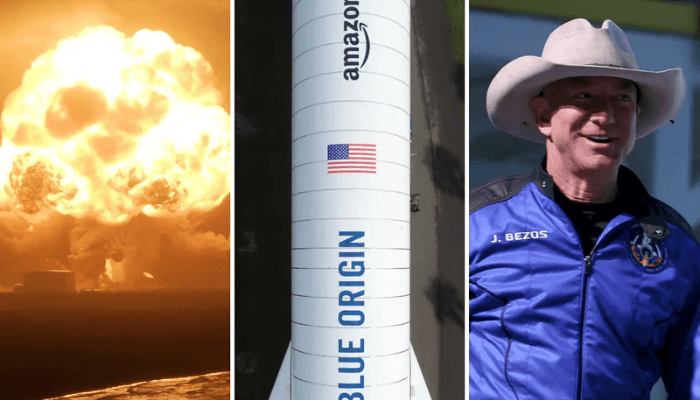
A massive explosion that lit up the skies over Florida has dealt a serious blow to Jeff Bezos’ space ambitions and raised fresh questions about whether Blue Origin can meet key NASA deadlines in the race back to the Moon.
- +Bezos’ Blue Origin rocket explosion throws NASA Moon plans into doubt
Blue Origin’s giant New Glenn rocket exploded late Thursday night during what the company described as a routine engine test at the Kennedy Space Centre in Florida, according to the BBC.
Blue Origin’s giant New Glenn rocket exploded late Thursday night during what the company described as a routine engine test at the Kennedy Space Centre in Florida, according to the BBC.
The 98 metre rocket had been preparing for a mission that would have launched 48 satellites for Amazon’s Leo broadband network as early as June 4. Instead, the test ended in a dramatic fireball that tore through the company’s launch facility at Space Launch Complex 36.
“All personnel are accounted for and safe,” Jeff Bezos wrote on X after the explosion. “Very rough day, but we’ll rebuild whatever needs rebuilding and get back to flying. It’s worth it.”
The blast, however, has created a much bigger problem than the loss of a single rocket.
The destroyed launch pad is currently the only facility capable of launching the New Glenn rocket anywhere in the world. Footage from the site showed severe damage, including one of the launch complex’s lightning towers collapsing after the explosion.
Industry analysts believe repairs and safety certification could take months, leaving Blue Origin unable to fly its most powerful rocket during a critical period for both the company and NASA.
The timing could hardly be worse.
Just days earlier, NASA administrator Jared Isaacman unveiled the first missions tied to the agency’s long term plan to establish a permanent human presence near the Moon’s south pole.
One of those missions, Moon Base 1, is scheduled for launch no earlier than autumn 2026 using Blue Origin’s Blue Moon Mark 1 “Endurance” lander. The mission is expected to deliver scientific equipment to the lunar surface and test precision landing systems needed for future astronaut missions.
That lander was supposed to launch aboard the New Glenn rocket.
Nasa also recently awarded Blue Origin a contract worth up to $468 million to deliver two lunar rovers to the Moon by 2028. Those vehicles are expected to arrive before astronauts return to the lunar surface under the Artemis programme.
The latest setback now threatens to delay several parts of NASA’s Moon strategy.
“NASA’s plan to land astronauts back on the Moon by 2028 and build a Moon base there now faces several problems that will inevitably lead to delays,” the BBC reported.
The explosion also deepens pressure on Amazon’s satellite internet ambitions.
The destroyed rocket had been expected to deploy part of Amazon’s Leo satellite constellation, previously known as Project Kuiper, which is designed to compete with Elon Musk’s Starlink network.
Amazon currently has just over 300 Leo satellites in orbit, compared with more than 10,000 Starlink satellites already operating in space.
Under rules set by the United States Federal Communications Commission, Amazon must place half of its planned 3,236 satellite network into orbit by July 30, 2026.
As of late May, the company was already more than 1,300 satellites behind schedule.
With New Glenn likely grounded for an extended period, Amazon may now become even more dependent on rival launch providers, including SpaceX, to keep the project alive.
Elon Musk reacted briefly to the explosion on X, writing: “Most unfortunate. Rockets are hard.”
The setback also reshapes the growing competition between the United States and China in the new lunar race.
China is targeting a crewed Moon landing by 2030, while NASA has been pushing to return astronauts to the lunar surface before the end of the decade through its Artemis programme.
Earlier this year, NASA launched Artemis II with four astronauts aboard the Orion spacecraft. Artemis III, currently planned for next year, is expected to test commercial lunar landers from both Blue Origin and SpaceX.
Before Thursday’s explosion, Blue Origin was widely seen as being ahead in preparations. Its lunar lander prototype was already in final assembly in Florida, while SpaceX continues working through technical challenges involving its Starship system.
Nasa administrator Jared Isaacman acknowledged the scale of the setback in a statement posted on X.
“Spaceflight is unforgiving, and developing new heavy lift launch capability is extraordinarily difficult,” he wrote.
For Blue Origin, the explosion represents not only a costly technical failure but also a major test of credibility at a time when the company is trying to prove it can compete with SpaceX in commercial launches and deep space exploration.
For Nasa, it creates fresh uncertainty around one of its most ambitious goals in decades: building a sustained human presence on the Moon.