Xenophobia Evacuations: MTN to donate cash, airtime to returnees as Imo govt promises indigenes N1m
Governor Hope Uzodimma of Imo State has approved a cash grant of N1 million each for all Imo indigenes evacuated from South Africa, while telecommunications company MTN announced a support package of N100,000 and N50,000 worth of airtime for every Nigerian repatriated in the first batch of the Federal Government’s evacuation exercise.
Governor Hope Uzodimma of Imo State has approved a cash grant of N1 million each for all Imo indigenes evacuated from South Africa, while telecommunications company MTN announced a support package of N100,000 and N50,000 worth of airtime for every Nigerian repatriated in the first batch of the Federal Government’s evacuation exercise.
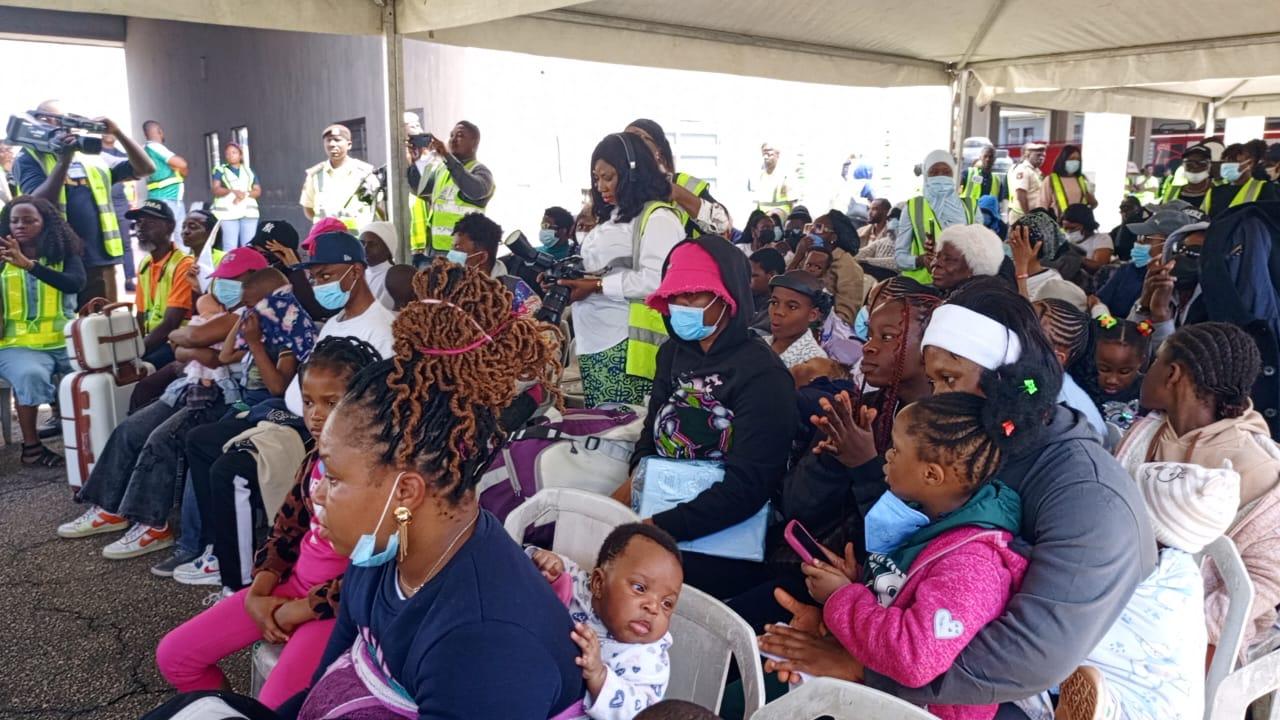
The interventions were announced on Wednesday as the first batch of 258 Nigerians evacuated from South Africa arrived at the Murtala Muhammed International Airport (Cargo Terminal), Lagos, aboard a specially chartered Air Peace flight.
The returnees, comprising men, women and children, are the first among more than 1,000 Nigerians who registered for voluntary evacuation following weeks of xenophobic attacks and anti-immigrant violence in parts of South Africa.
Officials of the Ministry of Foreign Affairs, the Nigerians in Diaspora Commission (NiDCOM) and other government agencies received the evacuees at the airport, where documentation and profiling commenced ahead of their reunion with families and enrolment in reintegration programmes.
Speaking during the reception, the Chairman/Chief Executive Officer of NiDCOM, Abike Dabiri-Erewa, announced the support package from MTN and the financial assistance approved by the Imo State governor.
“MTN is here. We have been working with them. They are going to transfer N100,000 to your accounts each, and they are also going to give N50,000 airtime each with starter packs and phones for you to use when you get home.
“National Identification Management System (NIMS) is also here. For those of you who need a National Identification Number, you can get it today.
“Secondly, Governor Hope Uzodimma said his office should get your account numbers. He will transfer N1 million each to Imo State indigenes among you,” she said.
Earlier, PREMIUM TIMES reported that Nigeria’s Acting High Commissioner to South Africa, Alexander Ajayi, described the returnees’ ordeal as traumatic but said they were relieved to be back in the country.
“I want to start by thanking the Almighty God for bringing us this far and for bringing us here safely,” Mr Ajayi said.
“The people you see here today are our fellow Nigerians who have decided to come back home to escape the irresponsible violence that has been taking place in South Africa. They are in good spirits and have been looking forward to returning home since we started this process.”
He said the 258 evacuees constitute the first batch in the ongoing repatriation exercise and commended President Bola Tinubu for personally driving the initiative.
According to him, shortly after the attacks began, the president established a direct communication channel involving the Presidency, the Ministry of Foreign Affairs and the Nigerian High Commission in Pretoria to monitor developments and coordinate the government’s response.
“From the very day the crisis started, Mr President established what we called a hotline communication between himself, the Ministry of Foreign Affairs and the mission in South Africa. Every day, he sought updates on developments and possible actions,” he said.
Mr Ajayi added that the Presidency also created a crisis monitoring unit to track developments across South Africa’s nine regions, where anti-immigrant protests spread in recent weeks.
He disclosed that President Tinubu had directed as far back as April that all Nigerians willing to return home should be evacuated.
Welcoming the returnees on behalf of the Federal Government, the Minister of State for Foreign Affairs, Ambassador Sola Enikanolaiye, acknowledged the trauma many of them experienced and assured them of government support to rebuild their lives.
“My fellow Nigerians returning home, you are most welcome,” the minister said.
“I am happy to welcome you in the name of Mr President, but at the same time I am saddened because I know the kind of trauma our people have gone through. We are very sorry that this happened.”
He said President Tinubu remained committed to creating opportunities at home so that Nigerians would travel abroad by choice rather than out of economic necessity.
Mr Enikanolaiye also disclosed that the federal government had fully paid Air Peace for the evacuation operation and commended the airline for what he described as a patriotic intervention.
He said the Federal Government, in collaboration with state governments and private sector partners, had developed support measures and incentives to assist the returnees with reintegration.
The minister said Nigeria would continue diplomatic engagement with South Africa to prevent a recurrence of attacks against Nigerians.
“We believe in diplomacy. We believe in engagement. We believe in dialogue,” he said.
Some of the returnees who spoke with PREMIUM TIMES expressed gratitude to Governor Uzodimma for the financial support, describing it as timely.
One of them, Chidebeze Okechukwu, said the N1 million grant would help him restart his life after losing everything during the attacks.
“The gesture will help me settle because I lost everything to the attack in South Africa,” he stated.
The arrival of the returnees marks the first phase of one of Africa’s largest coordinated repatriation exercises in recent years following renewed xenophobic attacks in South Africa.
The latest violence erupted in April after videos circulated online showing groups of South Africans assaulting Black foreign nationals and ordering them to leave the country, reviving concerns over recurring attacks that have strained diplomatic relations across the continent.
The unrest prompted Nigeria, Ghana, Kenya, Malawi, Zimbabwe and Mozambique to advise their citizens to avoid non-essential travel to South Africa, while several governments initiated evacuation programmes for nationals wishing to return home.
Nigeria announced plans to evacuate more than 1,000 citizens after two Nigerians, identified as Amaramiro Emmanuel and Ekpenyong Andrew, were allegedly killed in the country. Registration for voluntary evacuation was coordinated through the Nigerian High Commission in Pretoria in collaboration with South Africa’s Department of Home Affairs.
The evacuation, initially delayed by logistical challenges, eventually received presidential approval for five Air Peace flights after the number of registered Nigerians exceeded 1,000.
The latest crisis has revived memories of the deadly xenophobic attacks of 2008, 2015 and 2019, during which dozens of migrants were killed and foreign-owned businesses looted or destroyed.
Although South African President Cyril Ramaphosa has condemned the recent attacks, Nigerian authorities have expressed concern over the recurring violence, with officials pledging to intensify diplomatic engagement to ensure better protection for Nigerians living in the country.