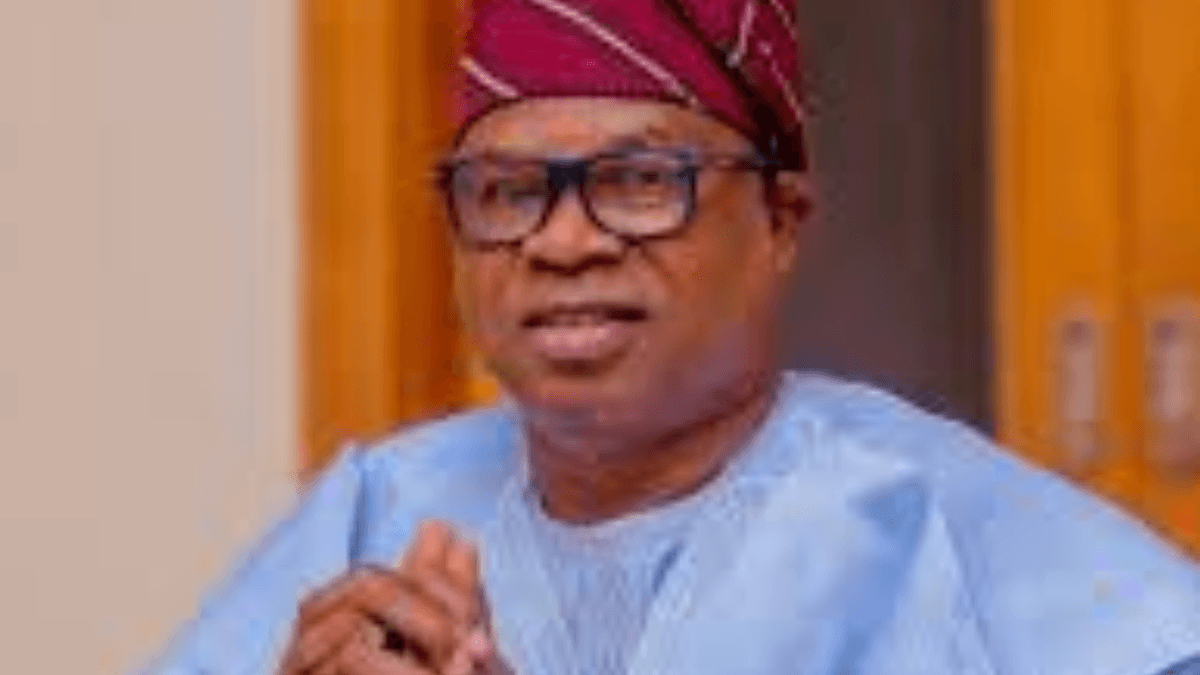
As Osun State approaches its August 15, 2026 governorship election, the conversation is gradually shifting from personality to proposition. Elections in Nigeria have long thrived on charisma, symbolism, and emotional connection. Yet, beneath that familiar terrain, there is a quieter but increasingly persistent question: who is best equipped to manage the complexities of governance in a demanding fiscal and administrative environment?
- +Structure, stability, and statecraft: Why Oyebamiji fits Osun’s next chapter
- +A different kind of political profile
- +From state to national exposure
In this evolving context, Bola Oyebamiji’s candidacy represents a distinct offering—one that prioritises structure over spectacle, systems over spontaneity, and long-term stability over short-term political theatre.
In this evolving context, Bola Oyebamiji’s candidacy represents a distinct offering—one that prioritises structure over spectacle, systems over spontaneity, and long-term stability over short-term political theatre.
It is not an argument rooted in dismissal of his opponent, Governor Ademola Adeleke, whose grassroots appeal and retail political strength remain formidable. Rather, it is an argument about fit: the alignment between Osun’s present needs and Oyebamiji’s particular strengths.
A different kind of political profile
Oyebamiji’s trajectory does not follow the familiar arc of Nigerian political ascendancy. There are no dramatic moments of sudden emergence or populist breakthroughs. Instead, his profile has been built incrementally, through years of engagement in both private enterprise and public administration.
With nearly three decades in the financial sector, he brings to politics a mindset shaped by discipline, risk assessment, and institutional thinking. His transition into public service, particularly as Commissioner for Finance in Osun State, did not mark a departure from those principles—it reinforced them.
At a time when Osun faced significant fiscal constraints, governance was less about expansion and more about survival. Decisions taken during that period were undeniably difficult and, in some cases, unpopular. Yet they reflected a governing philosophy anchored in sustainability rather than expediency. That distinction matters.
It would be incomplete to discuss Oyebamiji’s candidacy without acknowledging the controversies associated with his time in government, particularly the half-salary policy. That period remains a sensitive chapter in Osun’s political memory.
However, elections are not only about revisiting past decisions; they are also about interpreting them. The question is not merely what was done, but under what circumstances and with what intent.
Oyebamiji’s defenders argue that those measures were taken within a context of severe fiscal limitation, where the alternatives may have been far more damaging. The argument does not seek to erase the hardship experienced by citizens, but to frame those decisions as constrained choices rather than acts of indifference.
For voters, this introduces a more nuanced evaluation: whether difficult decisions made under pressure can be seen as evidence of capacity rather than liability.
From state to national exposure
Oyebamiji’s subsequent role at the National Inland Waterways Authority (NIWA) expanded his administrative scope beyond Osun. In that position, he engaged with issues that extend into infrastructure development, regulatory oversight, and economic diversification.
His tenure coincided with increased attention to inland waterways as viable economic corridors, alongside renewed emphasis on safety standards and institutional reform. This exposure places him within a broader governance framework, one that connects local administration to national policy and global best practices.
In political terms, such experience enhances credibility. It suggests familiarity not only with state-level challenges but also with the larger ecosystem in which those challenges exist.
One of the defining features of Oyebamiji’s candidacy is his alignment with the presidency. Within the South West’s political structure, such alignment is rarely insignificant.
It offers potential advantages in coordination, policy continuity, and access to federal resources. It also strengthens the argument for synergy between state and national governments, a factor often cited as critical for development.
At the same time, this alignment is not without its criticisms. Opponents are likely to frame it as undue influence or an attempt to shape Osun’s political direction from outside the state.
Yet this critique must contend with another reality: Oyebamiji is not an external imposition. He is deeply rooted in Osun’s political and social landscape, with longstanding ties that predate his current ambition.
The issue, therefore, is not whether he belongs, but whether his alignment enhances or complicates his ability to govern effectively.
Oyebamiji’s campaign messaging reflects his background. It emphasises productivity, accountability, and structured governance. His proposals—focused on agriculture, education, healthcare, and infrastructure—are framed within a broader narrative of efficiency and long-term planning.
This approach contrasts with more personality-driven campaigns. It asks voters to consider governance as a process rather than a performance.
Such a message can be challenging in a political culture that often rewards immediacy and visibility. However, it also aligns with a growing awareness among voters of the limitations of governance that prioritises optics over outcomes.
At its core, the argument for Oyebamiji rests on readiness.
His supporters present him as a candidate who understands the mechanics of governance, who has operated within both constrained and expansive systems, and who approaches leadership with a focus on sustainability.
This does not negate the achievements or appeal of the incumbent. Rather, it introduces a different metric for evaluation—one that prioritises administrative depth and strategic thinking.
Across Nigeria, there are subtle indications of a shift in voter expectations. While charisma and narrative remain influential, there is increasing attention to performance and delivery.
This shift is neither uniform nor complete. It coexists with traditional political dynamics. Yet it creates space for candidates whose appeal lies in competence rather than charisma alone.
Oyebamiji’s candidacy appears calibrated to this moment. It offers an alternative that speaks to governance as a structured endeavour.
Ultimately, elections are not decided by profiles alone. They are shaped by perception, organisation, and the complex interplay of voter sentiment.
Governor Adeleke retains significant advantages, including incumbency and strong grassroots connection. These are not easily discounted.
However, Oyebamiji introduces a compelling counter-narrative—one that emphasises stability, alignment, and institutional capacity.