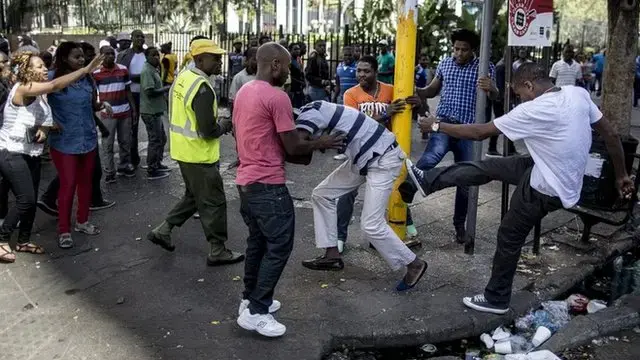
The Nigerian community in South Africa has alleged that at least 105 Nigerians have been killed in the country over the past seven years amid recurring xenophobic violence targeting migrants.
- +Xenophobia: Groups say 105 Nigerians killed in South Africa in 7 years
The claim was contained in a joint statement issued by leaders of the Nigerian Union South Africa (NUSA) and the Nigerian Citizens Association South Africa (NICASA).
The claim was contained in a joint statement issued by leaders of the Nigerian Union South Africa (NUSA) and the Nigerian Citizens Association South Africa (NICASA).
The statement was signed by Smart Nwobi and Frank Onyekwelu, who lead the two organisations respectively.
The development follows renewed attacks against Nigerians and other African nationals residing in South Africa.
In the statement, the organisations rejected a report attributed to South African Broadcasting Corporation (SABC), which cited South Africa’s Department of International Relations and Cooperation (DIRCO) as saying migrants were not being killed in the country.
The Nigerian groups argued that downplaying the concerns of migrant communities could discourage victims and witnesses from reporting abuses while weakening efforts toward justice and social cohesion.
The organisations alleged that Nigerians and other migrants have over the years been victims of xenophobic attacks, mob violence, alleged extra-judicial killings, shootings, vigilante actions, and unlawful use of force.
According to the groups, records compiled from community reports, civil society engagements, media publications, and documented incidents indicate numerous deaths involving Nigerians under troubling circumstances since 2019.
They alleged that during the xenophobic unrest that swept through Johannesburg in 2019, several Nigerian-owned businesses, shops, and vehicles were destroyed, while about 12 Nigerians reportedly lost their lives through mob attacks and related violence.
The groups further claimed that more than 17 Nigerians were killed in 2022 through violent attacks, vigilante-style executions, criminal assaults, and alleged security brutality.
In 2023, the organisations said over 40 Nigerians reportedly died in incidents linked to mob violence, alleged police misconduct, and unresolved violent encounters.
They added that about eight Nigerians allegedly died under tragic circumstances in 2024, while another eight reportedly lost their lives in 2025 through shootings, violent confrontations, and deaths in police custody.
Earlier this month, Nigeria’s Ministry of Foreign Affairs summoned South Africa’s Acting High Commissioner for diplomatic discussions following renewed concerns over xenophobic attacks targeting Nigerians.
The meeting was convened amid rising tensions within the Nigerian community after the reported killings of two Nigerians, Amaramiro Emmanuel and Ekpenyong Andrew.
The Federal Government said the diplomatic engagement was aimed at formally addressing concerns surrounding the incidents and their implications for relations between both countries.
While acknowledging that investigations were ongoing in several reported incidents, the Nigerian groups expressed concern over what they described as a lack of prosecutions, accountability, and transparent outcomes in many cases.
According to the organisations, the situation has heightened fear and mistrust among migrant communities in South Africa.
The groups stressed that their concerns were not intended to undermine South Africa’s democratic institutions or judicial system.
The organisations urged South African authorities to intensify efforts to protect all residents regardless of nationality or immigration status.
They also called for transparent investigations into reported violent attacks, deaths in custody, and alleged extra-judicial killings involving migrants.
In addition, the groups urged authorities to strengthen measures against xenophobia, vigilantism, mob justice, and unlawful conduct by individuals or security personnel.
The statement further advocated increased public education, community dialogue, and social integration programmes aimed at discouraging hatred, stereotyping, and violence against foreign nationals.
Meanwhile, Cyril Ramaphosa recently linked rising xenophobic tensions in South Africa to growing concerns over illegal immigration.
Ramaphosa warned that undocumented migration was placing pressure on jobs, public services, and social stability in vulnerable communities.
The South African president, however, condemned the recent attacks, insisting that such violence does not reflect the values or official policy of the South African government.
He added that criminal elements were exploiting socio-economic frustrations in poorer communities to fuel unrest and violence.