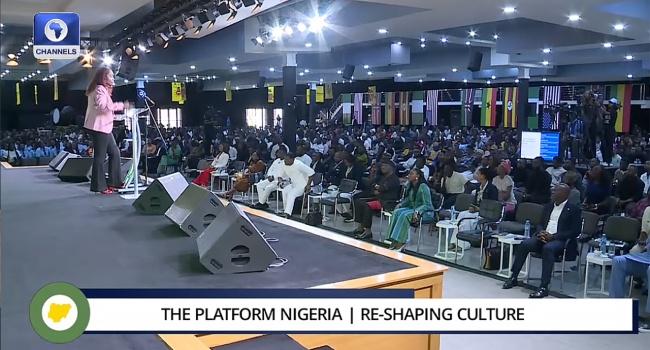
Leading business figures, policymakers, and entrepreneurs delivered a unifying message at the 2026 Workers’ Day edition of The Platform Nigeria to young Nigerians: success requires resilience, discipline, and a commitment to building value-driven enterprises.
- +Discipline, Enterprise Drive Conversations At The Platform 2026
- +Failure As Foundation, Not Setback
- +Self-Mastery, Clarity As Competitive Edge
- +Building Systems That Enable Growth
- +Bridging Divides, Building Unity
From lessons on failure to calls for self-mastery and national cohesion, speakers framed entrepreneurship as both a personal and collective responsibility.
From lessons on failure to calls for self-mastery and national cohesion, speakers framed entrepreneurship as both a personal and collective responsibility.
Failure As Foundation, Not Setback
Former Minister of Finance, Kemi Adeosun, set the tone with a candid reflection on her entrepreneurial journey, revealing that she had run nine businesses, six of which failed.
She urged aspiring entrepreneurs to see failure not as defeat but as a diagnostic tool for growth.
Adeosun warned against the misconception that entrepreneurship is the only path to success, describing such thinking as dangerous.
She outlined four key laws governing business success: the market, the numbers, the timing, and the team. According to her, even the most promising ideas must withstand these realities.
“Moses needed Aaron. Every founder needs a team,” she said.
She stressed the importance of validating demand, understanding revenue structures, and executing with speed to remain competitive.
“Do your research with wisdom. Some things are not what they seem; that is why knowing your numbers will help you,” she added, noting that preparedness and prayer remain critical to entrepreneurial readiness.
Self-Mastery, Clarity As Competitive Edge
Founder of Moniepoint Incorporated, Tosin Eniolorunda, shifted the focus inward, identifying self-mastery as the most critical factor for entrepreneurial success.
“The biggest problem of an entrepreneur is yourself, and when you conquer yourself, you conquer the world. As an entrepreneur, your biggest challenge is anxiety,” he said.
He emphasised goal-setting and clarity of purpose, cautioning against launching businesses without direction.
Eniolorunda also highlighted the importance of building structures that serve organisational goals rather than individuals.
“You need to set clear goals in your mind. You cannot set up a business that is for profit, and you do not have clarity about where you want to go,” he stated.
Addressing societal influences, he warned against glorifying quick wealth, urging young Nigerians to pursue legitimate and sustainable paths.
“Nigeria has what it takes. We are driven people, motivated people, and hardworking people. All we need to do is develop our human capital,” he added.
Building Systems That Enable Growth
Also speaking, Group Executive at Coronation Group, Ngozi Akinyele, highlighted the importance of trust, structure, and intentional leadership in driving innovation.
“Every single day, you have an opportunity to scale trust, and if you don’t scale trust, you can’t scale growth,” she said.
Akinyele stressed that organisations must deliberately design systems that support growth.
“Some organisations do not have an organisation. If you don’t have an organogram, you are simply saying you are not intentional about anybody’s growth,” she noted, likening poor structure to “asking somebody to climb a ladder when they can’t see the next rung.”
She encouraged entrepreneurs to adopt adaptability, urging them to become what she described as a “Sponge Boss.”
Enterprise As Engine For National Development Founder of Reel Fruit, Affiong Williams, argued that enterprise remains the fastest route to economic transformation across Nigeria and Africa.
She called for long-term thinking and sustainable business models capable of delivering lasting impact.
Similarly, the founder of Capital Sage Holdings, John Alamu, urged entrepreneurs to identify their core competencies, noting that execution would define future winners.
Bridging Divides, Building Unity
On the global stage, entrepreneur Vusi Thembekwayo addressed concerns over xenophobia in South Africa, challenging what he described as a misleading narrative.
“Contrary to what you see in the media, South Africans are not xenophobic,” Thembekwayo said, while acknowledging that xenophobia does exist in parts of society.
“I believe there is an agenda to turn us against each other. We fuel that agenda when we feed the noise and fire.
“I am not saying there is no xenophobia, but saying the entire nation being xenophobic is missing the point,” he added.
Declaring the event open, convener Poju Oyemade noted that The Platform, launched in 2007, has entered its 20th year.
He emphasised that true success lies in lifting others.
Held under the theme “Unlocking the Second Half Advantage: Transition, Impact and Legacy,” the event brought together influential voices to inspire a new generation of innovators and nation-builders.
Other influential builders, thinkers, and operators in Africa, who spoke directly to young Nigerians about enterprise, leadership, and the future of work, were Sinari Bolade Daranijo and Nancy Ogbue.