Why Ghana is set to become West Africa’s most inviting market for non-trading investors
- +2. Introduction of citizenship by investment (proposed framework)
- +3. Targeted requirements for trading companies
- +5. Investor Grievance Mechanism
- +∙Evidence of change in company name (if applicable); and
- +7. Mandatory registration for foreign participation
Ghana has taken a significant step towards improving its investment climate with the passage of the Ghana Investment Promotion Authority (GIPA) Bill, 2025, which seeks to repeal the Ghana Investment Promotion Centre Act, 2013 (Act 865). As of 28 April, 2026, this Bill was awaiting the President’s assent.
Ghana has taken a significant step towards improving its investment climate with the passage of the Ghana Investment Promotion Authority (GIPA) Bill, 2025, which seeks to repeal the Ghana Investment Promotion Centre Act, 2013 (Act 865).
The new framework establishes the Ghana Investment Promotion Authority (replacing the Ghana Investment Promotion Centre) as the central body responsible for promoting, facilitating, and regulating investments into and within Ghana. More broadly, the reforms are aimed at creating a more transparent, predictable, and investor-friendly environment.
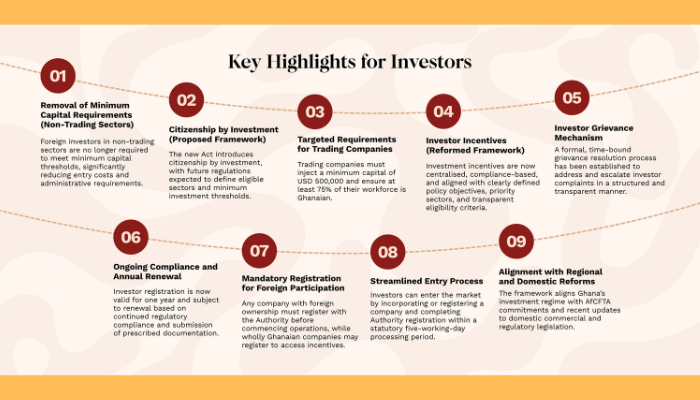
One of the most significant reforms is the removal of minimum foreign capital requirements for most sectors.
Previously, foreign investors were required to inject a prescribed minimum equity contribution (often involving opening cedi and forex bank accounts and obtaining a Bank of Ghana equity confirmation letter). This requirement has now been eliminated for non- trading businesses, substantially reducing the cost and administrative burden of market entry.
2. Introduction of citizenship by investment (proposed framework)
The Act introduces the concept of citizenship by investment. Further legislation is expected to prescribe the qualifying thresholds and sectors. Investment size is expected to be a key determining factor.
3. Targeted requirements for trading companies
For trading companies, the minimum capital requirements have been retained but reduced.
For companies engaged in trading activities (i.e. the purchase and resale of goods in the same or substantially the same condition), the minimum capital requirement is now USD 500,000 (reduced from USD 1 million); and at least 75% of employees must be Ghanaian.
This reflects a more balanced approach, protecting local participation in retail and trading while opening up other sectors.
Under the old regime (Act 865), incentives were broadly automatic and tied to general tax, VAT, and customs laws, with additional exemptions requiring case-by-case applications through the Centre and ministerial approval. Strategic incentives were also negotiated individually, leading to a more discretionary and less streamlined process. In contrast, the new framework centralises and simplifies incentives by moving away from generally automatic entitlements under multiple tax and customs statutes towards a more structured, purpose-driven system, where incentives are expressly tied to specific statutory and policy objectives and must be applied strictly within their authorised scope, making eligibility expressly conditional on registration and continued compliance with the Authority, with loss of benefits where an enterprise fails to register or renew its registration, streamlining tax incentives into industry-specific or programme-specific measures granted through regulations made by the Minister in consultation with the authority, rather than dispersed reliance on multiple tax and customs laws anchoring strategic investment incentives in Cabinet-determined priority areas that must be publicly disclosed together with clear criteria, thereby improving transparency, predictability, and upfront investor guidance.
5. Investor Grievance Mechanism
The new framework mandates the Authority to provide a structured process for the receipt, review, and resolution of investment-related complaints by enterprises in Ghana. The process is designed to be time-bound, cooperative, and administrative in nature, with defined escalation limits and reporting obligations.
Under the old investment regime, registration with the Authority was valid for two(2) years however, under the new regime, registration with the Authority is valid for one (1) year and is subject to renewal upon expiry, contingent upon the applicant’s continued compliance with all applicable requirements stipulated by the Authority.
The following documents are required to process the renewal:
∙Evidence of payment of the prescribed renewal fee;
∙The most recent Pay As You Earn (PAYE) schedule;
∙Evidence of change in company name (if applicable); and
∙Updated company profile reflecting current particulars (if applicable).
7. Mandatory registration for foreign participation
Companies with any level of foreign participation are required to register with the Authority prior to commencing operations in Ghana. Sector-specific licences and approvals will typically follow after this registration.
Wholly Ghanaian-owned companies are also encouraged to register to access available incentives and benefits.
The registration process remains straightforward:
∙Incorporate a company in Ghana under the Companies Act, 2019 (Act 992), or register an external company (branch); and
∙Register with the Authority before commencing operations.
Notably, the Authority is required to process and complete registrations within five (5) working days of receiving a complete application.
9. Alignment with regional and domestic reforms The new framework responds to developments such as Ghana’s participation in the African Continental Free Trade Area (AfCFTA) and updates to key domestic legislation.
The new regime significantly lowers barriers to entry, particularly for foreign investors in non-trading sectors. By removing capital requirements and simplifying the registration process, Ghana positions itself as a more accessible and competitive investment destination in the region.