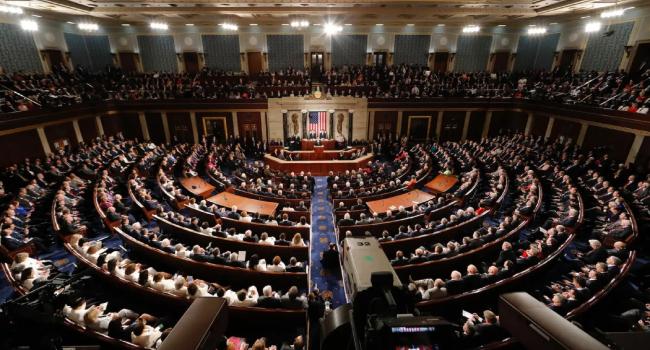
The US House of Representatives is poised to reject a bipartisan resolution aimed at curbing President Donald Trump's authority to wage war against Iran, a move that has sparked fierce criticism over the administration's handling of the conflict without congressional approval.
- +US House Expected to Reject Bid to Curb Trump's Iran War Powers
According to sources, lawmakers are due to vote on the measure, led by Republican Thomas Massie and Democrat Ro Khanna, which would require Trump to obtain congressional authorisation before continuing military operations against Tehran.
According to sources, lawmakers are due to vote on the measure, led by Republican Thomas Massie and Democrat Ro Khanna, which would require Trump to obtain congressional authorisation before continuing military operations against Tehran. However, the resolution is widely expected to fail, following a similar effort by the Senate that was rejected yesterday.
The vote comes less than a week after the United States and Israel launched a sweeping military campaign against Iran, targeting missile facilities, naval assets, and other infrastructure. The strikes have already claimed the lives of senior Iranian leaders, including Supreme Leader Ayatollah Ali Khamenei, and triggered retaliatory attacks across the region. Furthermore, six US servicemembers have been killed in retaliatory strikes, including on a US base in Kuwait, intensifying pressure on lawmakers to weigh in on a war that Congress has not explicitly authorised.
Democrats have argued that the administration has offered shifting explanations for the strikes and has failed to demonstrate that Iran posed an imminent threat requiring immediate military action. "Senate Republicans had their chance to do something that would have been overwhelmingly popular: to say no to Trump's war," said Chuck Schumer, the leader of the Senate's Democratic minority, in a floor speech yesterday. "Instead, they enthusiastically said yes, and now they own this war with Iran just as much as Donald Trump does."
Under the US Constitution, only Congress has the power to declare war. The 1973 War Powers Resolution, passed after the Vietnam War, was intended to prevent presidents from committing US forces to prolonged conflicts without congressional consent. The House resolution invokes this law, directing the president to withdraw US forces from "unauthorised hostilities" involving Iran unless lawmakers explicitly approve the operation.
However, Republican leaders have rallied behind Trump, arguing that limiting his authority during an ongoing military campaign would embolden Iran and endanger US troops. "I think passage of a war powers resolution right now would be a terrible, dangerous idea... It would empower our enemies," said House Republican Speaker Mike Johnson. "It would kneecap our own forces, and it would take the ability of the US military and the commander in chief away in completing this critical mission to keep everybody safe."
Despite the expected rejection of the resolution, lawmakers are under increasing pressure to assert their constitutional role in overseeing the conflict. "Under our Constitution, the power to initiate war rests solely with Congress," said Massie, one of the few Republicans willing to break with the administration. "Congress owes our service members a clearly defined mission, so that when they accomplish it, they can come home."
The outcome of the vote will have significant implications for the conflict, with some analysts warning that a veto by Trump could lead to a prolonged and bloody stalemate. Even if the resolution were to pass, Trump's ability to override it with a two-thirds majority in both chambers is highly unlikely in the current Congress. As the situation continues to unfold, one thing is clear: the US House's decision will have far-reaching consequences for the future of US-Iran relations and the role of Congress in shaping America's foreign policy.