When Bola Tinubu, president of Africa’s most populous country, appointed Taiwo Oyedele as Nigeria’s new Minister of Finance and Coordinating Minister for the Economy, the immediate reaction focused on tax.
- +Nigeria’s new finance minister and the illusion of the first 100 days
That is understandable.
That is understandable. Oyedele built his reputation as one of Nigeria’s best-known voices on tax reform and fiscal modernisation. But viewing his appointment through that narrow lens misses the larger challenge.
The bigger mistake would be to judge him by what many political systems now fetishise: the first 100 days.
The phrase still carries symbolic power, borrowed from Franklin D. Roosevelt’s burst of legislative action during the Great Depression. But modern economies do not move at Rooseveltian speed. Inflation does not collapse in three months. Growth does not surge on command. Debt burdens do not disappear because a minister takes office.
For a finance minister in today’s Nigeria, the first 100 days are not about delivering miracles. They are about establishing whether the country now has a serious fiscal steward.
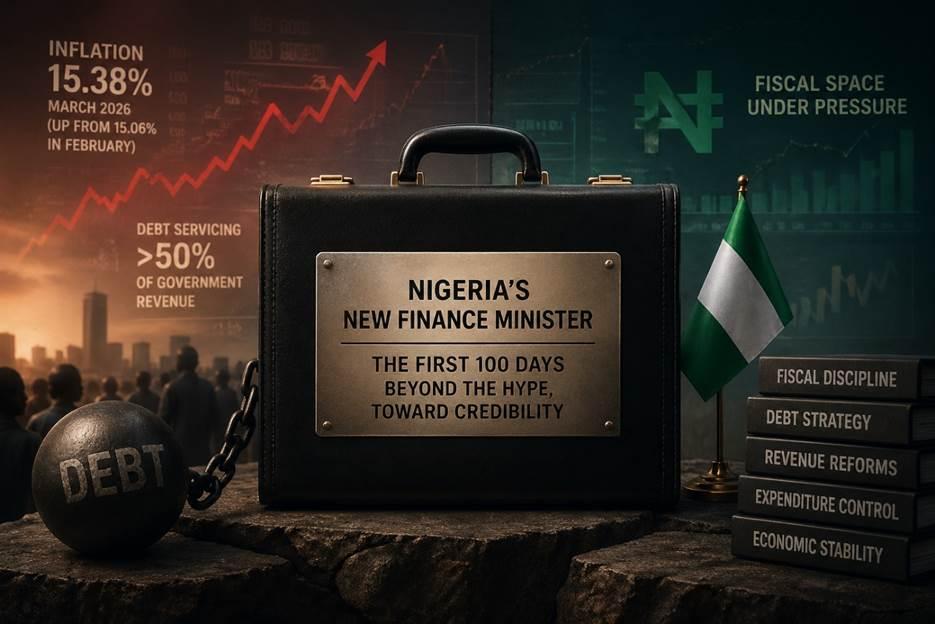
Nigeria’s economy enters this transition with limited room for error. Inflation rose to 15.38 percent in March 2026, up from 15.06 percent in February, according to the National Bureau of Statistics, ending an 11-month disinflation trend.
At the same time, debt servicing continues to absorb well over 50 percent of government revenue in recent periods, leaving limited fiscal space for investment and social spending. Revenue remains weak relative to the size of the economy. Reforms in fuel subsidies and foreign exchange have improved policy direction, but they have also imposed visible social strain.
In such an environment, markets, businesses and households are not looking for instant transformation. They are looking for signals.
The most important question in Oyedele’s early months is not how much growth he produces, but whether he can convince investors, institutions and citizens that Nigeria has a coherent fiscal strategy.
That means showing discipline on spending, realism on borrowing and seriousness on reform.
Faruq Quadri, economist at SPEC-Matrix, said the early test for the minister would be whether policy becomes more predictable. “In a fragile environment, credibility can improve sentiment before hard indicators improve,” he said.
Nigeria’s fiscal debate often defaults to taxation. Yet the more immediate challenge may be expenditure quality. Without stronger control over waste, leakages and recurrent costs, higher revenues can disappear into an inefficient system.
Michael Ariyibi, public sector economist at Password Professional, said revenue reforms without spending discipline would offer only temporary relief. “Nigeria’s fiscal challenge is not just how much comes in, but how effectively public money is used,” he said.
His first tests, therefore, are likely to be less dramatic than headline writers expect: tighter budget controls, clearer expenditure priorities, and more transparent use of public funds.
These actions may not excite the public. But they are the building blocks of confidence.
Nigeria’s debt stock is often debated, but the more pressing concern is debt affordability.
Servicing obligations consumes resources that could otherwise support infrastructure, health or education. That makes borrowing strategy as important as borrowing size.
The early signal investors will watch is whether the government intends to keep relying on debt to bridge structural weaknesses, or whether it plans to shift gradually toward earning more and borrowing less.
That means lengthening maturities, improving the domestic-external mix, and coordinating more clearly with debt managers.
Idris Oyekan, a capital market analyst, said investors would focus less on rhetoric than on whether fiscal policy reduces uncertainty. “Markets price direction early, not perfection,” he said.
Abdulsallam Sheriff, corporate and alternative investment analyst, said the structure of borrowing would matter as much as headline debt levels. “Cost, tenor and refinancing risk are now central to fiscal sustainability,” he said.
No single move changes the picture overnight. But direction matters quickly.
Oyedele’s background gives him an advantage few predecessors had: technical credibility on taxation.
Yet tax policy in office is not the same as tax policy in theory.
Nigeria does not only suffer from low tax collection. It also struggles with compliance burdens, fragmented administration and weak trust between citizens and the state. Raising pressure without improving service delivery would deepen resistance rather than expand the base.
His comparative advantage, then, may lie less in imposing new taxes than in simplifying systems, improving collection efficiency and reducing friction between taxpayers and authorities.
That is slower work than announcing new levies. It is also more durable.
The first months of any finance minister can be most dangerous not because too little happens, but because too much happens badly.
Poorly designed budgets, unrealistic deficit assumptions, mixed messages with the central bank, or politically convenient giveaways can damage credibility faster than reforms can rebuild it.
Nigeria’s recent policy gains remain fragile. The new minister’s first responsibility may be to avoid squandering them.
Economic reform is never purely technical. It is political management under constraint.
That means using early months to build alliances across government, prepare the public for trade-offs, and sequence reforms carefully enough to survive resistance.
Political analysts at NES said the first 100 days would matter less for economic outcomes than for managing expectations. Public tolerance for reform, they noted, often depends on whether citizens believe sacrifice is temporary and fairly shared.
Households under pressure are unlikely to reward abstract macroeconomic gains. They need evidence that sacrifice has direction, fairness and an endpoint.
That is why communication matters as much as spreadsheets.
Nigeria should not expect a growth boom in 100 days. It should not expect inflation to vanish. It should not expect structural transformation by the next quarter.
The right tests are simpler. Has the new minister established credibility? Has he clarified priorities? Has he shown respect for economic constraints? Has he reduced uncertainty?
If the answer is yes, the foundations of progress may already be in place long before headline statistics improve.
The temptation to define Taiwo Oyedele by tax expertise is understandable. But the office he now occupies demands more than technical skill in one field.
It requires balancing austerity and growth, borrowing and reform, politics and discipline.
The first 100 days will not determine Nigeria’s future. But they may reveal whether its new finance minister understands the real job.