Across Nigeria, unregulated investment channels promise high returns, collect millions through personal accounts, then vanish, leaving victims with heavy losses. In this report, BusinessDay Investigations exposes how these platforms recruit investors, exploit gaps in verification and transaction monitoring, and disappear without a trace, leaving victims with mounting losses and little recourse. SODIQ OJUROUNGBE writes.
- +Retail investors lose billions to fake investment schemes
- +The property shares that vanished
When Chukwu Okafor (not real name) received a Telegram message from a woman who introduced herself as Chioma Adebayo, nothing about the opening exchange sounded like fraud.
When Chukwu Okafor (not real name) received a Telegram message from a woman who introduced herself as Chioma Adebayo, nothing about the opening exchange sounded like fraud. The tone was welcoming and formal.
She claimed to operate a closed, VIP betting system powered by paid analytics, gaming algorithms, and insider knowledge of match outcomes.
Adebayo claimed she could convert a modest investment into millions of naira within hours. The returns were tempting and were backed with screenshots of past winnings and testimonials from ‘other clients’ inside a private Telegram channel.
For Okafor, though the invitation looked risky, he was assured a refund plus 30 per cent compensation if anything went wrong.
When Okafor agreed to proceed, he was presented with three investment tiers. The lowest option required N76,000 and promised a minimum return of N1.44 million within hours.
Okafor chose the lowest plan and paid N76,000 into a Moniepoint account number 9033991676, with the name, Kizito Chikamnele Olabisi, expecting N1.44 million in return.
Days after, he was told his earnings had risen to over N10 million. But to withdraw the money, he had to pay N250,000 naira for verification. Okafor made another payment, this time into a different account held with Guaranty Trust Bank, account number 0449784925, registered under the name Nwanna Emmanuel Kosisochukwu.
After the verification payment, the supposed winnings increased again, this time to N12.8 million. But instead of a payout, another barrier appeared. Adebayo told him that an additional N600,000 had to be paid as a tax charge through a so-called “National Tax Service” before the funds could be legally released, however, such an agency does not exist in Nigeria.
“It was that time that I started growing suspicious of the investment scheme, but she kept insisting I had to pay the money before my returns would be processed,” Okafor said.
Each payment came with bigger promises, but no payout. The winnings kept rising, and so did the demands. When Okafor questioned the process and revealed he was a journalist, the tone changed, the response stopped, but the money never came. A Real Estate Investment scam
The property shares that vanished
She was familiar with online investing and the capital market boom. Her husband used Risevest to buy dollar assets, including property. What stood out was the promise of fast weekly payouts instead of long-term growth.
Adepokiki searched the name Emaar and found Emaar Properties, a well-known real estate company in Dubai, United Arab Emirates (UAE). Seeing the name gave her confidence. The Telegram group repeatedly mentioned Emaar projects and shared messages about high profits. Large investments were promised returns of up to 50 percent per week. Members were urged to invest more to earn more.
After signing up, she was asked to pay into a private Kuda account to secure her slot. She questioned it, but was told it would make transactions faster.
At first, she was able to withdraw money twice. That built her trust. Encouraged by group messages, she invested more, including the returns from the initial investment.
That was when the withdrawals stopped. Her dashboard still showed a balance, but when she clicked to withdraw, nothing happened. Messages sent in the group went unanswered. Eventually, the group’s coordinator’s Telegram account disappeared, and the group itself went silent.
What appeared to be a structured property investment scheme was, in reality, a hoax. It used a respected company’s name to gain confidence, delivered small early payouts to build trust, and collected money through personal accounts before vanishing without a trace.
“It looked legitimate because the name was real. That’s what convinced me. But the real company had nothing to do with it. By the time I realised that, the group was gone,” she told BusinessDay Investigations.
Like Adepokiki’s experience, BusinessDay found that many Telegram-based investment groups misappropriate corporate brand names, promise unusually high returns in short periods, collect payments through personal and fintech accounts, and disappear once enough capital has been extracted from unsuspecting victims.
An investigation by this Newspaper into illegal investment operations on Telegram and Facebook showed that the experiences of Okafor and Adepokiki are not isolated incidents but part of a well-rehearsed operational framework used by fraudsters.
More than 10 victims who have lost millions of naira in such a scheme told our correspondent how they came across the investment, mostly through Telegram platforms.
Many told BusinessDay that by the time they realised what had happened, the administrators’ profiles had vanished, group chats were locked, and payment accounts were no longer active.
They lamented that attempts to recover funds through banks often yielded little success because transfers were authorised voluntarily, even if under deception.
Following complaints and patterns identified from these cases, BusinessDay Investigations conducted a review of online investment platforms targeting Nigerians.
Our correspondent used keyword searches such as ‘investment platform’ and ‘daily earnings’ and observed public groups and pages, documenting screenshots, links, and activity strictly from publicly available content.
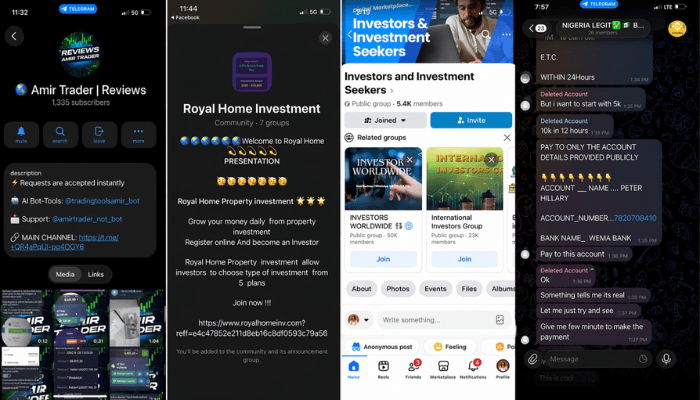
One of the platforms operated under the name Dubai Investment Fund, also referred to as Amir Trade. On the Telegram group, our correspondent observed that an administrator known as Amir frequently posted updates and recruitment messages.
New members were guided through pinned onboarding instructions, giving the platform a structured, almost corporate appearance.
It was discovered that the scheme relied on referral links within Telegram channels to attract participants. Promises included high returns and rapid profits, while deposits were collected via direct bank transfers. Some red flags found included repetitive testimonials using similar language and posts that emphasised urgency, pushing participants to make high minimum deposits to accumulate large sums quickly. Some of the fake telegram accounts