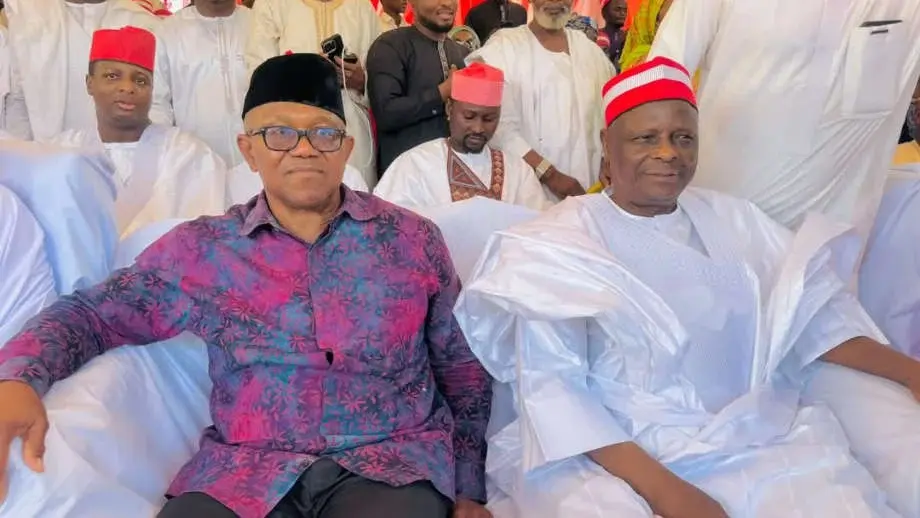
Fresh cracks have emerged within the OK Movement, a political support platform established to mobilise backing for the joint ticket of the presidential candidate of the Nigeria Democratic Congress, Peter Obi, and former Kano Governor Rabiu Kwankwaso, following a bitter leadership tussle that has triggered accusations, counter-accusations and competing claims to the group’s leadership.
- +Power tussle rocks Obi, Kwankwaso campaign teams
The crisis escalated after the movement announced the appointment of former Inter-Party Advisory Council Chairman, Peter Ameh, as its National Director-General in a statement signed by Jackie Wayas.
The crisis escalated after the movement announced the appointment of former Inter-Party Advisory Council Chairman, Peter Ameh, as its National Director-General in a statement signed by Jackie Wayas.
Wayas, who identified herself as the National Convener of the movement, said the decision followed a meeting of its steering committee.
The former Deputy National Publicity Secretary of the African Democratic Congress added that Ameh’s appointment was unanimously approved because of his political experience and commitment to the ideals of the movement.
However, within hours of the announcement, the statement generated controversy after several members questioned Wayas’ authority to describe herself as the national convener of the movement.
Repeated efforts by The PUNCH to obtain clarification from Wayas on when and how she assumed the position were unsuccessful, as calls and messages sent to her were not returned as of the time of filing this report.
The controversy soon exposed a wider leadership dispute within the movement.
Speaking with our correspondent, the immediate past National Publicity Secretary of the movement, Justin Ijeh, acknowledged that disagreements existed but insisted they should be resolved internally rather than through the media.
He said, “There’s a reason I have not spoken up on this issue. I believe some things should be resolved behind the scenes. The primary target for me is that we must achieve our aim at the polls. I spoke to all the parties concerned about my concerns.
“It’s okay to fight. If you’re not fighting, you’re probably lying to yourselves. It’s not the worst thing that there are differences, but to let them come out into the public space is a big no-no for me.
“My principle on it is that we should not be discussing this thing in the public domain. People will always speculate and talk.
“As I said, these are issues that we need to go behind the scenes and resolve. We cannot be fighting a civil war when we have external aggression to deal with.
“The fact that this matter has come out makes it look larger than what it is because people are now talking about it.
“The truth is that it’s an internal dispute over how things are being done. People have different opinions, and then it goes into the mix. It’s not so much about secrecy.
“It’s about not allowing it to be detrimental to the larger cause. For me, the mission is to win elections.”
Continuing, Ijeh said differences were inevitable in political organisations and warned that allowing them to play out publicly could undermine the movement’s broader objective of winning elections.
According to him, he had stepped aside as spokesman pending the resolution of the dispute, noting that competing claims to the office of the Director-General had complicated the situation.
“I have told all parties that I cannot be the spokesperson anymore until they resolve issues. Tell me, when two persons declared themselves DG of an organisation, what do you do?
“I cannot even deny the fact that I know the Jackie Wayas you are talking about. She is also one of us,” he noted.
The movement’s Director-General, John Ughulu, however, dismissed Ijeh as a sacked official and accused the rival faction of attempting to hijack the organisation.
Ughulu maintained that the former spokesman no longer had the authority to speak for the organisation, adding that he had long been relieved of his position.
He said, “No, Justin has been sacked long ago. He belongs to the other group. I had relieved all of them of their responsibility for us to move forward.
“Their ideology is different from what I brought on board. Look, I want everybody to focus beyond the 2027 election, if by God’s grace, Peter Obi wins.”
Ughulu traced the origin of the movement to discussions aimed at creating a broader coalition capable of bringing together supporters of Obi and Kwankwaso under one umbrella without dissolving their existing political identities.
He disclosed that the arrangement was conceived as a long-term political platform rather than one that would automatically dissolve after the next election cycle.
“There was an initial agreement between the two candidates, Obi and Kwankwaso, that this OK Movement would not be relinquished. It would still have to campaign for him in 2031 if he decides to come out for the presidential position. I was a signatory to that.
“So when this latest internal conflict came up, Obi pleaded with me. He said, John, please, I beg you. Do not go to press. Do not say anything,” he said.
Ughulu accused rival members of attempting to take over the movement.
He also defended his decision to separate the leadership of the Obidients from that of the OK Movement, saying overlapping structures would create conflicts.
“The mistake I made was that when they were appointing leaders for me, I was in America, trying to establish the OK Movement in London. Then Justin was brought in as our publicity secretary. I knew he worked for the Obidient Movement.
“Obi himself had given the warning not to mix the two,” he said.
Ughulu further claimed that Obi had previously expressed concern over the absence of a formal leadership structure within the Obidient Movement.
He alleged that he had proposed different leadership arrangements before Yunusa Tanko eventually emerged in an acting capacity.
The Ok Movement DG also narrated disagreements involving prominent members of the movement and defended his role in building the coalition.
According to him, attempts had been made to portray him as someone working against Obi’s political interests.
Ughulu insisted that the OK Movement was conceived to broaden Obi’s support base beyond the Obidient Movement.
In his analysis, the movement was inspired by consultations with several political leaders, including former President Olusegun Obasanjo, the Secretary General of Afenifere and former DG of Obi-Datti Presidential Campaign Council, Akin Osuntokun.
He added that the name “OK Movement” was deliberately chosen to attract supporters outside the traditional Obidient base.
“There are people who so much love and want to support Peter Obi who are not Obidient members. If we decide to stick only to that, other associations and political parties will not want to associate with you.
“So, that was how we settled for the name, OK Movement,” he said.
He also defended his decision to disengage Ijeh.