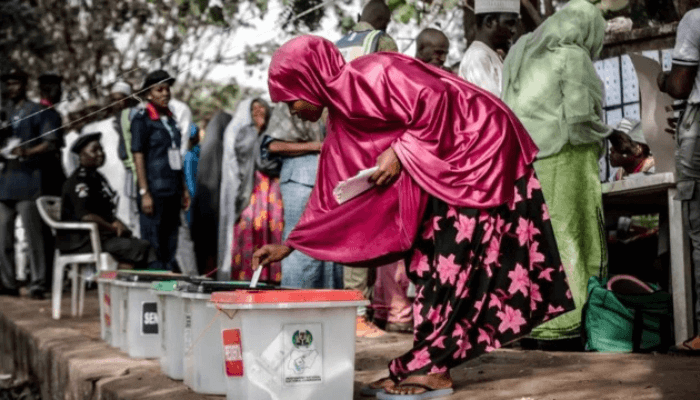
Millions of Nigerians abroad collectively send more money home than the country earns from foreign direct investment – yet they have no say in who governs the nation, even as their remittances help keep the country afloat, while several African countries allow their citizens abroad to vote. Oluwatobi Odeyinka writes.
- +Diaspora Nigerians shut out of voting despite yearly $21bn remittances
- +Diaspora remittance dwarfs FDI, rivals total tax revenue
- +Abike Dabiri’s unfulfilled dream, and Abass’s unfinished business
52-year-old Uchenna Pricilla ordered her teenage daughter to turn off the TV or change the channel as the news flash of another schoolchildren abduction in Nigeria appeared on their screen.
52-year-old Uchenna Pricilla ordered her teenage daughter to turn off the TV or change the channel as the news flash of another schoolchildren abduction in Nigeria appeared on their screen.
Pricillia, her husband and their two children moved to Canada 10 years ago for economic reasons.
In 2015, the family sold their only house in Lagos and moved to Ontario, where they both got employment and are now residents, but the stories coming out of Nigeria have been troubling for her.
“We like to follow Nigerian news, but the daily bad news from the country is making me depressed, especially because we are hoping to go back home, but to what? Insecurity?” she told this reporter.
Pricilla follows Nigeria’s political activities and yearns for an opportunity to make an input through voting. She said she has been disappointed by recent electoral outcomes and believes that her vote and those of other Nigerians abroad could have made the difference. But weak legislation have persistently dashed her hopes for decades.
From the United States’ city of Missouri, Omotayo Jemiluyi, a graduate fellow at the University of Missouri, Columbia, worries about his siblings and relatives scattered across Nigeria, as banditry and terrorism spread from the ravaged North to the hitherto peaceful South.
“I have five siblings and almost twenty nephews and nieces, all of whom I am very close to, so the consequences of Nigeria’s failures are anything but distant to me.”
He argues that not being allowed to vote for the leaders who manage his taxes on remittance is “disenfranchising” and may be deliberate by the Nigerian political class to prevent Nigerians like him, who cannot be swayed by “stomach infrastructure” and ethnic or religious bigotry, from participating in elections.
Beyond the material effects of bad leadership on citizens at home, Jemiluyi said he is affected even abroad, as he carries the burden of Nigeria’s “negative global perception”.
“When a country consistently fails to develop itself, the societies its citizens migrate to or even visit often extend that failure onto the people who come from there. This is one of the most unfortunate consequences for those of us in the diaspora, especially as one now sees growing waves of anti-Nigerian animus in different places,” he emphasised.
Despite being the most populous nation in Africa, Nigeria has yet to integrate diaspora voting in its electoral processes for its over 17 million diasporans living abroad, while no fewer than 19 countries on the continent allow diaspora citizens to vote.
Diaspora remittance dwarfs FDI, rivals total tax revenue
Nigeria is also the country with the largest diaspora remittance in Africa and ranks among the top 10 in the world. There are about 17 million Nigerians in diaspora, and they remitted $21.8 billion in 2025, contributing nearly 12% of the country’s GDP, according to data from the Central Bank of Nigeria (CBN).
Diaspora remittance inflows rival total capital importation, which stands at $23.2 billion in 2025, and dwarfs foreign direct investment (FDI), a measly $923 million.
Diaspora remittance inflows also edge Nigeria’s total tax revenue, which is N28.29 trillion ($19.8bn) in 2025.
Jemiluyi argues that it is unfair to Nigerians who contribute millions of dollars in remittances to be denied their civic responsibility of voting without having to travel down home every election period.
Senegal, Benin, Ivory Coast, other African countries take lead on diaspora voting
While Nigerians abroad struggle to see their quest for diaspora voting through legislation, several other African countries have since adopted the practice into their electoral laws, albeit with varying levels of implementation.
Senegal has a record of enabling diaspora civic and political participation, granting all diaspora members the right to vote and to be elected to Parliament. For the March 24, 2024, presidential election, Senegal’s voter registry included 7,372,110 voters in total — 7,033,852 on the national territory and 338,258 registered abroad. To accommodate them, 809 polling stations were set up across 51 countries.
In the neighbouring Benin Republic, diaspora voting is permissible in its electoral laws and is consistently practised. In its April 2026 presidential election, the electoral authority declared that a total of 7,897,287 people were eligible to vote, including 62,679 diaspora voters spread across 112 polling stations in diplomatic and consular representations abroad.
Also, Cameroonian citizens settled or residing abroad exercise their right to vote in presidential elections and referendums. Since 2011, they have participated in three presidential elections: 2011, 2018, and 2025.
Other countries that have adopted diaspora voting include Kenya, Botswana, Rwanda, Ivory Coast, and Egypt, among others. Ghana and Togo have also legalised diaspora voting, but implementation is yet to commence.
Abike Dabiri’s unfulfilled dream, and Abass’s unfinished business
For decades, several legislative efforts to give the diaspora a political voice have repeatedly failed.
Abike Dabiri-Erewa, the pioneer Chairman and CEO of the Nigerians in Diaspora Commission (NiDCOM), once served as a member of the House of Representatives, where she represented Ikorodu Federal Constituency from 2003 to 2015.
As the Chairman of the House Committee on Diaspora, she sponsored a bill seeking to amend Nigeria’s 2010 Electoral Act in order to grant Nigerians in the diaspora the right to vote during general elections in Nigeria. Specifically, the bill sought to grant voting rights in the form of absentee voting.
But her bill was rejected by the majority of members of the House on the grounds that it was too expensive and that Nigeria was not ripe for it. She made several unsuccessful attempts before she left the green chamber.
In 2022, the bill for diaspora voting returned to the National Assembly through another bill sponsored by the National Assembly Joint Ad-Hoc Committee on Constitution Review, and presented by Ovie Omo-Agege (Deputy Senate President), and Ahmed Idris Wase (Deputy Speaker of the House of Reps).
The bill sought to amend Sections 77(2) and 117(2) of the 1999 Constitution to allow every Nigerian citizen aged 18 and above, whether residing within or outside the country, to register and vote in elections.