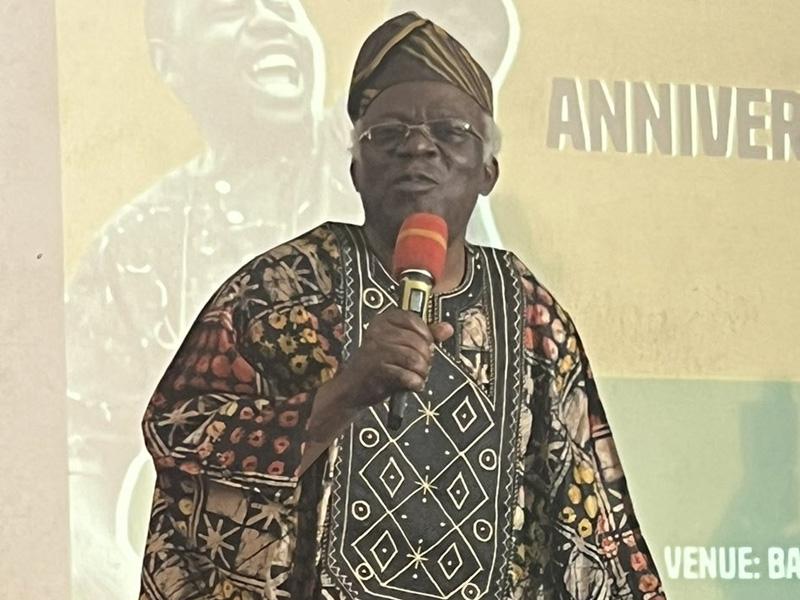
Femi Falana says Nigeria operates civil rule, not true democracy but insists military rule is not better than current dispensation.
- +Falana Says Nigeria Operating Civil Rule, Not Genuine Democratic Governance
Prominent human rights advocate, Femi Falana has declared that despite growing public frustration with governance, military rule can never be a better alternative to democracy, insisting, however, that Nigeria is yet to attain true democratic governance and is merely operating a system of civil rule.
Prominent human rights advocate, Femi Falana has declared that despite growing public frustration with governance, military rule can never be a better alternative to democracy, insisting, however, that Nigeria is yet to attain true democratic governance and is merely operating a system of civil rule.
Speaking at the 2nd Annual General Meeting (AGM) of Amnesty International (Nigeria) on Saturday in Abuja on democracy, constitutional governance and human rights, the advocate challenged Nigerians to distinguish between elected civilian government and genuine democracy, arguing that democratic governance must be measured by the extent to which citizens enjoy justice, accountability, human rights and social welfare.
Falana, who spoke online, noted that while the country has recorded 27 years of uninterrupted civilian administration, many of the promises embedded in the Constitution remain unrealised for millions of Nigerians.
He added that: “Military rule is not better than democracy regardless of the frustrations people may have. But we must also be honest enough to admit that what we currently have is largely civil rule and not the full expression of democracy that Nigerians fought and sacrificed for,”
The rights campaigner warned against growing nostalgia for military regimes in some quarters, describing such sentiments as dangerous and historically inaccurate.
He noted that democratic governance is not merely about conducting elections but about creating institutions that respect citizens’ rights, uphold the rule of law and guarantee social and economic justice.
He lamented the widening gap between constitutional guarantees and the daily realities faced by ordinary Nigerians, particularly in the areas of education, healthcare, security and access to economic opportunities.
He argued that many of the provisions designed to improve the welfare of citizens remain largely unenforceable, leaving millions without effective protection despite constitutional assurances.
Drawing attention to human rights concerns, he stressed that the country must move beyond celebrating constitutional promises and begin implementing policies that directly improve the lives of citizens.
The advocate further called for stronger institutions capable of holding public officials accountable and ensuring that government actions remain consistent with democratic principles.
He pointed to challenges within the justice sector, law enforcement and governance structures, warning that democracy cannot flourish where citizens lack confidence in public institutions.
On education, Falana welcomed recent interventions aimed at expanding access to learning opportunities, including student support initiatives and school feeding programmes, but maintained that more must be done to guarantee equal access to quality education.
He described education as one of the most powerful tools for reducing poverty, promoting social mobility and strengthening democratic participation.
The rights advocate also urged authorities to pay greater attention to the welfare of children, teachers and vulnerable communities, arguing that the strength of any democracy should be measured by how it treats its weakest citizens.
He stressed the need for greater citizen participation in governance, insisting that democracy requires active engagement from the public rather than passive observation.
According to him, civil society organisations, the media, professional bodies and community leaders have a critical role to play in defending democratic values and demanding accountability from those in power.
Falana, while acknowledging some progress in governance and institutional development, maintained that significant challenges remain, including rights violations, weak implementation of laws, poverty and growing public distrust of government institutions.
He therefore called for a national commitment to transforming constitutional ideals into practical realities through effective leadership, institutional reforms and people-centred policies.
The advocate said that Nigeria’s democratic journey should not be judged solely by the number of years spent under civilian administration but by the extent to which citizens experience freedom, justice, dignity and equal opportunity.
He warned that unless democratic institutions begin delivering tangible benefits to the people, public confidence in the system could continue to erode.
His remarks come amid increasing national conversations about governance, democratic accountability and the future of constitutional rule in Nigeria as the country marks more than two decades of uninterrupted civilian government.
Earlier in his remarks, the Board Chair, Amnesty International Nigeria, Auwal Musa Rafsanjani noted that the past year has been one of bold action and significant milestones.
He said: “Our investigation into the Tiger Base anti-kidnapping police unit in Owerri, Imo State, stands as one of our most impactful interventions.”
He noted that: “The report uncovered entrenched human rights violations, including prolonged arbitrary detention, torture, extortion and enforced disappearances.”
Rafsanjani said: “We documented at least 200 deaths and disappearances between 2021 and 2025.”