Nigeria’s petrol three-wheelers are going electric—with batteries powered by diesel
Two years ago, Moses’ mechanic gave him advice that cost the mechanic his business.
Two years ago, Moses’ mechanic gave him advice that cost the mechanic his business. Moses was a regular, often bringing his commercial three-wheeler, popularly known as keke in Nigeria, to the workshop. Perhaps that frequency is what led the mechanic to suggest Moses rip the failing petrol engine out of his keke and let a startup called Swap replace it with an electric motor.
He told TechCabal he has not visited a mechanic since the replacement.
“Since I started, I have not fixed my engine,” Moses said in an interview at a battery swapping station in Magodo run by Swap, a Nigerian startup that converts petrol kekes to electric kekes across its five stations in Lagos.
He bought his keke secondhand with its engine already failing. It had been worn down by Lagos traffic, bad fuel, bad roads, and compounding neglect. After his mechanic sent him to Swap, Moses registered, and Swap converted his vehicle for free.
Now, twice a day, he rides to the battery station in Magodo, one of the most expensive high-income neighbourhoods in the city, and swaps a dead battery for a charged one. Within two minutes he’s back to work.
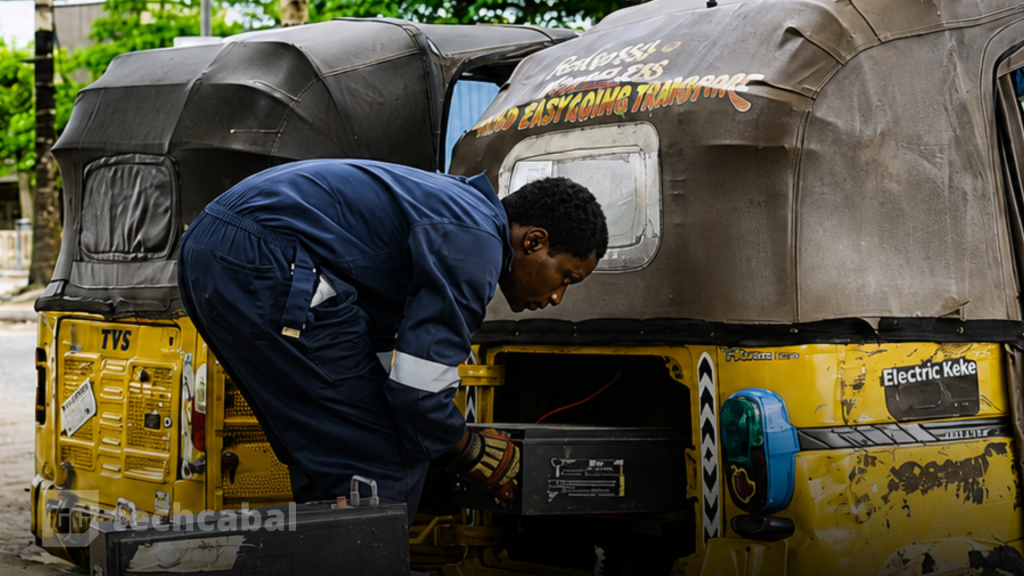
Three-wheelers have been the last-mile replacement since the government banned commercial motorcycles across most of Lagos, Nigeria’s most populous city, in 2020. They ferry passengers through narrow roads buses cannot reach, and some cars would rather avoid. They also connect major roads and are affordable enough to remain an option for Lagosians.
There are now just over 300 converted kekes in Lagos, according to Swap, and the company says more than 100,000 tricycles are on a waitlist. There are many reasons for the gap between those two numbers, and that is what this story is about. Moses and the other drivers who have already switched, alongside the long waitlist, show the demand is real. What holds Swap back is the cost and difficulty of keeping batteries charged and the capital needed to meet the demand.
When I visited Swap’s station in Ikorodu, a fast-growing town on Lagos’s northeastern outskirts, in June, it had been without electricity since January 2026. To charge batteries, the station runs two generators that barely stop. As soon as a round of batteries is charged, the next batch goes on, and the generators keep burning diesel so that drivers keep working.
The station serves 150 drivers and charges between 90 and 100 batteries, according to Victor Oguare, the station manager. Only two diesel generators carry that load.
“If one generator runs for four hours, we shut one down and let it rest for one hour,” Oguare said. “Then we turn on the other one and shut that one down to rest for another hour. There’s a way we normally shuffle it so that it will not cause any overworking.”
To keep batteries available, Swap buys diesel in bulk. “We purchase 1,000 litres for our drums, which serves us for three to four days,” he said. At the current retail price of ₦1,750 ($1.28) per litre, that comes to ₦1.95 million ($1,450) every three to four days—roughly ₦487,500 ($363) a day just to keep the batteries charged.
On generators, the station’s capacity to charge batteries drops sharply. The grid delivers far more power, so instead of 90 batteries at a time, the station manages 40 to 50, and each charge cycle stretches from 90 minutes to nearly two and a half hours. A generator-powered station runs at roughly a third of the output of a grid-connected one.
Oguare told TechCabal the shortages caused by the reduced output are rare. But the drivers tell a different story.
“We used to be there for some hours waiting for batteries,” said Paul, an Ikorodu-based keke driver who operates on a hire-purchase arrangement and asked to be identified by his first name.
Paul did not choose to go electric. His keke belongs to a fleet owner, and he was handed the key and told where to swap. He pays ₦7,500 ($5.61) daily to the owner, plus the cost of each battery swap: ₦2,800 ($2.09) for the first, ₦2,800 ($2.09) for the second, and ₦2,200 ($1.65) for the third if he can get one.
He told me he makes around ₦20,000 ($14.96) on a four-battery day. Subtract the ₦7,500 ($5.61) higher-purchase fee and roughly ₦10,000 ($7.48) in swap costs, and he takes home somewhere between ₦2,500 ($1.87) and ₦5,000 ($3.74).
On days when batteries run short, when the generators cannot charge fast enough to meet demand, Paul gets two or three batteries instead of four. His earning window shrinks to a few hours. The ₦7,500 ($5.61) delivery fee does not shrink with it.
“If I pay ₦7,500 [$5.61] for delivery, with the ticket money, everything that I paid, I will not take anything home,” Paul said. “It’s not easy.”
He has run out of battery mid-route. When that happens, he pushes the keke. There is no jerrycan equivalent for an electric vehicle, no roadside solution. You either push or you ask someone to help you push. When I visited Swap’s Magodo station in June 2026, I saw drivers arriving on foot, carrying their dead batteries because the kekes could not move.
Despite the frustrations of an occasional battery shortage or a pack dying mid-trip, drivers still prefer Swap’s engines to petrol. “It’s better than fuel,” Paul said. When batteries are available, the economics work. He doesn’t need a mechanic. The ride is smoother. A petrol keke driver on a similar route spends over ₦10,000 ($7.26) daily on fuel alone, he estimated, before repairs.
Anthony Adiku has driven the same keke since 2022. He converted it in December 2025, after the engine started costing him more than it earned. “I swapped it to Swap because the engine then was giving me issues,” he told TechCabal at Swap’s Magodo station.
He uses two Swap batteries on a regular day, at ₦6,000 ($4.36) per pair, and makes around ₦15,000 ($10.89) working 12 hours daily. Three batteries, he said, cost him ₦10,000 to ₦11,000 ($7.26 to $7.99) and cover for any day he wants to run longer hours.
For him, the biggest change Swap brought is not really about money. It is the ease it brings to his day. Before, a breakdown could take two hours out of his morning, and he would come back to the route already exhausted and behind his target.
“Once I got into Swap, I woke up at my own convenient time because I know that I don’t have any problem,” he said. “The only problem I have is to face my customers. So once I wake up around nine, I close around seven; I’m okay.”
Launched in May 2024, Swap is an early-stage Nigerian startup that removes petrol engines from Lagos’s commercial tricycles and replaces them with electric motors powered by swappable lithium batteries at no upfront cost to the driver.