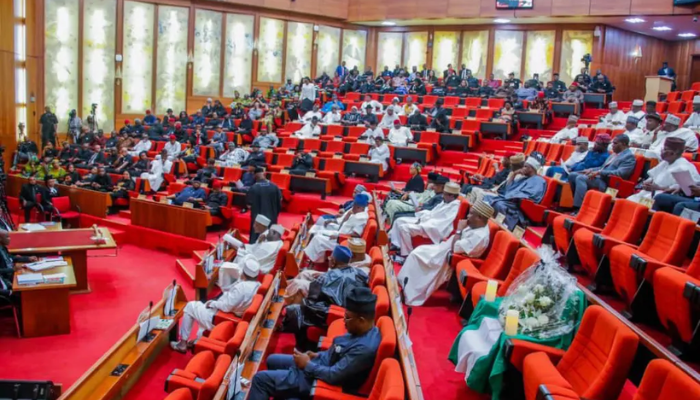
Senate denies bill seeks to ban street preaching, says FRSC provision existed since 2007
The Senate has dismissed claims that the proposed amendment to the Federal Road Safety Commission (FRSC) Act seeks to outlaw street preaching, clarifying that the contentious provision only relates to preaching and hawking inside commercial vehicles and has been part of Nigeria’s road traffic law since 2007.
The Senate has dismissed claims that the proposed amendment to the Federal Road Safety Commission (FRSC) Act seeks to outlaw street preaching, clarifying that the contentious provision only relates to preaching and hawking inside commercial vehicles and has been part of Nigeria’s road traffic law since 2007.
The clarification followed public criticism of the Federal Road Safety Commission (Establishment) Act (Amendment) Bill, 2026, currently before the National Assembly, amid claims that it would criminalise religious preaching in public places.
In a statement issued by the Directorate of Media and Public Affairs, Office of the Leader of the Senate, the red chamber said the controversial provision was not new and had merely been renumbered in the amendment process.
“The Senate has duly noticed public concerns on the purported proscription of preaching and hawking in a commercial vehicle under the ongoing amendment to the Federal Road Safety Commission (Establishment) Act, No. 22, 2007,” the statement said.
It explained that Section 10(4) of the Federal Road Safety Commission (Establishment) Act, 2007 and Regulation 220 of the National Road Traffic Regulations (NRTR), 2012 already classify preaching and hawking in commercial vehicles as traffic offences.
According to the Senate, “Pursuant to Section 10(4) of the Federal Road Safety Commission (Establishment) Act, 2007 and Regulation 220 of the National Road Traffic Regulations (NRTR) 2012), preaching and hawking in a commercial vehicle are offences. The offences have been part of the Act before the current amendment.”
The statement further noted that the provision was previously listed as Item 36 in the Second Schedule of the principal Act enacted in 2007 but now appears as Item 49 in the proposed amendment.
“Entrenched as Item 36 in the Second Schedule of the Act, preaching and hawking in a commercial vehicle are not new provisions in our legal system. The provisions have been part of the Act as far back as 2007. However, it is now listed as Item 49, Second Schedule of the Act,” it stated.
The Senate stressed that the legislation does not prohibit evangelism or religious activities conducted outside commercial vehicles.
“The Bill, therefore, does not outlaw preaching on the streets as some interests have claimed in different fora. It is about the safety of commuters and other road users and not intended to undermine any religious activity in the public space,” the statement added.
The clarification comes amid growing debate on social media, where critics alleged that the amendment was designed to criminalise public preaching, prompting widespread reactions from religious groups and members of the public.
The Senate also distanced Opeyemi Bamidele, the Leader of the Senate, from claims that he sponsored the controversial provision.
“The Bill is not an initiative of the Leader of the Senate, Senator Opeyemi Bamidele. Rather, it is a concurrence bill first amended by the House of Representatives. As required by the 1999 Constitution, the Bill requires the concurrence of the Senate before it can become effective,” the statement said.
Under Nigeria’s bicameral legislative process, a bill passed by one chamber must secure the concurrence of the other chamber before it can be transmitted to the President for assent.
The Senate noted that deliberations on the amendment were still in progress and encouraged interested stakeholders to make their views known through the legislative process.
“The amendment process is still ongoing. In the spirit of democracy, stakeholders can channel their concerns to the appropriate institutions before the completion of the process,” the statement added.
The proposed amendment to the FRSC Act is intended to update the legal framework guiding the operations of the road safety agency, with lawmakers maintaining that the disputed provision is aimed at improving commuter safety rather than restricting constitutionally guaranteed rights to freedom of religion or expression.