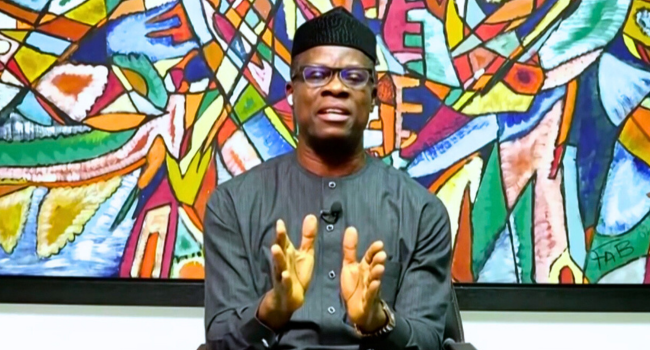
Former Resident Electoral Commissioner, Mike Igini, has described as “very regrettable and most unfortunate” the controversy surrounding the Independent National Electoral Commission (INEC), urging its leadership to urgently clear doubts over alleged partisanship to restore public trust ahead of upcoming elections.
- +INEC Must Clear Doubts Over Partisanship Allegations – Igini
Igini, who spoke on Tuesday’s edition of Channels Television’s Politics Today programme, stressed that perception plays a critical role in electoral credibility, particularly for an electoral management body.
Igini, who spoke on Tuesday’s edition of Channels Television’s Politics Today programme, stressed that perception plays a critical role in electoral credibility, particularly for an electoral management body.
“It’s very regrettable and most unfortunate that we have found ourselves, a few months to an election, with the EMB (Electoral Management Body) under this type of controversy. Perception matters a lot, and public perception management is very key for those saddled with the responsibility to conduct elections.
“I think the commission’s leadership should address these issues appropriately to clear all doubts, because it is expected that all actions and inactions of an EMB official must be seen to be above board and exhibit the highest principles of ethical standards. That is what is required for people to have faith and confidence in the process, that the rules are observed and enforced wholly, fairly and impartially,” he said.
The former Akwa Ibom REC also faulted political parties for failing to complement INEC’s reforms, warning that provisions within the Electoral Act 2026 could undermine the credibility of the 2027 elections.
Igini also highlighted the importance of a strong opposition in sustaining democracy, warning that “there will be no hopeful future for democracy without a credible and institutionalised opposition.”
He also raised concerns about the growing role of the judiciary in determining electoral outcomes, cautioning that “perceived weaknesses” or susceptibility to political pressure could “undermine the rule of law” and threaten democratic stability.
The controversy centres on allegations that INEC’s chairman was linked to a partisan social media account that appeared to support the All Progressives Congress (APC) during the 2023 elections.
Screenshots circulated across X showed the alleged account making a partisan comment, “Victory is sure,” in response to a post by the ruling All Progressives Congress (APC) youth leader.
The tweet quickly sparked a firestorm of criticism, as netizens pointed to digital trails that allegedly linked the partisan account to the INEC chairman’s personal records.
While INEC dismissed the claims as digital impersonation, critics have questioned the credibility of the investigation, fuelling public distrust.
In response, INEC commissioned an independent forensic and cybersecurity probe, which found no link between the account and the chairman.
The report stated that the account, created in September 2022, had no connection to official institutional channels and that all associated posts were fraudulent.
INEC also highlighted a technical inconsistency, noting that a purported reply attributed to the account was timestamped 13 minutes before the original post, describing the episode as a “coordinated disinformation campaign.”
Despite these findings, the controversy has triggered backlash, with opposition parties calling for the chairman’s resignation and civil society groups demanding electoral reforms amid fears over the integrity of the 2027 polls.