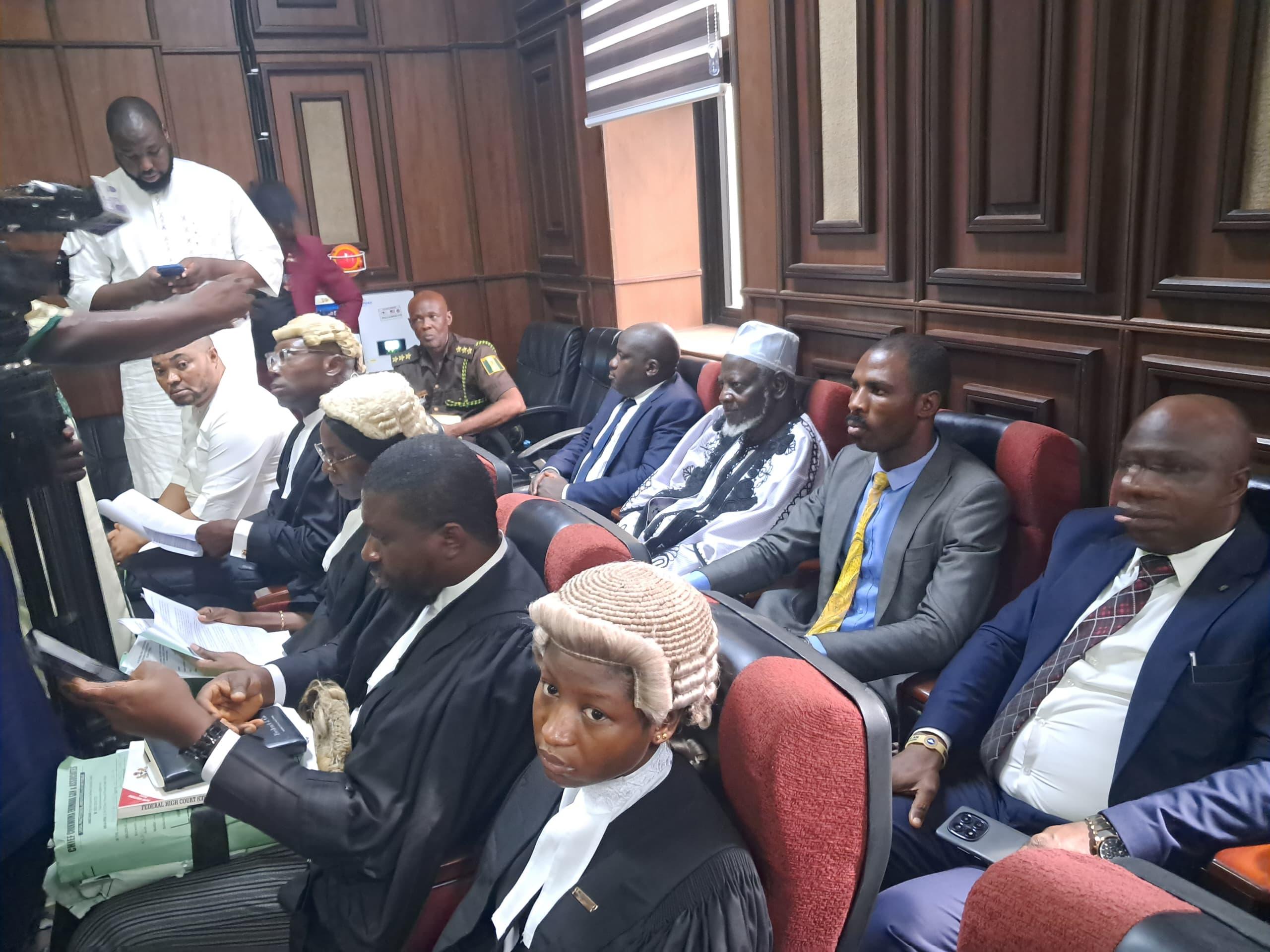
The Federal High Court in Abuja briefly halted the arraignment of individuals linked to a failed coup against the Bola Tinubu administration on Wednesday.
- +Judge briefly pauses six coup suspects’ arraignment
The unplanned break ensued due to the absence of an interpreter for one of the defendants.
The unplanned break ensued due to the absence of an interpreter for one of the defendants. Abdulkadir Sani, who is a Zaria, Kaduna State-based Islamic cleric.
His lawyer, Sanusi Musa, a Senior Advocate of Nigeria (SAN), said his client could not understand English language. The lawyer said Mr Sani understood only Hausa and Arabic.
Court officials apparently did not prepare an interpreter for the proceedings because they did not envisage a need for one would arise. Nigerian courts generally suffer shortage of interpreters, even though they are supposed to be sufficiently resourced with those who can interprete proceedings in at least the three major Nigerian languages.
Judge Joyce Abdulmalik briefly put the arraignment of the suspected coup conspirators on hold pending the availability of an interpreter in the courtroom.
PREMIUM TIMES reported Mr Sani’s early arrival in court at about 9 a.m. on Wednesday for the arraignment scheduled for 12 p.m.
Mr Sani, the sixth defendant who came on his own, arrived ahead of others who were produced in court by agents of the State Security Service (SSS).
A judgement of the Federal High Court in Abuja ordered his uncontional release on Monday.
The SSS produced the other defendants for arraignment at about 1.40 p.m.
The other defendants include Mohammed Ibrahim Gana, a retired major-general, and Erasmus Ochegobia Victor, a retired navy captain.
The rest are Ahmed Ibrahim, a police inspector; Zekeri Umoru, an electrician at the Presidential Villa, and Bukar Kashim Goni.
The proceedings kicked off shortly after their arrival on Wednesday.
The Attorney-General of the Federation, Lateef Fagbemi, together with the Director of Public Prosecutions of the Federation (DPPF), Rotimi Oyedepo, appeared for the prosecution on Wednesday.
All the defendants, except Ahmed Ibrahim, a police officer and the third defendant, had their lawyers in court.
Mr Ibrahim told the court that he had engaged a lawyer, who he said was unavoidably absent.
The judge noted that since it was an arraignment, Mr Ibrahim could take his plea.
At 2.04 p.m., the judge paused the proceedings due to the absence of an interpreter required by Mr Sani.
While waiting for the arrival of an interpreter to relate the proceedings to Mr Sani in Hausa, she used the time-out to attend to other cases.
She resumed hearing the coup case with the arrival of an interpreter at about 2.25 p.m.
The courtroom was packed on Wednesday, with the judge ordering the ejection of those who could not find a seat.
PREMIUM TIMES has extensively reported on the alleged unsuccessful coup plot against President Bola Tinubu’s government.
One of this newspaper’s reports in March detailed an elaborate plot by suspected coup conspirators to storm Nigeria’s seat of power, seize the Presidential Villa, and capture President Bola Tinubu and other top officials
The suspects allegedly planned to overrun the Presidential Villa in Abuja, Nigeria’s most fortified political stronghold, and capture President Tinubu, along with Vice President Kashim Shettima.
Senate President Godswill Akpabio and House Speaker Tajudeen Abbas were also to be captured and possibly eliminated.
The alleged conspiracy involved at least 40 suspects, including senior officers such as Brigadier General M.A. Sadiq, and Colonel M.A. Ma’aji, as well as several lieutenant colonels drawn from signals, infantry, and special forces units.
The serving military officers are expected to be court-martialled, whille the retired officers reasonably suspected to be part of the failed plot are expected to face the regular court.
Timipre Silva, former Governor of Bayelsa, was named as a conspirator in seven of the 13 counts but has yet to be charged as a defendant.
The prosecution said Mr Silva, who served as the Minister of State for Petroleum Resources during the immediate-past administration of the late former President Muhammadu Buhari, is on the run. While Mr Sylva remains out of government’s reach, five of his aides and domestic workers are being detained over the coup allegations.
The federal government brought 13 coup charges against the six defendants in the case marked FHC/ABJ/CR/206/2026.
The charges were brought under the Criminal Code Act, the Terrorism (Prevention and Prohibition) Act of 2022, and the Money Laundering (Prevention and Prohibition) Act of 2022.
The government accused the six individuals of treason, terrorism, failure to disclose coup information to relevant authorities, and financing terrorism through money laundering.
While Mr Sani’s name appears in most of the 13 counts filed against the defendants, count nine focuses solely on him.
According to the government, the cleric indirectly retained N2 million in his Jaiz Bank account from A & A Express Link Concept, funds authorities say he reasonably ought to have known were proceeds of terrorism financing.
The government brought the defendants’ offences under the Criminal Code Act, the Terrorism (Prevention and Prohibition) Act, 2022, and the Money Laundering (Prevention and Prohibition) Act, 2022.
In five of the 13 counts, the prosecution alleged that various funds ranging from N2 million to N50 million, totalling N71.2 million, were found in the accounts of the police officer and civilians among the defendants.
The five counts name the individuals, including Mr Sani, in whose accounts the various sums of money were discovered. The charges described the funds as proceeds of terrorism financing.
In the first count, the defendants were accused of conspiring to “wage war” against the state to remove President Tinubu from office, an offence punishable under Section 37(2) of the Criminal Code.
The second and third counts allege that the defendants had knowledge of plans by the alleged coup leader, Mohammed Ma’aji, a colonel, and others to commit treason but failed to report or prevent it, in violation of Section 40(b) of the Criminal Code.
The fourth count accuses them of conspiracy to commit terrorism under Section 26(1) of the Terrorism Act.
In the fifth count, Mr Ibrahim, the police inspector, and Mr Umoru were specifically accused of participating in meetings linked to terrorist activities, contrary to Sections 2(3)(d) and 12(a) of the Terrorism Act.
Subsequent counts allege that the defendants provided support to the plotters, failed to disclose critical intelligence that could have prevented the alleged acts, and withheld information that could have aided their arrest.
Count nine focuses on Mr Sani, the cleric, who is accused of indirectly retaining N2 million in his Jaiz Bank account from A & A Express Link Concept, funds authorities say he reasonably ought to have known were proceeds of terrorism financing.