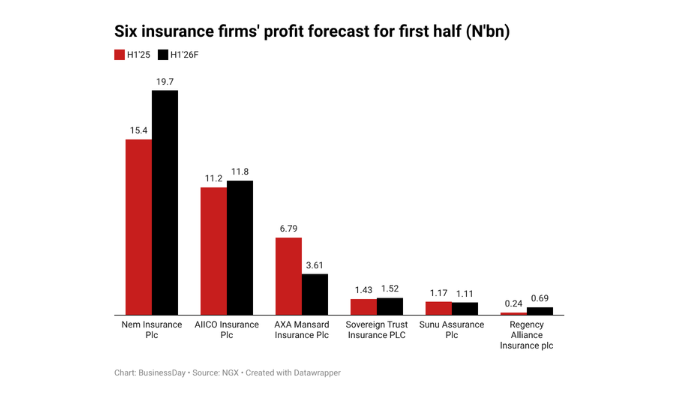
Six listed insurance firms have a projected combined after-tax profit of N38.4 billion for the first half of 2026, marking a 6.07 percent increase from the N36.2 billion recorded in the same period last year, according to their earnings projections.
- +Six insurance firms’ eye N38.4bn profit in H1
The surveyed firms include Nem Insurance Plc, AIICO Insurance Plc, AXA Mansard Insurance Plc, Sovereign Trust Insurance Plc, Sunu Assurance Plc, and Regency Alliance Insurance Plc.
The surveyed firms include Nem Insurance Plc, AIICO Insurance Plc, AXA Mansard Insurance Plc, Sovereign Trust Insurance Plc, Sunu Assurance Plc, and Regency Alliance Insurance Plc.
NEM Insurance Plc remains the largest profit contributor, with earnings forecast to rise to N19.7 billion in H1 from N15.4 billion reported in the first half of 2025, an increase of 27.9 percent. AIICO Insurance Plc is projected to post a modest increase in profit to N11.8 billion from N11.2 billion, translating to a growth rate of 5.4 percent.
Sovereign Trust is expected to deliver moderate growth, with profit rising to N1.52 billion from N1.43 billion, an increase of 6.3 percent.
Regency Alliance Insurance Plc is forecast to achieve the strongest percentage growth, with profit increasing to N687 million from N240 million, representing a 186 percent rise.
In contrast, AXA Mansard is forecast to record the sharpest decline among the firms. Profit is expected to fall to N3.61 billion from N6.79 billion, representing a 46.8 percent decline, significantly weighing on the sector’s aggregate performance.
SUNU Assurance Plc is projected to report a slight decline in profit to N1.11 billion from N1.17 billion, reflecting a contraction of 5.1 percent.
These firms’ projected insurance revenue is expected to rise to N315.1 billion in H1 from N231.4 billion reported in the first half of 2025.
The anticipated earnings growth comes at a crucial period for the industry, which is undergoing one of its most significant recapitalisation exercises in decades under the Nigerian Insurance Industry Reform Act (NIIRA) 2025.
The new law raised minimum capital requirements to N10 billion for life insurers, N15 billion for non-life insurers, N25 billion for composite insurers, and N35 billion for reinsurers, with a July 2026 compliance deadline.
The stronger profit outlook reflects growing confidence among policyholders and businesses, which are increasingly seeking protection against economic uncertainty, asset risks, and inflation-induced losses.
The earnings expansion is also expected to improve insurers’ ability to meet the new capital thresholds through retained earnings, reducing dependence on external fundraising.
According to Agusto and Co.’s 2026 Insurance Industry Report, about N270 billion capital injection will be needed for the insurers to comply with the minimum capital requirement specified in the NIIRA 2025, ahead of the July 2026 deadline.
“Our analysis indicates that circa 63 percent of this capital injection will originate from the non-life segment, which remains populated by several severely undercapitalised players. Conversely, life insurers will account for only 13 percent of additional capital, while composite insurers will inject the remaining 24 percent,” it said.
Twenty insurance companies have so far signalled their readiness for capital verification as part of the ongoing recapitalisation exercise aimed at strengthening the financial capital and resilience of operators in the Nigerian insurance industry, according to the National Insurance Commission (NAICOM).
To ensure credibility and transparency, NAICOM has engaged four of the world’s leading audit firms—PricewaterhouseCoopers, Ernst & Young, KPMG, and Deloitte—to independently scrutinise the capital positions of the insurers. The firms are working in collaboration with the regulator and are expected to complete the first phase of the exercise within three weeks, after which another batch of companies will undergo similar checks.
Olusegun Omosehin, the commissioner for insurance and chief executive officer of NAICOM, underscored the importance of the verification process, particularly the role of statutory deposits held with the Central Bank of Nigeria.
“Statutory deposits are an important criterion in this exercise and any operator who does not meet this requirement will not be given regulatory nod of compliance,” he said. “By regulation, statutory deposits translate to 10 per cent of your minimum capital that must be sent to the apex bank.
“So, CBN will be working with NAICOM and the four verifying companies to know the true position of these underwriters.”
According to reports on NGX, Sovereign Trust Insurance Plc, Guinea Insurance Plc, and Universal Insurance Plc have fully deposited their statutory fund with the CBN and are pursuing fresh capital injections to finalise full NIIRA threshold compliance.
How the insurance firm’s share price performed year-to-date Investor confidence in the sector continues to rise, as reflected in the performance of insurance stocks on the Nigerian Exchange (NGX). The NGX Insurance Index posted a rally for a year-to-date return of 2.99 percent, ranking among the least-performing sectors.
Analysts say the performance stems from the ongoing recapitalisation process, as investors remain apathetic toward insurance shares despite ongoing recapitalisation efforts because the sector continues to battle a history of low dividend payouts, poor corporate governance, and a severe trust deficit regarding claims settlement.
Year-to-date, the share price of Nem Insurance rose to N31.95, gaining over 19.2 percent from January 2 to June 10. Followed by AIICO Insurance gaining 17.3 percent.
However, the share performance of AXA Mansard Insurance, Sovereign Trust Insurance Plc, Sunu Assurance Plc, and Regency Alliance Insurance Plc fell by 1.46 percent, 33.07 percent, 25.45 percent, and 8.18 percent, respectively.
Johnson Chukwu, the chief executive officer of Cowry Asset Management Limited, during an interview on Arise TV, said that, unlike last year when the insurance index increased by approximately 60.49 percent, this year has seen a different trend.
Chukwu indicated that the lack of investor excitement is due to concerns about the industry’s ability to meet capital requirements. He suggested that investors are cautiously waiting to see if the industry can fulfill these obligations before committing their funds.
He emphasised that once this phase is navigated, investors will give the insurance sector a more thorough evaluation.
Regarding dividend expectations, Chukwu highlighted that these depend heavily on the opportunities created by the deployment of increased capital.
“With a stronger capital base, confidence in the insurance industry will grow, leading to more individuals seeking insurance coverage against the risks they face. This increased demand is what will ultimately drive dividends for insurance companies.”