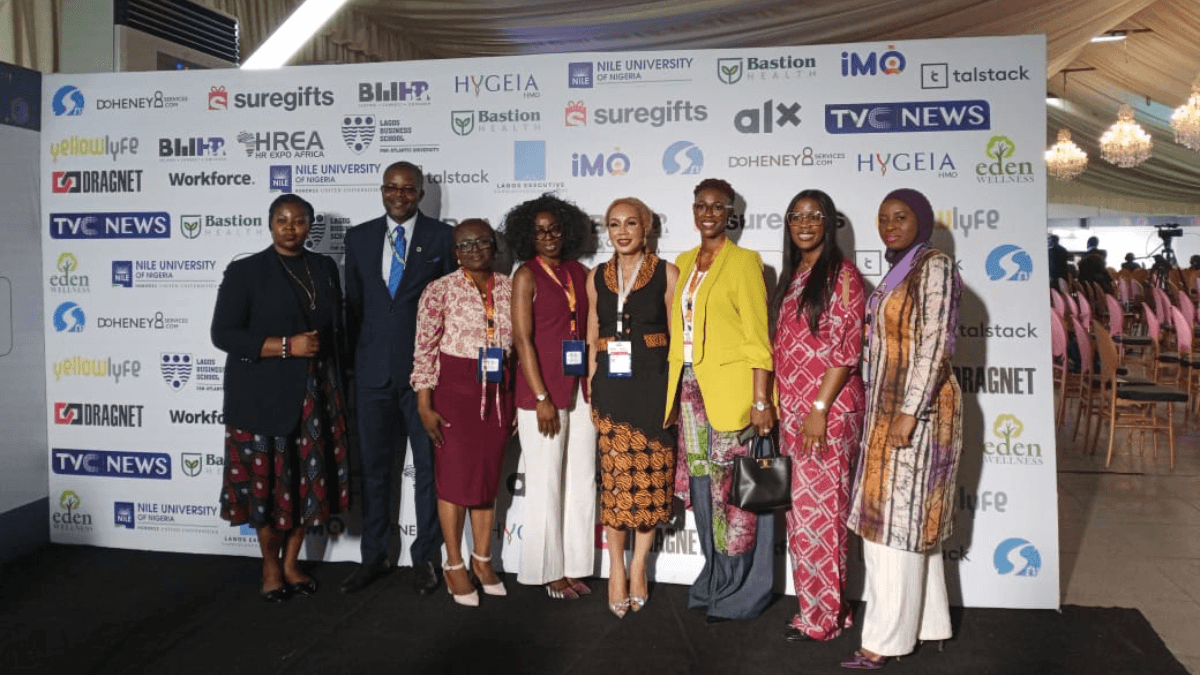
Experts unveil AI’s game changing potential in workflow output, boost business efficiency
Experts at HR Expo Africa Work Festival, illuminate AI’s potential to revolutionise workflow productivity, drive data–driven decisions and boost business efficiency.
Experts at HR Expo Africa Work Festival, illuminate AI’s potential to revolutionise workflow productivity, drive data–driven decisions and boost business efficiency.
The festival which held in Lagos drawn professionals from various sectors of the economy and they explored practical Africa-centric strategies blending tech excellence with human-centered leadership.
Speaking at the event which held under the theme, “Redefining Productivity in the Age of AI and Analytics’’, keynote speaker, Regional Director for ALX Africa in West and Central Africa, Ruby Igwe, highlighted how AI is rapidly transforming workplace expectations.
According to Igwe,, tasks that once consumed hours can now be completed in minutes, compelling connoisseurs and establishments to rethink how they measure output and relevance.
“AI is changing the definition of productivity. The real question now is: what do we do with the extra time it creates? How do we use it to drive better outcomes and create more value?” she said.
Igwe emphasised the need for continuous learning, urging employees to conduct personal skills gap analyses and adopt emerging tools.
She noted that institutions like ALX Africa are already training hundreds of thousands across the continent in AI, data, leadership and entrepreneurship.
However, she warned against over-reliance on AI, adding that blind dependence could lead to what she described as “AI slump”, a situation where outputs lack originality or critical thinking.
“AI is a tool, not a replacement for human intelligence. You must still think, analyze, and protect sensitive data,” she added.
On his part, the Director-General of the Nigerian Employers’ Consultative Association (NECA), Adewale-Smatt Oyerinde, stressed that investing in people through coaching is essential for organisational growth.
“If you fix the person, the person’s ability to fix the business becomes higher. Coaching should be seen as an investment, not a cost,” he said.
He further noted that as AI adoption increases, organisations must also strengthen governance, ethics, and compliance frameworks to prevent misuse.
Convener of the event and founder of HREA, Erefa Coker, described HR as the “driver of the driver,” noting that organizations are fundamentally people-powered.
Reflecting on the evolution of the conference since its inception, Coker said HR Expo Africa has consistently anticipated workplace trends from early discussions on the future of work to digital transformation and remote working, long before the COVID-19 pandemic accelerated those realities.
“Today, productivity is no longer about hours worked. It is about value creation. AI can automate tasks, but humans must define value,” she said.
She added that ethical considerations, transparency, and policy development around AI would be critical focus areas for organizations moving forward.
Similarly, Group Head of HR at Sahara Group Emilomo Arorote who also spoke in one of the Masterclasses, emphasised the pivotal role managers play in shaping employee experience.
To her : “Managers are the experience. Employees’ engagement and retention depend largely on their relationship with their managers,” she said.
Arorote outlined key pillars for improving workplace experience, including organisational culture, talent development, succession planning, and technology adoption. She stressed that managers must align employees with organizational vision to drive productivity.
Another session led by the Head of People and Stakeholder Experience at TSL Logistics, Ifiok Ezenwa, explored the concept of internal talent marketplaces.
She explained that many organizations overlook existing skills within their workforce, often resorting to external hiring instead.
“Employees are more than their job roles. AI-powered talent marketplaces can reveal hidden skills and connect people to opportunities within the organization,” she said.
Ezenwa added that such systems not only improve productivity but also enhance employee engagement and retention.
Also speaking at the event which was the 11th in its series, Managing Partner at DBrown Consulting, David Brown, urged professionals to rethink their relationship with AI.
“Do not abdicate to AI but delegate to AI,” he said, emphasising the importance of domain expertise.
According to Brown, while AI can handle repetitive tasks faster, professionals must retain responsibility, apply judgment, and ensure accuracy.
Brown further explained that people who embrace AI would become more competitive and profitable than those who did not.