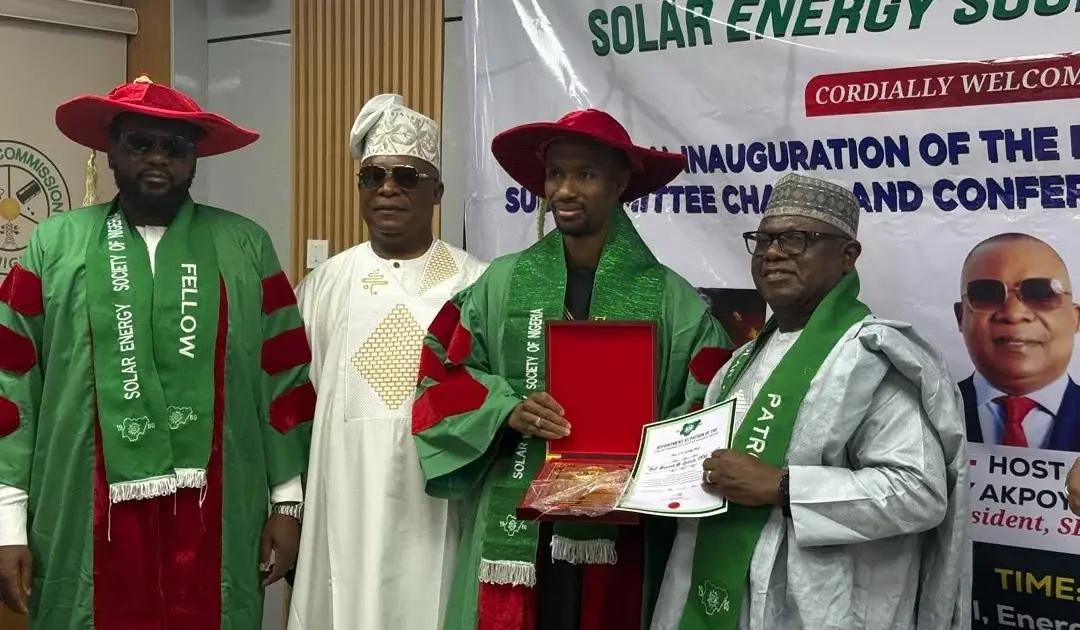
The President of the Solar Energy Society of Nigeria, Dr. Sunny Akpoyibo, has called for increased investment in youth development, innovation and research to strengthen Nigeria’s energy security and accelerate the country’s transition to renewable energy.
- +Expert urges investment in solar research to boost power supply
Akpoyibo revealed that addressing Nigeria’s growing energy needs requires stronger collaboration among stakeholders, institutional reforms and strategic investments in renewable energy technologies.
Akpoyibo revealed that addressing Nigeria’s growing energy needs requires stronger collaboration among stakeholders, institutional reforms and strategic investments in renewable energy technologies.
This was disclosed in a statement signed by Akpoyibo on Friday.
According to the statement, he made the call on Thursday in Abuja during the inauguration of the Society’s Board of Trustees, Patrons and Sub-Committee Chairpersons, alongside the conferment of Fellowship Awards at the Prof. I. H. Umar Conference Hall.
He stressed that equipping young Nigerians with technical skills and opportunities in the solar energy sector would not only strengthen the industry but also create jobs and support national development.
“We will prioritise youth empowerment through capacity-building programmes, research initiatives and skills development in solar energy technologies, contributing to job creation and national development,” he said. President of the Solar Energy Society of Nigeria, Dr. Sunny Akpoyibo and others. Photo: SESN
Akpoyibo described the inauguration ceremony as a significant milestone in the Society’s history, noting that the recognition of patrons, inauguration of committees and conferment of fellowships would enhance SESN’s capacity to advance renewable energy development across the country.
He charged members of the newly inaugurated Board of Trustees to provide strategic leadership and safeguard the Society’s long-term vision.
“Your role is to provide strategic oversight, preserve our institutional integrity and guide the long-term vision of the Solar Energy Society of Nigeria,” he said.
The SESN president also tasked sub-committee chairpersons with driving innovation, research, advocacy and member engagement, describing the committees as the operational backbone of the Society.
Speaking on the fellowship awards, Akpoyibo said the honour recognises individuals who have made outstanding contributions to renewable energy development and the advancement of the Society.
“The Fellowship of the Solar Energy Society of Nigeria is one of our highest honours. It is conferred upon individuals who have demonstrated exceptional professional achievement, commitment to renewable energy development and service to the Society and the nation,” he stated.
The newly inaugurated Board of Trustees includes former senator and engineer, Senator Uche Ekwunife, CON; Senator Engr. Ibrahim Gobir, PhD; Prof. Salihu Mustafa; Vice Admiral Kari Ombu (Rtd), CFR, mni; Prof. Isaac Nathaniel Itodo, FSESN; Prof. Sunny Ahweafada; and Alhaji Kabir Shagaya.
SESN also recognised its patrons, led by Chairman of the Patrons Council, Emeritus Professor A. S. Sambo, OON. Other patrons include Emeritus Professor O. C. Iloeje, Prof. A. A. Asere, Prof. Maxwell M. Gidado, OON, SAN, Commodore Isaac M. Mankilik (Rtd), PhD, and Engr. Dr. Samuel Erhiare Onoji.
As part of efforts to reposition the Society for greater impact, Akpoyibo unveiled a strategic agenda focused on expanding membership through inclusion and diversity, establishing functional committees, developing a digital membership and registration system, strengthening partnerships with government agencies and private-sector organisations, promoting youth development and broadening the reach of the National Solar Energy Forum.
He added that future editions of the forum would be hosted in Abuja or Lagos to attract wider participation from policymakers, investors, academics and international development partners.
Over the years, Nigeria continues to grapple with a longstanding electricity crisis despite being Africa’s largest oil producer.
Although the country’s installed electricity generation capacity exceeds 13,000 megawatts, actual power generation remains far below demand, forcing millions of households and businesses to rely on costly petrol and diesel generators.
The economic impact is substantial, with businesses spending trillions of naira annually on alternative power sources.
Small and medium-sized enterprises are particularly affected, as high energy costs erode profitability and limit growth.