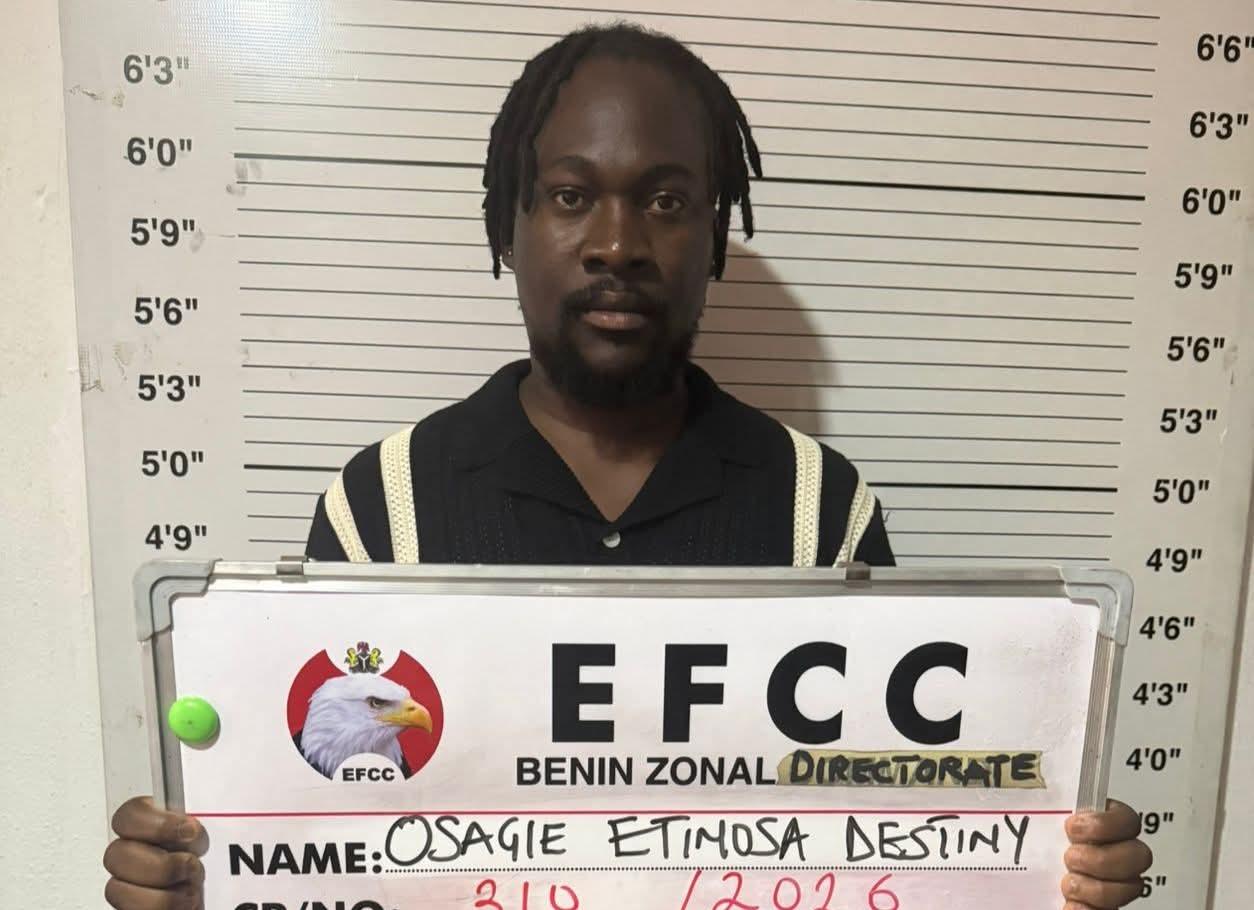
Operatives of the Economic and Financial Crimes Commission (EFCC) have arrested a self-acclaimed football agent, Osagie Etinosa, over an alleged ₦11 million fraud in Benin City, Edo State.
- +EFCC arrests football agent over alleged ₦11m fraud in Benin
The anti-graft agency, in a statement issued by its Benin Zonal Directorate on Wednesday, said the suspect was apprehended through intelligence gathering and digital tracking.
The anti-graft agency, in a statement issued by its Benin Zonal Directorate on Wednesday, said the suspect was apprehended through intelligence gathering and digital tracking.
Investigators said the suspect specialised in promising overseas trials and professional opportunities to unsuspecting players seeking careers in Europe.
In one case cited by the commission, Mr Etinosa allegedly collected ₦11 million from a victim, Samuel Beke Ohazuruike, under the pretext of securing trial opportunities with clubs in Romania and Bulgaria.
The EFCC said the promised trials never materialised, and repeated efforts by the victim to recover his funds were unsuccessful.
“The suspect will soon be arraigned in court,” the commission stated, adding that investigations into the matter are ongoing.
Details circulating on social media indicate that the suspect allegedly operated a carefully structured scheme, exploiting trust and repeatedly demanding payments under different pretexts.
According to the account, the suspect initially secured the family’s trust with a Romanian deal, demanding staged payments in euros and naira for “processing,” including invitation letters, documentation, and visa arrangements. He allegedly continued to introduce new financial requirements at each stage, including fees for embassy appointments, insurance, and football association documentation.
When the initial deal failed to materialise, the suspect reportedly redirected the family to a second, more expensive opportunity in Bulgaria, again demanding fresh payments while assuring them of a “guaranteed” contract. The family was also said to have signed a document waiving any right to refunds.
The scheme allegedly escalated with multiple additional charges, including payments for extra invitation letters, embassy scheduling, and other administrative processes. At one point, the victim—reported to be a minor—was taken to Abuja for a supposed visa interview under questionable arrangements.
Suspicion grew after inconsistencies were identified in the documents provided, prompting independent verification attempts that reportedly revealed discrepancies linked to the foreign club invitation. The suspect was also alleged to have discouraged direct contact with the club and later attempted to intimidate the family after the claims were challenged.
Authorities have not publicly confirmed all aspects of these claims, but the EFCC said investigations are ongoing.
The case highlights a growing pattern of fraud targeting young Nigerian footballers eager to secure opportunities abroad.
With limited access to structured scouting systems and increasing desperation among grassroots players, fake agents have exploited social media to advertise non-existent trials, contracts, and connections to foreign clubs.
Nigeria has long been a major exporter of football talent to Europe, producing several international stars. However, the pathway to professional football remains largely unregulated at the lower levels, creating opportunities for exploitation by fraudulent intermediaries.
Global football governing body FIFA has introduced regulations aimed at sanitising the activities of agents, including licensing requirements and transparency in player representation. Despite these measures, enforcement at the local level in many countries, including Nigeria, remains inconsistent.
In Nigeria, the Nigeria Football Federation (NFF) is responsible for overseeing football administration, including aspects of player transfers and agent activities. However, informal networks and unregistered agents continue to operate widely, particularly on digital platforms.