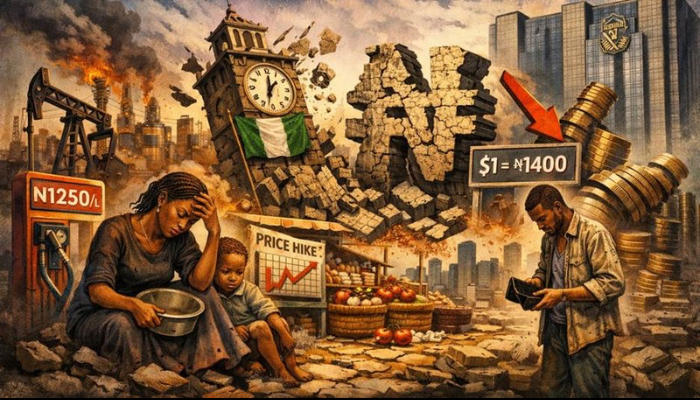
Nigeria is paying today for reforms delayed over many years. Under the ‘Renew Hope Agenda,’ those overdue economic adjustments are now arriving all at once, and that suddenness is part of the problem.
- +Nigeria pays today for years of delayed reforms
- +Inflation surges amid structural shocks
- +Exchange rate adjustment deepens the shock
- +Weak revenue limits government cushion
- +The social cost of delayed reforms
For more than a decade, policymakers postponed the toughest adjustments.
For more than a decade, policymakers postponed the toughest adjustments. Fuel subsidies lingered long after they became unsustainable.
The exchange rate was controlled even as foreign earnings weakened. Public revenue stayed persistently low despite repeated warnings from the International Monetary Fund and the World Bank.
The result is not gradual reform. It is compressed adjustment, and ordinary households are bearing the brunt.
Inflation surges amid structural shocks
Nigeria’s headline inflation rose from 15.6 percent in January 2022 to over 30 percent by early 2024, according to the National Bureau of Statistics.
Food inflation climbed even faster, exceeding 35 percent and peaking near 40 percent during the same period. This is not a typical inflation cycle. It reflects structural shocks stacked on years of delayed policy adjustment.
The sharpest trigger came in May 2023, when the government removed the petrol subsidy. For years, the subsidy had absorbed vast fiscal resources.
In 2022 alone, Nigeria spent about N4.4 trillion on petrol subsidies, roughly 2.5 to 3 percent of GDP, based on official budget and fiscal data, comparable to or exceeding federal spending on health and education combined.
Yet the subsidy was never a lasting solution. It distorted prices, encouraged smuggling, and disproportionately benefited higher-income households. Removing it was necessary, but the delay made the adjustment far more painful.
Petrol prices jumped from about N185 per litre to over N600 within months, and now reach N1,250 in some parts of Nigeria. Transport costs surged, and food prices followed.
Exchange rate adjustment deepens the shock
The exchange rate tells a similar story. For years, Nigeria operated multiple rate windows, with the official rate often far removed from market realities. By mid-2023, the gap between official and parallel rates had widened, creating arbitrage opportunities and discouraging foreign inflows.
When authorities unified the rate in June 2023, the naira fell sharply, from around N460 per dollar to beyond N1,400 at points in 2024.
A gradual correction over several years might have softened the impact. Instead, the effect on prices was immediate and severe. External buffers offered little protection. Nigeria’s foreign exchange reserves hovered between $33bn and $36bn during 2023 and 2024, modest for a country of its size, especially one heavily reliant on imports for fuel, machinery, and food.
Oil, Nigeria’s main source of foreign earnings, did not provide relief. Production struggled due to theft, pipeline vandalism, and underinvestment. Crude output fell to around 1.2 million barrels per day in 2022, well below OPEC quotas. Although some recovery occurred, supply remains volatile, keeping dollars scarce.
Weak revenue limits government cushion
Government revenue remains structurally weak. Nigeria’s tax to GDP ratio is about 10 percent, far below the African average of 16 to 18 percent. This limits the state’s ability to cushion shocks and explains why subsidy removal, however painful, became unavoidable.
The Central Bank of Nigeria responded with aggressive monetary policy, raising the policy rate from 11.5 percent in 2021 to 24.75 percent by 2024. Higher interest rates aimed to contain inflation and stabilize the currency but tightened credit for businesses already facing rising costs. Stabilisation today risked slower growth tomorrow.
Faruq Quadri, an economist at SPEC-Matrix, described the challenge: “The reforms were unavoidable, but the concentration of adjustment within a short period has made macroeconomic stabilisation more painful than it might otherwise have been. Restoring confidence will depend on how quickly inflation eases without further weakening productive activity.”
The social cost of delayed reforms
The labour market reflects the strain. Real incomes have been eroded by inflation, while formal job creation remains limited. Many households cope by cutting consumption rather than earning more. This is the social cost of delayed adjustment.
Muda Yusuf, md/ceo of Centre for the Promotion of Private Enterprise (CPPE), explained the deeper problem: “Nigeria’s current economic pains are largely the consequence of delayed structural reforms. What should have been gradual, well-sequenced adjustments over time has now become abrupt, high-impact correction under severe fiscal and macroeconomic pressure.
The burden on citizens, businesses, and investors is therefore not just a function of current policy choices, but the accumulated cost of years of reform inertia.”
Emeka Ucheaga, head of strategy, research, and financial inclusion at Credit Direct, added insight on inflation dynamics: “The inflation shock is over. We have now recorded eleven consecutive months of disinflation, with headline inflation at 15.06 percent. From a peak of around 35 percent, inflation has more than halved, reinforcing the view that the worst is behind us.
But the challenge did not end with the initial adjustment. Policy sequencing, timing, and speed of execution are as important as the reforms themselves. Going forward, decisions must be implemented deliberately to ensure policies designed to solve structural problems do not inadvertently become sources of further instability.”
None of this means the reforms were wrong. Most economists agree they were necessary. The problem lies in timing and sequencing. Delays increased the eventual cost. Economic policy is not only about choosing the right measures. It is also about choosing the right moment. Delay can be as costly as error.
Nigeria’s current hardship is not only the result of recent decisions. It is the cumulative outcome of choices made, and avoided, over many years. The country is now undertaking reforms that should have been implemented gradually long ago.
The risk is that the burden of adjustment, concentrated in a short period, weakens public support before benefits are visible. That is often how reform cycles fail.
The challenge is to ensure this period of pain leads to lasting gain. That means strengthening revenue collection, improving oil production, and building credible institutions that can sustain a market-based system.
Without timely action, Nigeria risks repeating a familiar cycle: delay, shock, hardship, and delay again.