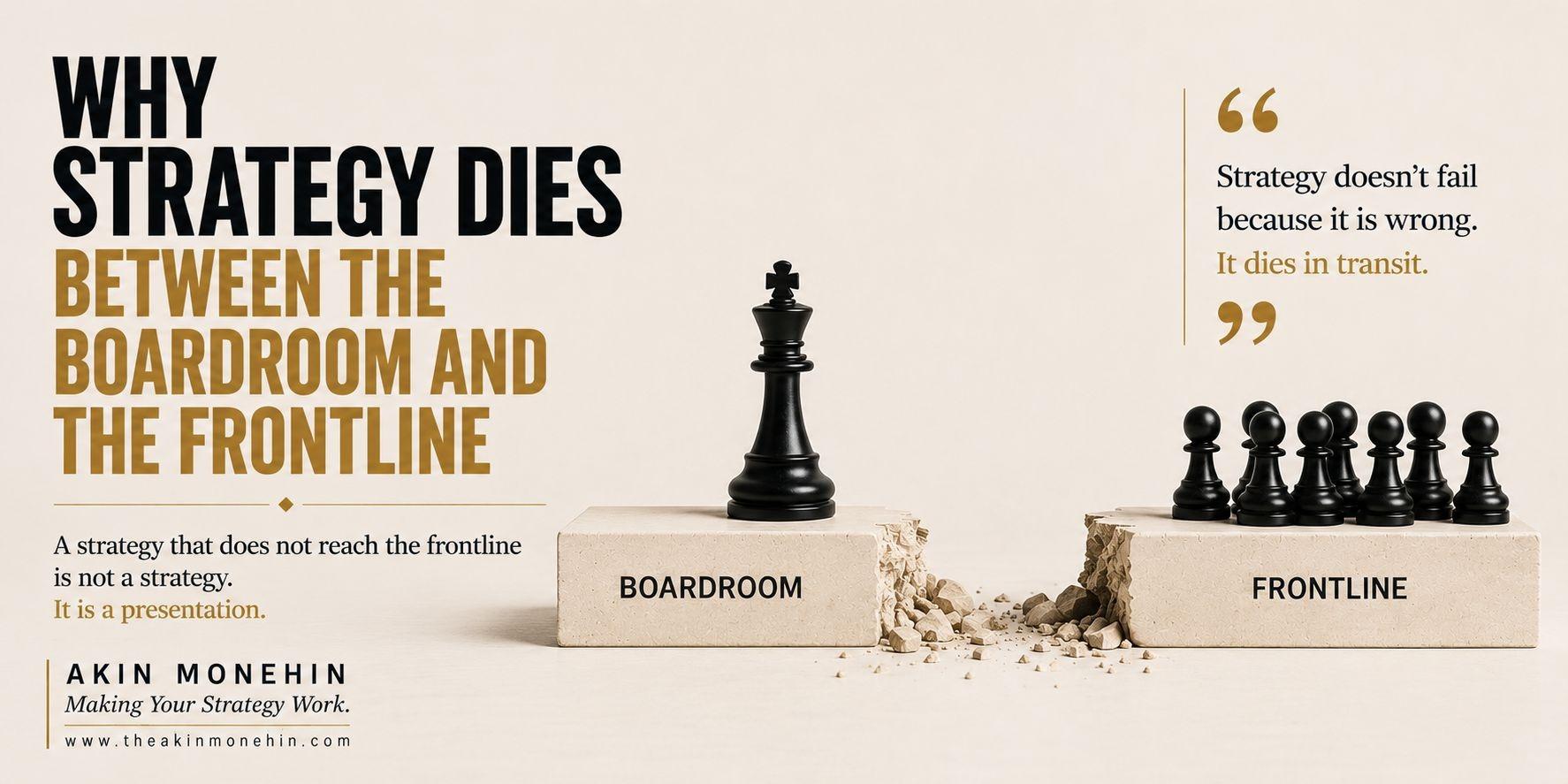
Most organisations are rich in strategy; they conduct retreats, engage consultants, produce detailed strategic plans, define ambitious targets, and communicate priorities. And yet, months later, leaders find themselves asking a familiar question: “If the strategy was so clear, why are we not seeing the results?”
- +Why strategy dies between the boardroom and the frontline
- +‘The quality of the strategy matters. The quality of translation matters more.”
The answer is often uncomfortable – many strategies do not fail because they are wrong but because they never successfully travel from leadership intent into operational reality.
The answer is often uncomfortable – many strategies do not fail because they are wrong but because they never successfully travel from leadership intent into operational reality. In other words, they die in transit. This is what I describe as an ‘execution disconnect’: a condition where leadership believes the strategy is clear, while the people responsible for delivering it experience something entirely different.
The challenge is rarely strategy quality but strategy translation. Most leadership teams spend considerable time discussing what the organisation should do, but far less time is spent ensuring that every level of the organisation understands what should happen differently because the strategy exists.
“Most strategies do not fail in the boardroom. They die in transit between leadership intent and operational reality.”
That distinction matters because a strategy only creates value when it changes decisions, behaviours, priorities and resource allocation throughout the organisation. Otherwise, it remains an aspiration.
One of the most overlooked causes of execution disconnect is what might be called the missing middle; leadership teams often focus on communicating strategy to the organisation. At the same time, they expect frontline employees to execute it. But between leadership and the frontline sits a critical group: middle managers.
Middle managers are the translators of strategy. They decide what gets prioritised, where resources go, what gets escalated, gets measured & gets discussed in team meetings. When middle managers are unclear, inconsistent or overloaded, strategy stalls.
The boardroom may be aligned. The frontline may be willing. But the transmission mechanism breaks down. As a result, strategies die in transit.
‘The quality of the strategy matters. The quality of translation matters more.”
In my experience, strategies successfully reach execution only when they pass three important translation tests.
The first is the understanding test: do people genuinely understand the strategy? Many organisations mistake communication for understanding. Strategy presentations are delivered, town halls are organised, emails are distributed and leadership assumes alignment has occurred.
But communication does not equal comprehension. And comprehension does not equal adoption.
Employees may be able to repeat strategic slogans without understanding what has changed, what matters most, what should stop & what success now looks like.
Strategy remains trapped inside presentations.
The second is the operational test: can people translate strategy into daily action? This is where many strategies begin to unravel. Frontline employees ask: “What changes for me on Monday morning?” Supervisors ask, “What should my team do differently?” Managers ask: “What decisions should I make differently?” If those questions remain unanswered, strategy remains informational rather than operational.
The organisation continues working, but it continues working exactly as before.
The third is the reinforcement test: do incentives support the strategy? A company may declare that customer experience is its top priority, yet managers continue to be measured primarily on utilisation, cost reduction or output volume.
An organisation may emphasise collaboration while continuing to reward individual optimisation.
And people quickly learn which priorities are real, not by listening to leadership speeches but by observing what gets measured, rewarded and promoted. What gets measured gets attention. What gets attention gets executed. What gets executed becomes reality.
The consequences of execution Disconnects are often significant. Disconnecting initiatives stall. Training programmes lose momentum. Strategic investments fail to generate expected returns. Employees become frustrated. Leadership teams spend increasing amounts of time chasing alignment rather than creating value.
Execution Disconnect is not merely a communication problem, but often one of the most expensive performance problems inside organisations. And the problem is not limited to business.
The same pattern appears in government; policies approved at the centre often fail to influence service delivery because implementation expectations never successfully translate into frontline behaviour. A ministry may launch a reform programme. A state government may introduce a new policy. A development agency may announce a major initiative. Yet citizens experience little change because strategy, policy and intent never successfully cross the bridge into execution.
The challenge is the same; however, the context is different. Leaders often assume: “If we communicate the strategy clearly enough, execution will follow.” Reality is more demanding because a successful strategy must be understood, translated, prioritised, measured & reinforced at every level of the organisation.
Without that translation process, strategy remains aspiration, and boards should pay particular attention to this issue because many boards spend considerable time asking whether a strategy exists. Far fewer ask whether it is being translated consistently throughout the organisation.
Yet execution risk often emerges not from strategy design but from strategy transmission. The quality of the strategy matters, no doubt, but the quality of translation matters more.
Ultimately, a strategy that does not reach the frontline is not a strategy. It is a presentation. Execution begins when people understand what changes because the strategy exists. And perhaps that is the question more leadership teams should ask themselves. Not: “Do we have a strategy?” But: “Has our strategy successfully survived the journey from leadership intent to operational reality?”
Because most strategies do not fail in the boardroom. They die in transit.
If you randomly selected ten frontline employees today, how many would describe your organisation’s priorities in the same way as the executive team? The answer may tell you more about execution than the strategy document itself.
Akin Monehin is the author of Execution Is a Lie and founder of Praxis Execution Advisory, where he helps organisations strengthen strategy execution, organisational alignment and institutional effectiveness. His work focuses on translating strategy into results, policy into impact and knowledge into action across business, government and academia.