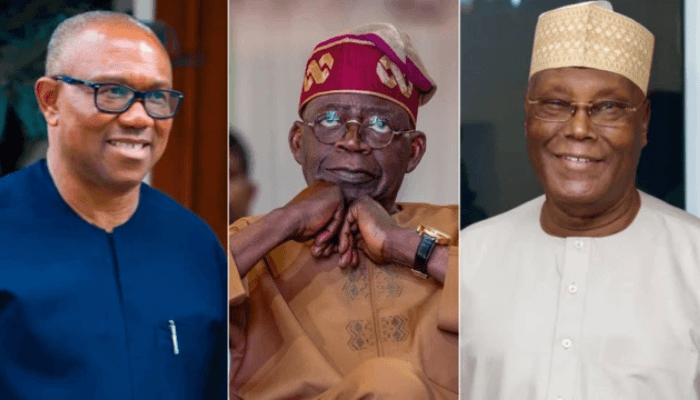
As political activities ahead of Nigeria’s 2027 presidential election gradually gather momentum, three contrasting strategies are beginning to define the calculations of the country’s leading political actors.
- +Tinubu’s grip on power, Obi’s one-term deal and Atiku’s silent strategy
President Bola Ahmed Tinubu is relying on the formidable advantages of incumbency and the machinery of government to consolidate his hold on power.
President Bola Ahmed Tinubu is relying on the formidable advantages of incumbency and the machinery of government to consolidate his hold on power.
Peter Obi of the Nigeria Democratic Congress (NDC) is attempting to build a broad coalition around a promise to serve only one four-year term, while former Vice President Atiku Abubakar and candidate of the African Democratic Congress (ADC) has largely remained silent on the issue of tenure, a posture that is generating its own political interpretations.
Observers say the three approaches underscore the complexity of Nigeria’s political landscape, where regional interests, zoning considerations and coalition-building often prove as decisive as policy debates.
Some analysts have argued that for Tinubu, the greatest political asset remains incumbency. History has shown that sitting Nigerian presidents seeking a second term enjoy significant institutional and political advantages.
Beyond commanding national visibility, incumbents often benefit from greater influence within their political parties, stronger fundraising capacity and the ability to attract governors, lawmakers and other influential stakeholders seeking political relevance. The trend continued until President Goodluck Jonathan lost to the opposition in 2015, despite having all it took to retain power.
Observers say the ruling All Progressives Congress (APC) appears relatively united around Tinubu’s re-election bid. Although there are internal debates over issues such as the vice-presidential slot and regional balancing, there has been little indication of any organised resistance to his candidature.
Tinubu’s administration has also spent considerable effort courting political heavyweights across party lines. The wave of defections by governors, lawmakers and other influential politicians into the APC has strengthened the perception that the President retains considerable control over the political space.
However, Bernard Mikko, political scientist and former federal lawmaker, cautioned against relying on incumbency as a guarantee of electoral victory, stressing that the credibility of the electoral process would be critical in determining the outcome of the 2027 polls.
“Incumbency is not an electoral support on its own. If anybody is relying on that, there will be concerns about attempts to manipulate the electoral process,” he said.
Mikko further argued that Nigerians would ultimately decide the outcome of the election based on their assessment of the performance of the current administration. He also noted that the international community was closely monitoring political developments in Nigeria ahead of the 2027 election.
Drawing a comparison with political developments in Venezuela, Mikko warned that governments should ensure transparent electoral processes to avoid legitimacy crises.
“What we are praying for is for the administration to open the doors for a fair contest. That is what will strengthen Nigeria’s democracy,” he said.
The opposition hopes public dissatisfaction over the avalanche of challenges facing Nigerians under the Tinubu administration could outweigh the institutional benefits that come with holding office.
The New Nigeria Peoples Party (NNPP) and the Osun State chapter of the African Democratic Congress (ADC) have argued that worsening economic hardship will be a decisive factor in determining President Bola Tinubu’s political fortunes in the 2027 general election.
The opposition parties made the assertion in separate reactions to the recent wave of defections that hit their ranks, particularly the People’s Democratic Party (PDP), Labour Party (LP), and NNPP.
Against this backdrop, Obi has introduced perhaps the most unconventional political proposition ahead of 2027: a public commitment to serve only one term if elected. The promise appears designed primarily to address longstanding concerns over power rotation between Nigeria’s North and South.
Since Tinubu, a southerner, would have served only one term by 2027 if defeated, some northern political actors remain uncomfortable with another southern president potentially occupying office for eight consecutive years.
Analysts say it provides a possible framework for building a broad opposition coalition by reducing fears of prolonged southern dominance. It also portrays Obi as a leader willing to sacrifice personal political ambition in the interest of national unity.
Nevertheless, the proposal carries significant risks. Some of Obi’s supporters question whether voluntarily limiting himself to a single term would provide sufficient time to implement the sweeping economic and governance reforms he has consistently promised.
Others argue that making such a commitment before assuming office could weaken his bargaining position and create uncertainty over policy continuity.
Murtala Abubakar, a political analyst, recently described Obi’s one-term pledge as “a political gimmick designed to secure electoral sympathy.”
According to him, the promise lacks both legal and moral binding force, as there is no constitutional mechanism to compel compliance once a president is elected. He argued that the North has become increasingly cautious after what many perceived as the collapse of the zoning understanding during Jonathan’s administration.
“What we seek is not a temporary placeholder arrangement, but leadership that respects fairness and demonstrates genuine commitment to power rotation,” he said.
Similarly, Isah Abubakar, national president of the Northern Youth Council of Nigeria, said the North now approaches such promises with a “once bitten, twice shy” mentality.
He said that memories of the 2011 political transition remain fresh among many northerners, who believe the region was politically disadvantaged after Yar’Adua’s death. He said that accepting a four-year “bridge presidency” without constitutional safeguards could expose the region to uncertainty if the promise is abandoned after incumbency has been consolidated.
Also, Bala Ibrahim, the APC national director of Publicity, dismissed the proposal, insisting that Nigerians should be wary of the promise because “the Constitution precedes all other promises.”
He argued that political advisers and supporters could eventually persuade Obi to exercise his constitutional right to seek re-election if elected president.
However, Atiku’s approach has been markedly different. Unlike Obi, Atiku has avoided making public commitments about serving a single term despite remaining arguably the North’s most established presidential figure.
His silence appears deliberate.