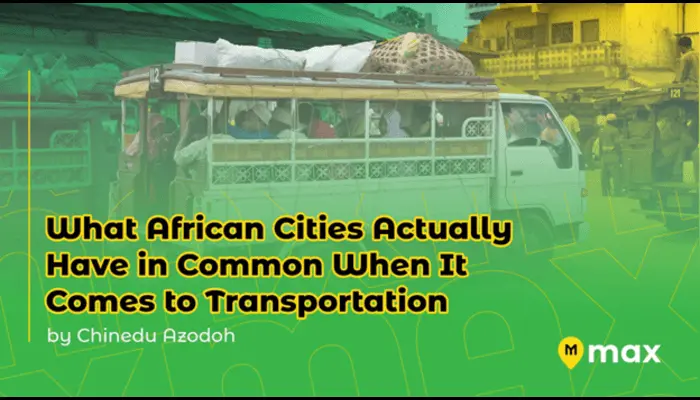
If you spend enough time moving through Africa’s major cities like Lagos, Accra, Nairobi, and Kigali, you start to notice a rhythm.
- +What African Cities Actually Have in Common When It Comes to Transportation
- +Why Mobility Is Directly Linked to Income
At first glance, the cities feel entirely distinct.
At first glance, the cities feel entirely distinct. The cultures, the pace, and the energy are uniquely their own. But when you look past the surface at how people move, how goods are transported, and how daily life is actually sustained, a shared story begins to emerge.
And those similarities reveal something crucial about the future of urban mobility in Africa.
Whether you are navigating the morning rush in Nairobi or dodging gridlock in Lagos, the underlying mobility challenges are strikingly similar:
In these environments, transportation is not occasional; it is continuous. You see it early in the morning, when people are already on the move before the day officially begins. You see it during peak hours, when congestion (Traffic) stretches time, and productivity is lost.
And you see it in the small, everyday frustrations:
This is the reality of transportation in many African cities.
Why Mobility Is Directly Linked to Income
In many parts of the world, getting from point A to point B is a matter of convenience. But here, mobility is directly tied to income.
When movement is reliable, people earn. When movement is disrupted, livelihoods take a hit. For riders, drivers, and SMEs, downtime isn’t just an annoyance; it has harsh economic consequences. A vehicle off the road for three hours means missed trips, slashed daily earnings, and lost opportunities.
This brings us to the growing conversation around Electric Vehicles (EVs).
Can electric vehicles truly fit into how people earn a living without getting in the way?
That question sits at the center of mobility challenges in Nigeria and across Africa. Because beyond the promise of cleaner transport, the real test is whether EVs can work within the everyday realities of riders whose income depends on time, consistency, and uptime.
At MAX, we’ve kept coming back to this. Not as a talking point, but as a design principle. If the system slows people down, it simply won’t work and one of the biggest barriers has been power. And closely following that, the time it takes to stay powered.
MAX’s battery swapping stations offer a practical solution. Instead of waiting hours to charge, a rider can switch out a depleted battery for a fully charged one in minutes and continue working with little to no interruption.
It’s a small shift in process, but a critical one in practice. Because it aligns the technology with how people actually move, work, and earn. With battery swapping, vehicles spend less time off the road, riders maintain consistent earnings, and businesses operate more efficiently
From a system perspective, this creates a more reliable and scalable model for EV adoption in Africa.
The question is not whether charging works. Because It does. The better question is: What works best within the realities of African cities?
Battery swapping aligns more closely with:
This is why, in many cases, swapping becomes not just an alternative but a more suitable solution.
One key lesson across African markets is this:
Solutions must be designed for context.
Importing models without adapting them often leads to inefficiencies.
Effective EV infrastructure in Africa must consider:
Battery swapping works because it is designed around these realities.
The future of sustainable transport in Africa will depend on more than just adopting electric vehicles.
It will depend on building systems that: reduce downtime, improve reliability, support economic activity, and scale across different cities
Battery swapping is one of the models that meet these criteria. Not because it is new, but because it fits.
Wrapping up, when you step back and observe transportation across African cities, the patterns are clear. Different environments, but shared challenges. And within those shared challenges lies an opportunity:
To build mobility systems that are not just imported, but intentionally designed for Africa.
Because mobility is not just about movement. It is about access, income, and opportunity.
And the systems we build today will determine how those opportunities grow in the future.