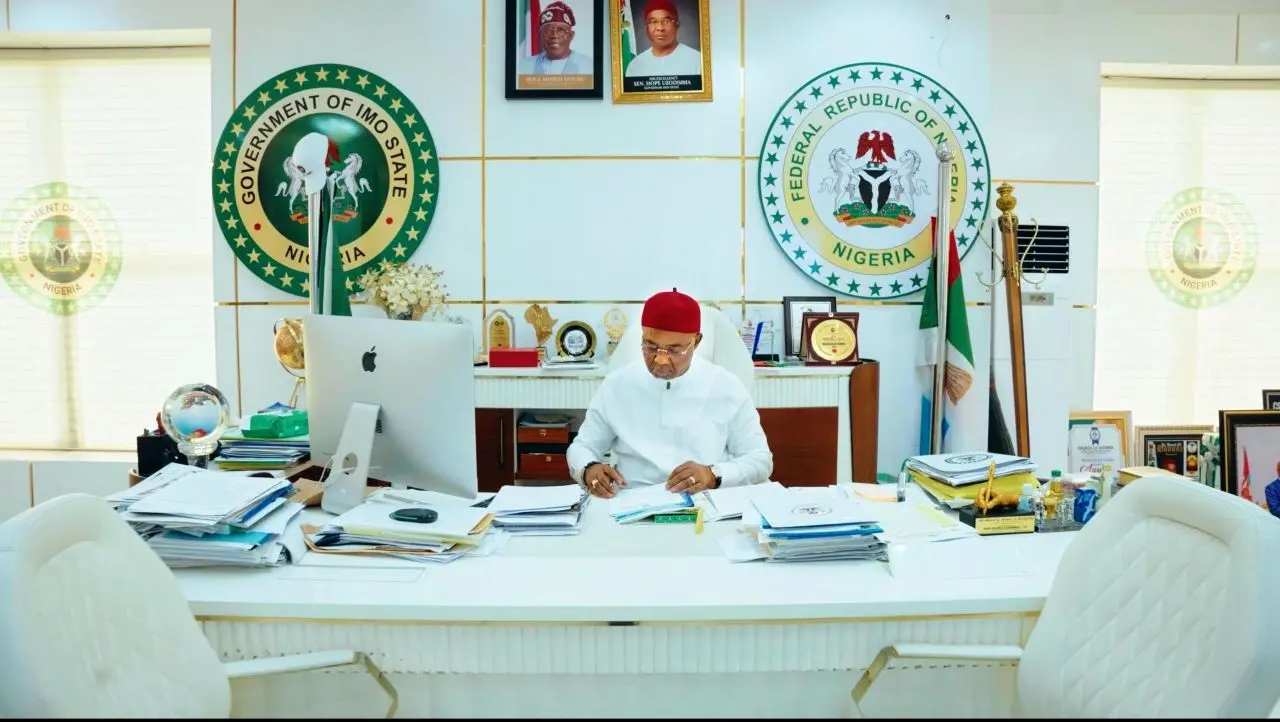
Drive through Owerri today and you can’t miss it. On the billboards lining the airport road, past the roundabouts, along the corridor into the city centre, the same four words keep repeating:
- +Imo Is Ready: Inside Nigeria’s Boldest State-Level Pitch to Investors
It reads like a slogan.
It reads like a slogan. It’s meant to be one. But behind the billboard campaign sits a more deliberate argument — that a state long associated with political turbulence and neglected roads has quietly rebuilt itself into something Nigeria’s investors can no longer ignore.
Governor Hope Uzodimma has made the case in person, on stages far from home. At Invest Lagos 3.0 in June, before a room of investors at Eko Hotel and Suites, he offered a line he now repeats often: that the letters in Imo stand for something else entirely — “Investment Meets Opportunities.”
It’s tidy branding. But the substance behind it is what the campaign is really selling. The governor points to major improvements in infrastructure, security, power and ease of doing business as the foundation of the pitch, and he traces it to a specific turning point. He has described the state’s approach before 2020 as one where government tried to build, run and own industries rather than focus on governance — a model he says failed everywhere it was tried, Imo included. What changed, in his telling, was a shift toward government as enabler rather than operator, clearing the path for private capital rather than competing with it.
Billboards can promise anything. What gives the Imo pitch some teeth is the list of things state officials point to when investors ask for specifics.
Power, and specifically, Orashi. Reliable electricity has long been the biggest complaint of anyone running a factory in Nigeria. Imo’s answer has been to go around the national grid entirely. Following the Electricity Act of 2023, the state established its own regulatory commission and licensed the Orashi Electricity Company through a public-private partnership, with Egyptian energy group Madkour Holding as technical partner. The first phase, commissioned this year under the “Light Up Imo” programme, includes a 15MVA, 33/11KV injection substation and a 45-kilometre distribution network, drawing on both gas and hydropower from the Orashi River.
Nigeria’s Minister of Power, Adebayo Adelabu, has described Imo as a model for other states, citing Orashi as evidence the 2023 reforms actually work on the ground. It runs inside the Orashi Energy Free Trade Zone, which the state government says sits on more than 200 trillion cubic feet of gas reserves — tied to producing assets like the Assa North-Ohaji South development and the ANOH processing plant at Assah, which came online at 850 million standard cubic feet a day, the largest gas facility in the country.
Roads and connectivity. Officials point to the rebuilt Owerri–Mbaise–Obowo–Umuahia corridor, on top of what the government describes as near-complete road works across almost every local government area — arteries meant to tie Imo back into the wider commercial network of the South-East.
Air and logistics. Owerri sits within reach of Port Harcourt, Aba, Onitsha and Enugu, a cluster of markets few Nigerian states can claim proximity to at once, and the Sam Mbakwe International Cargo Airport gives it a logistics edge neighbouring states without air cargo access simply don’t have.
Security. This is the line that lands hardest with outside investors, given the South-East’s recent history. The state’s investment promotion agency says Imo has been rated the best in the country for security by the federal government, and the governor has referenced AI-assisted security technology now used by state agencies to flag threats before they escalate.
Hospitality and human capital. The billboard promise of a “hospitable” Imo shows up in projects like the newly commissioned Emmanuel Iwuanyanwu International Convention Centre, the state’s push to bring Hilton into Owerri, and Imo Digital City, a skills programme the government says has trained over 65,000 young people.
Money on the table. Uzodimma has framed 2026 around what he calls a ₦1.4 trillion “Budget of Economic Breakthrough,” with growth targets across power, health, agriculture, education and food security.
None of this erases the skepticism any Nigerian state faces when it asks the world to invest. Infrastructure promises are cheap; delivery is not. Security ratings can shift with a single bad month. A slogan doesn’t build a factory.
But the Imo pitch is at least trying to answer the questions investors actually ask, rather than asking for faith. Power that doesn’t depend on the national grid. A named electricity company. A specific airport. A specific summit — the state hosted its first Imo Economic and Investment Summit last December, and officials say the state is now living off the momentum it generated.
Whether “Imo Is Ready” becomes more than a billboard depends on what happens after the ribbon-cuttings — whether the power stays on, the roads hold up, and the next investor who visits finds the pitch matches the place. For now, the state has at least done something Nigerian sub-nationals rarely bother to do: it has made a specific, checkable case for itself, instead of a vague one.
That, more than the slogan, is worth watching.
This article draws on public statements by Governor Hope Uzodimma and materials from the Imo State Investment Promotion Agency (ISIPA).